Joann’s First Paddle in Her NDK Pilgrim

Joann has a new boat. Today she had it on the water for the first time. This boat, an NDK Pilgrim, has been on her wish list for a couple of years. Seven of us launched our boats from Ferry Point, on the water at 10:30. Here’s a photo of Joann heading out. The plan was to paddle inside the breakwater and over to Shimada Friendship Park.

Our plans changed. As we paddled along the breakwater, we noticed that with the high tide, we might be able to paddle over the rocks at a break. Here’s a photo of Joann paddling through the break. If you look closely, you can see the rocks just in front of her boat. I was a bit surprised she was willing to take her new carbon-Kevlar boat close to the rocks.

Once we were through the breakwater we decided to continue around Brooks Island, landing for lunch at Barbara and Jay Vincent Park.

Back on the water, we hugged the Richmond waterfront and made our way back to our launch point. We found ourselves facing a moderate headwind on our way back. Over the course of the day, we had a variety of conditions from calm to a bit of chop and wind, with the wind on various points. Great conditions for trying out a new boat. Joann reports that she is quite happy with the boat. It’s nimble and handles well.

NDK boats are not easy to come by. They are made in North Wales, designed by Nigel Dennis. Joann snapped this boat up in October when the local distributor posted a special sale price. The downside was waiting for several months for the opportunity to have the boat transported across country. The Pilgrim is designed for a small paddler under 140 pounds. At 15.75 feet long and 20″ wide, it’s sleek and nimble. It’s also easy to get on the cartop carrier at 38 pounds. I’m experiencing boat envy; it’s time to think about what my next boat may be.

After the Storm

Yesterday at 3:25 PM an email appeared in my inbox with the subject “Late notification: Paddle tomorrow…” Outside my window a heavy rain was pounding the house, and I was not of a mind to go outside. The weather prediction was for the weather to clear up, and looking at my calendar, paddling looked like a possibility. I decided to wait until morning to see if the weather, and my body, still in recovery from knee surgery were up for paddling.

I awoke to clearing clouds and a rainbow. I put my boat on top of the car and headed to Ferry Point. Part of my motivation was the possibility of some photo opportunities paddling on calm waters with blue sky and dramatic clouds. At 10:30 seven of us launched our boats and paddled out to the end of the breakwater and then made a turn to the south to paddle around Brooks Island.

At noon we landed at Barbara and Jay Vincent Park in Richmond where we broke out our lunches. After lunch we were back in the boats at 12:45 to continue our circumnavigation, staying close to the Richmond shore.

We were back at our launch site at 1:40, having logged a little over six miles on a glorious paddle. More photos are available in an online gallery.

Emeryville to Pt Isabel

Seven of us assembled on the boat ramp at the Emeryville Marina for a 10:30 departure to paddle to Pt Isabel. This was a great turnout considering I had only announced the paddle 24 hours ahead. The plan was to paddle along the east side of the bay to avoid the current which would be flooding most of the day. Maximum flood at Emeryville was predicted to be 0.29 knots at 12:30 pm, negligible as far as our group is concerned. Weather predictions were for light winds in the morning (8 to 10 knots). I had a sense that it might be too warm for my drysuit, so I opted for my farmer john and a long sleeve rash guard. We were on the water at 10:35 and paddled out of the marina in calm water.

We paddled out past the defunct HS Lordships Restaurant, closed since June 2018, speculating on what the future holds for that facility. Then under the Berkeley Pier, past the Albany Bulb, and east towards Point Isabel, looking for the windsock that marks the landing. You can’t see the ramp from this approach since it’s hidden behind a short breakwater. Some care is required to land here when the tide is low since there are rocks that are not all that visible, and the wind tends to push boats into the rocks.

As we were eating lunch the wind started to freshen, and we were anxious to get back on the water before the wind increased. Needless to say, we had our work cut out for us powering into the wind and the chop with our boats bouncing over the waves and spray flying over our decks. I would occasionally pick up my camera to try to capture the action, and immediately lose all forward progress, having to paddle hard to get some speed back. Our group got spread out a bit, but we remained in radio contact. Again, using the radio meant I was not paddling and was pushed backward by the wind.

We gathered up once we were inside the breakwater at the Berkeley Marina. Two paddlers opted to bail out at this point. They paddled into the Berkeley Yacht Club dock. It seems their boats were not behaving well in the wind and chop. The remaining five of us paddled back to Emeryville. After passing HS Lordships, we turned eastward a bit and that eased the angle of wind. The wind also dropped, making for a leisurely paddle back to our launch side. It was 2:50 when we landed. We had a good workout and logged 9.27 miles. More photos are available in an online gallery.

Ferry Pt to Pt Isabel

Today was a glorious day for a paddle on San Francisco Bay. We have had several days of stormy wet weather, so it was nice to have some relief from the rain. A low tide meant that some of our favorite launch sites would be muddy, so we opted to launch from Ferry Point. Google Maps refers to this spot as the Point Richmond Pier, part of the Miller Knox Regional Shoreline.

Seven of us were on the water at 10:30. We had flat calm as we paddled out to the end of the jetty, with a little wave action from the wake of passing boats. This was my first day paddling with a Greenland Paddle. You can see the paddle hanging out of the cockpit of my wooden boat.

Once we were out past the jetty we headed east, rounding Brooks Island and then making our way to Point Isabel. I couldn’t resist capturing photos. The blue sky and clouds were dramatic. Every time I take a photo though, I have to stop paddling, and if I’m not paddling, I’m not going anywhere. Meantime, my paddling buddies keep their cadence, so I’m always playing catch-up.

As we passed Bird Rock, we kept our distance, so as not to disturb the harbor seals that were basking on the rocks. We landed at Point Isabel one boat at a time. The tide and rocks didn’t afford us much beach, but it didn’t take much time to get all the boats off the water.

While we were eating lunch the wind picked up, kicking up some wind waves and making work for us as we slogged into the wind and towards Brooks Island. We paddled to the north of Brooks Island, using the island and the breakwater to cut the wind.

As we paddled up the Richmond Channel, we passed the ferry, and we had a bit of rain. Over the course of the day, we logged 8.28 miles. The Greenland Paddle served me well. It felt a bit awkward for the first 20 minutes, but by the end of the day I had grown accustomed to it. I’m also finding that my iPhone 14 in a dive case seems to provide excellent quality photos. More photos are available in an online gallery.

Loch Lomond to China Camp

Another glorious day to be kayaking. Nine of us, all BASK members, assembled at the boat ramp at Loch Lomond. We were on the water at 10:00. With a morning flood, slack water at noon and afternoon ebb our plan was to take advantage of the current to paddle to China Camp for lunch.

We paddled out past the Marin Islands, where we were able to pick up the tail end of the flood current to carry us up the bay. Making good time, we headed to the Sisters where we were able to thread Grendel’s Needle. You can see in the photo two boats heading through the slot, with rippled water on approaching side where the current was pushing us and flat water on the far side. An easy ride through the slot.

From The Sisters it was an easy paddle over to China Camp where we landed and pulled our boats up the beach to make sure they didn’t drift away on the rising tide.

After lunch we were back on the water taking advantage of the ebbing current to give us a push back to Loch Lomond. More photos are available in an online gallery. We logged 8.4 miles on a perfect day to be paddling.

Remembering Danny

I met Danny Forer on June 9, 2016. That was my first venture joining Danny’s regular Thursday paddle. I wrote about that adventure in a blog Kayaking for Sanity. Danny was an inspiration to many outdoor sports enthusiasts including many members of the Bay Area Sea Kayakers club (BASK).

Here’s a photo of Danny I captured on paddle in December 2019. Danny passed away in December and fellow BASK member Susan Snow organized a gathering to remember Danny hosting a lunch at the Sailing Goat.

A dozen or so of us put our kayaks in the water at Ferry Point at 10:00 and made our way to Point San Pablo Yacht Harbor. From the beach we paddled out across the shipping channel, then past Red Rock, under the Richmond-San Rafael Bridge, between The Brothers Islands around the Point San Pablo and on into the Yacht Harbor landing on the beach. We had a bit of a push from the current riding the tail end of the flood.

There we joined a fellow BASK members for lunch. There were 25 of us in all.

After sharing lunch and many stories of Danny’s legendary exploits we were back in our boats for the return trip. We had a couple of paddlers that opted for one-way paddle, so there was some jockeying of boats and cars.

For the return leg we opted to paddle closer to shore, and with the growing ebb, we had a quick trip back to our launch site, covering the six miles in an hour and 20 minutes. We had a variety of conditions from mild chop and wind, a few eddy lines with some interesting water and mild conditions for the most part. We logged 11.91 miles. It was a fun day with lots of comradery, good food and great stories. You can see the track of our paddle above. More photos are available in an online gallery.

Geezers Go Paddling

At 73 years of age, I’m the youngster on today’s paddle. The five of us range in age from 73 to 81. Never mind that Alan tapes up his hands with duct tape before climbing in his boat. Our launch point is Jean & John Starkweather Shoreline Park near the west end of the Richmond-San Rafael Bridge. We were on the water at 10:30 launching on calm water under blue skies, a welcome change following several days of rain.

Our course took us out past the Marin Islands, padding by several barges and some dredging equipment. We paddled on to Point San Pedro. From there The Sisters looked quite inviting. Two paddlers decided to head to our designated lunch site at Loch Lomond. Three of us paddled out and around The Sisters, stopping to play in the slot in the rock called Grendel’s Needle. We had a high tide and very little current. Sometimes there can be some dynamic water here. Today it was quiet.

Then it was time to head for Loch Lomond Yacht Harbor for lunch, landing on the boat ramp and carrying our boats up the ramp and out of the way to keep the ramp clear for other boaters.

After lunch it was back on the water. Alan had acquired a unicorn figurehead for his boat. Then it was back across San Rafael Bay to our launch site.

We were back at our launch site at 2:15 pm having logged 9 miles. More photos available in an online gallery. I had to look up the definition of “Geezer,” Vocabulary.com says “A geezer is an old person. It might hurt your grandfather’s feelings if you refer to him as a geezer, since he thinks of himself as being youthful.” So, apologies to my paddling buddies; paddling keeps us young.

Paddling to Paradise

Our paddle today takes us to Paradise. Paradise Beach on the Tiburon Peninsula. Our Lauch site is Windsurfer Beach. Given the tide prediction for the day we decided to launch at 11:00. Yea! I can miss the morning commute traffic on the Richmond-San Rafael Bridge. It took me less that 30 minutes to get to our launch site. There were 12 of us assembled on the beach at 11:00, quite a turnout for our recurring Thursday paddle.

The temperature was a bit chilly, so I put a second thermal top on under my drysuit and glad I did. I was quite comfortable despite the chilly overcast.

Our course took us across the ferry channel. We stopped to let ferries go by going both directions, then it was across the channel, past Paradise Cay, and on to Paradise Beach.

We landed at 12:05, grabbed our lunches and made the short walk up the hill to the picnic tables in the park.

The overcast sky provided nice lighting for portraits, and a nice view of Mount Tamalpais and we made our way back to Windsurfer Beach. I’m experimenting with my iPhone in a waterproof dive case. It seems some moisture condensation inside the case resulted in a soft-focus effect.

We were back on the beach at 2:30 having logged 8.5 miles. The battery on my iPhone went dead on our return leg, so I lost my GPS log i normally track with GAIA GPS. I was also carrying a Garmin InReach and an Olympus TG-5 camera. It was good to have a backup, both for the GPS log and for photos. More photos ae available in an online gallery.

Lunch at China Cove

Our paddle today took us from Dunphy Park in Sausalito to China Cove on Angel Island. There were 12 of us, a large group for a weekday paddle. We assembled on the beach for a safety talk and radio check, and then we were on the water at 11. Slack water in Raccoon Straight was 12:30, with a high tide of 6.4 feet at 11:15. We try to plan our paddles to take advantage of the current. Being on the water a little before slack means we might be pushing against a slight current, and after lunch we would have the current with us for our return trip. My boat for the day was my Pygmy Ronan which handles the wind and chop of the Bay with aplomb, although we had little to challenge us in that regard.

At China Cove we decided to carry our boats well above the tide line lest the rising tide should carry our boats away. Here’s a photo of our group having lunch, along with a map that shows our track and a photo of a pod of kayakers preparing to land at China Cove.

Weather conditions were quite favorable. My drysuit and my usual insulating layer felt a bit warm initially and I was thinking I might have overdressed, but in the end my layering proved to be a good choice. We had calm water on the route to the island. On our return we had a bit of lumpy water as we crossed Raccoon Straight. By now the ebb had started and we had the current assisting us on the return trip, logging up to 6 MPH. We were back at our launch site at 2:30.

It turned to out to be a beautiful day on the Bay, with a great group of friends. For wildlife we saw pelicans, cormorants, a great blue heron, and the requisite harbor seals. We logged 7.8 miles. More photos are available in an online gallery.

Rescue Practice

So here’s the scenario. You’re out paddling your kayak along with some of your buddies and one of your paddling buddies ends up unconscious floating face down in the water. And this happens under the Golden Gate Bridge in some lumpy water. What do you do?

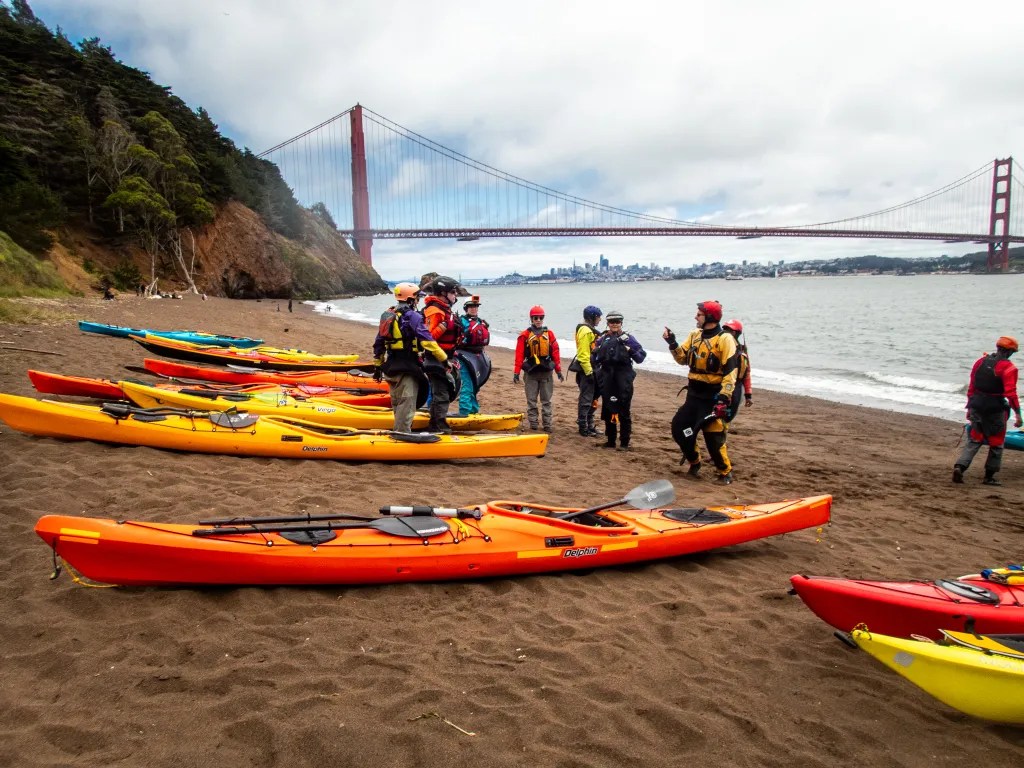
This is one of the scenarios we acted out with members of our kayaking club, Bay Area Sea Kayakers (BASK) recently. We gathered in the morning at Horseshoe Bay, on the North side of the Golden Gate Bridge. We broke into two groups, those that wanted to practice basic rescue skills and those that wanted something more challenging, including incident management.

I joined the more advanced group. We launched our boats and headed out to the Golden Gate Bridge. It was just off Lime Point where we had our first execution of a T-rescue. With practice, this is an efficient and quick way to get someone back in a boat. After the morning’s practice sessions, we landed at Kirby Cove for lunch. As you can see, it was a gorgeous day to be on the water.

After lunch we were back on the water. This is where we had a more complicated scenario. Just what do you do when you have an unconscious kayaker in the water? Someone needs to go in the water to assist the person, get them face up, and perhaps provide rescue breathing. Someone else needs to get on the radio to call for help. In our practice, we did get the person back in the kayak and upright, with some cooperation from our “unconscious” victim. The kayak was now full of water and unstable, so two kayakers came alongside to stabilize the boat and the paddler. Two other kayakers used an inline two to get the swamped boat and victim to safety. We were now surfing breaking waves with white caps. I can’t say our “victim” would have survived if this was a real situation, but we all agreed that practicing this scenario gave us a better understanding of what we would do in a real situation. And messing about in boats with good friends and well-accomplished paddlers is always fun.