Aurora Borealis Adventure: Tips for Your Fairbanks Trip

In early January it looked we might have the opportunity to see the Northern Lights. The solar activity was such that people were reporting good aurora viewing. We marked out five days in the middle of February and started planning, choosing Fairbanks as our destination. There are a number of options for viewing the aurora. You can book through an agency that will cover all your needs in posh accommodations, or you can piece together a tour on your own. We put together our own tour.

A vibrant display of the Northern Lights with green auroras illuminating the night sky, surrounded by dark clouds and twinkling stars above a snowy landscape.
Aurora Borealis

Our trip would include three nights in Fairbanks, a ride on the Aurora Winter Train from Fairbanks to Anchorage, and two nights in Anchorage with relatives. I’ll write more about that part of the trip in another post.

At this phase of planning, temperatures were running -40 degrees Fahrenheit in Fairbanks. We were quite concerned about how we could be comfortable in such extreme temperatures. I found a resource that gave advice on how to dress. I also discovered that we could rent gear from Alaska Outdoor Gear Rental. Not only that, but they would deliver the gear to our hotel and we could drop it off at the airport in Anchorage at the end of our trip.

We booked a tour with Fairbanks Aurora Tours after reviewing a number of outfitters. They cater to photographers. We booked a tour for the evening of February 15 and a second tour two days later with another tour operator as a backup. As it turned out,we were successful on our first tour and we were able to cancel the second tour without any penalty.

Februrary 15 proved to be a long day. We were on our way to the Oakland Airport at 4:00 AM. We arrived at La Quinta Inn about 3:00 PM. We checked in and picked up a huge duffel bag of our rental clothing including heavy, thick, down-filled bibs and coats and winter boots.

Of course, we had to try on the clothes to make sure they would fit. Then at 9:05 PM our tour van pulled up to the hotel. There were ten people on the tour. We were a little anxious about the possibility of seeing the aurora. The weather was overcast but our guide assured us that conditions were looking good. As we drove out of town our guide would stop the van occasionally to check the local weather and the space weather, debating the options as we traveled.

I must say I’m happy the tour guide knew what he was doing both with the driving and monitoring weather. Driving on snowy mountain roads in the middle of the night is not for me. We passed one truck that had slid off the road, and another incident with flashing lights.

It turned out to be a 2-1/2 hour drive. Our guide was very good at entertaining us, lecturing about the physics of the aurora borealis and providing pointers about setting our cameras to get the best exposures.

Just before midnight our guide parked. We stepped out under clear skies and a temperature of just under 0 degrees Fahrenheit. As I was setting up my tripod the waves of color were just starting to appear. It was hard to know where to point the camera since the display was covering the whole sky.

I had come prepared to try to capture a timelapse, but the remote controller failed to function. The battery had succumbed to the cold temperature. Likewise, my iPhone and my backup battery bank ceased to function as well. Luckily my Nikon D850 kept going.

For about 45 minutes we were awed by the waves of color dancing across the sky. Eventually the aurora display started to dissipate. I noticed that everyone else had climbed back into the heated van. I climbed back onboard and we made the return drive to Fairbanks, arriving back at the hotel at 3:45 AM. I’ve included a map that shows the route we took from Fairbanks.

A note to anyone else that might want to plan such a trip: We used the hotel shuttle to get from the airport to the hotel, and Uber to get around town. The hotel provided a hearty breakfast buffet, but there is not much else nearby for dining. The rooms at La Quinta Inn have refrigerators and microwaves, and there were a variety of Ramen noodles and frozen foods available at the front desk. We had a very nice lunch at Pike’s landing one day, but it’s a mile walk in the snow, and not something we wanted to repeat. We ended up buying a few things at the local Safeway and having dinner in the room.

Joann’s First Paddle in Her NDK Pilgrim

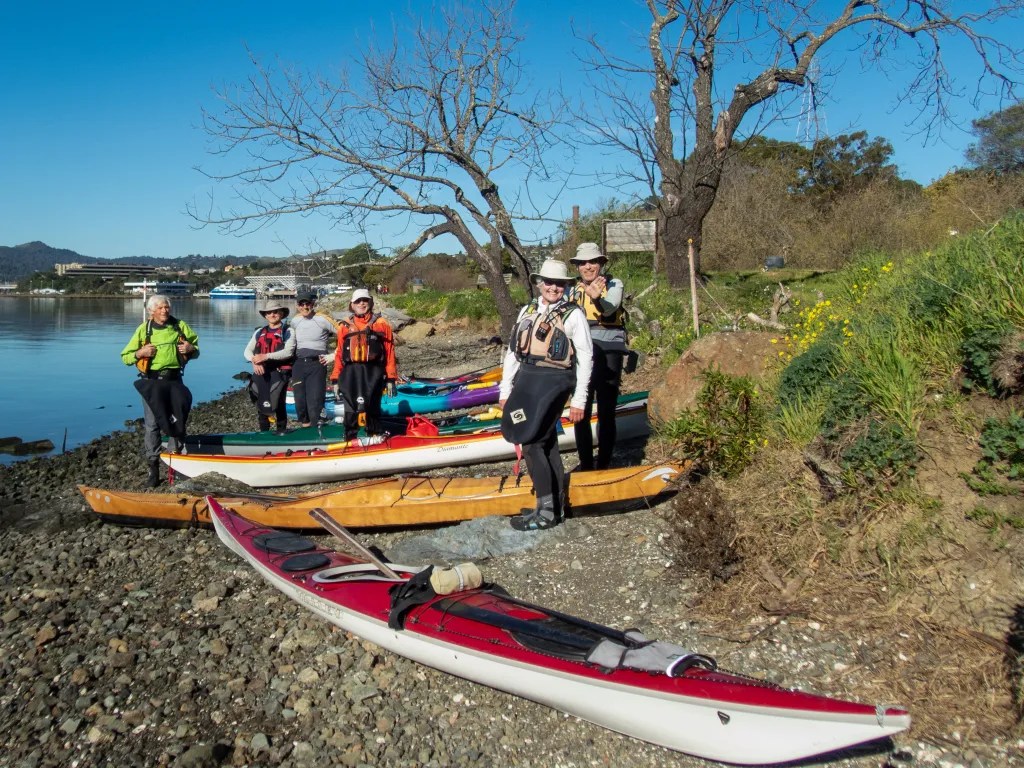
Joann has a new boat. Today she had it on the water for the first time. This boat, an NDK Pilgrim, has been on her wish list for a couple of years. Seven of us launched our boats from Ferry Point, on the water at 10:30. Here’s a photo of Joann heading out. The plan was to paddle inside the breakwater and over to Shimada Friendship Park.

Our plans changed. As we paddled along the breakwater, we noticed that with the high tide, we might be able to paddle over the rocks at a break. Here’s a photo of Joann paddling through the break. If you look closely, you can see the rocks just in front of her boat. I was a bit surprised she was willing to take her new carbon-Kevlar boat close to the rocks.

Once we were through the breakwater we decided to continue around Brooks Island, landing for lunch at Barbara and Jay Vincent Park.

Back on the water, we hugged the Richmond waterfront and made our way back to our launch point. We found ourselves facing a moderate headwind on our way back. Over the course of the day, we had a variety of conditions from calm to a bit of chop and wind, with the wind on various points. Great conditions for trying out a new boat. Joann reports that she is quite happy with the boat. It’s nimble and handles well.

NDK boats are not easy to come by. They are made in North Wales, designed by Nigel Dennis. Joann snapped this boat up in October when the local distributor posted a special sale price. The downside was waiting for several months for the opportunity to have the boat transported across country. The Pilgrim is designed for a small paddler under 140 pounds. At 15.75 feet long and 20″ wide, it’s sleek and nimble. It’s also easy to get on the cartop carrier at 38 pounds. I’m experiencing boat envy; it’s time to think about what my next boat may be.

Up the Creek

Ten paddles and eight boats. More paddles than people since you wouldn’t want to be stuck up the creek without a paddle. Some of us carry spare paddles. I broke a paddle a couple of years ago so it’s nice to have a spare available.

Our day began with an early start, with a stop at the Bovine Bakery in Point Reyes Station for breakfast. Their Morning Bun Coffee Cake is extraordinary. After our breakfast stop, we continued on to Miller Boat Launch. From there the plan was to paddle up Walker Creek until we could paddle no further. A king tide would afford us access to the upper reaches of the creek that are not normally accessible. Since this was mostly a flatwater paddle, I decided to take three cameras: my iPhone 14 in a waterproof dive case, my GoPro mounted on the deck and my trusty Olympus TG5 which is my camera of choice for kayaking. If I’m paddling in active water where managing a camera can be a challenge, I usually stick to my TG5 or my GoPro mounted on my helmet.

We were on the water shortly before 10:00 a.m., ahead of the posted OTW (on the water) of 10:00. When you are paddling with this group it’s best to be on time. Our navigation was a bit off. We missed the entrance to the creek and ended up dragging our boats over a bit of marsh. Once we were back on the main waterway it was smooth paddling.

We paddled up the creek and under the Highway 1 Bridge, continuing on as the waterway narrowed, keeping an eye out for snags and an occasional branch slapping us in the face. At the 5-mile mark we could paddle no further, so we turned around and paddled back to a little beach for lunch. 

After lunch we were back on the water, anxious to get back down the creek while we still had water. The current was now moving down the creek and it gave us a bit of a push. We saw a number of birds: egrets, herons and white pelicans. They evaded my photo attempts. More photos are available in an online gallery. You can also view more details about our track online. We were back at our launch point about 2 p.m. having logged 10 miles over the course of our paddle.

I was quite happy with the photos I got from the iPhone, although the shutter actuation on the dive case was a bit problematic. That’s something I need to work on.

Going on a Lupine Hunt

June 7. Time to go on a wildflower hunt. I had seen photos of some amazing Lupine blooms, so we set off to see what we could find. Following the suggestion that we explore North Oak Creek Road, we ended up at the Baxter Pass Trail Head. It was a chilly day with drizzles of rain off and on, but the dark sky added drama and some nice soft light for interesting photos.

We found quite a bit to photograph including wild roses, prickly poppy, and paintbrush.

There seemed to be endless photo opportunities with the dark and stormy clouds and the patches of color. Eventually we grew hungry, so we headed back down the mountain to the Old Mount Whitney Fish Hatchery where we found a picnic table to break out our lunch.

There’s always something to see in the Eastern Sierra, and Carson enjoyed some off-leash time in the mountains.

BahĂ­a ConcepciĂłn

Today we arrived at Playa Santipac. At the gate we paid 200 pesos for one night thinking we would move on the next day, but we ended up spending two nights. The campground was fairly busy, but we did find a suitable site with a palapa about 1/2 mile down the beach.

Playa Santipac is a popular spot for big rigs but also suitable for smaller rigs and tents. We had fun visiting with fellow campers who were walking along the beach, many of them from Canada and other northern locations that come down to Baja for several weeks or more. One of the joys of traveling is hearing people’s stories. Everybody on the road seems to be quite friendly and happy to share information.

There is no running water at the campsites, but vendors drive along the beach in the morning and provide you with a blue barrel with as much water as you wish for a small fee. There are also vendors selling fresh fish and a variety of other things. We bought water to use for washing since we wanted to conserve the water we had on board for drinking and cooking. We also bought some fresh halibut which served us for a couple of dinners as well as a hammock and some carrot cake.

We did manage to get our boats on the water, paddling out from the beach and around several islands. In one of the photos, you can see Joann in the little wooden boat with a line of RVs on the beach in the background. The beach at our campsite was quite shallow at low tide, so we ended up dragging the boats until we had enough water to paddle. If I had been paying attention, I would have given priority to a campsite further west where the beach wasn’t quite so shallow.

After a few days of dry camping, it was nice to have a shower even if it was just pouring a bucket of cold water over my head. For lunch we walked down the beach to Armando’s, a rustic shack on the beach with delicious seafood tacos.

After a couple of days at Playa Santipac we moved on to Playa Coyote. This is a popular spot. We pulled into the campground at 10:30 in the morning and found the last open site. We were surprised to discover that the campers next to us were kayakers, fellow members of BASK (Bay Area Sea Kayakers). We pooled our resources for dinner. I fired up the Dutch Oven and baked up some Halibut. In the morning we paddled together around Isle Coyote. It was a gorgeous day to be on the water and the flat calm gave us the opportunity to look below the surface. We saw many sting rays.

And talking about sting rays, I managed to step on one. Ouch! Before we launched our kayaks, I was tossing the ball for Carson and the ball went in the water. Carson wouldn’t go in the water to get it, and while the water was only six inches deep, I forgot to do the sting ray shuffle. Fortunately, I was wearing sandals and after a little first aid I was on the water paddling. I think I was quite lucky, since sting ray wounds can be very painful.

While we did have thoughts of driving further south to Loreto, Playa Coyote was such an idyllic spot we decided to spend time there rather than adding more miles to our trip.

More photos of Bahia Conception are available in an online gallery.

Seven Celebrate Seventy

A friend of mine retired recently and he asked me if kayaking was a suitable sport for seniors. I’ll answer that question with a report on a recent paddle. On February 10, seven of us launched our kayaks from Windsurfer Beach, a little beach not far from the Larkspur Landing Ferry Terminal. The youngster in our group was celebrating his 70th birthday. The beach was a bit rocky given the tide, and it’s a short carry down the bank from the road.

We were on the water at 10 a.m. on February 10. The current was ebbing for our time on the water, with maximum ebb a little less than one knot at 11:40 a.m. at Point San Quentin. That meant we would be paddling upstream in the morning. We had a calm, sunny, beautiful day. We paddled out around Point San Quentin and turned north under the Richmond-San Rafael Bridge. Then it was north to the Marin Islands. The islands are part of the Marin Islands National Wildlife Refuge, which was established in 1992, named after a Coast Miwok man known as Chief Marin. Access to the islands is restricted, so we rounded the bigger of the two islands and headed west for Loch Lomond Marina.

We landed on the boat ramp and immediately moved our boats off the ramp so that we wouldn’t interfere with any boaters. No cake today, but plenty of chocolate treats including those provided by the birthday boy, Steve. After lunch we were back on the water making a direct line to Point San Quentin. The current was with us going back.

Once around the point we paddled back to our launch site passing San Quentin State Prison, the oldest prison in California. We logged 8.3 miles on an unseasonably warm day. Of course, part of the drill is getting the boats off the beach and on top of our cars–a total body workout. Not bad for seven septuagenarians.

Check out more photos in my online gallery.

Rescue Practice

On October 9 we had perfect weather for our kayaking club (BASK) rescue practice. My dry suit had just come back from Kokatat after having the neck gasket replaced. So I was looking forward to putting it to the test.

After signing in and having a brief orientation, we broke up into pods, with some of the newer members seeking basic instruction and some of the more experienced members looking for peer practice. Above is a photo of the group of paddlers watching a demonstration of how to get into a boat using a “heel hook” technique, followed by some photos of paddlers doing T-rescues.

Of course, to practice getting back into the boat you have to get wet. So over we go, upside down and reaching for the release loop on the cockpit cover. I discovered that my dry suit wasn’t keeping me dry. I could feel cold water inside my suit, pooling around my right elbow. Not a happy feeling since my suit just came back from the factory. In the future I think I’ll pay the additional fee for pressure testing. In any event, I was wearing a thick layer of expedition weight polypropylene for insulation, and this kept me comfortable despite the water.

The T-rescue with the heel hook went well. I added a twist, since I’m usually anxious to get back in the boat once I’m in the water. During this exercise I decided to pull my camera out to take a few photo from the swimmer’s perspective. Following the T-rescue, I tried a paddle float self-rescue, a technique where you put a float on one end of the paddle and use the paddle and float as an outrigger to get back in the boat. Easier said than done, but with practice it works. Finally I attempted a cowboy scramble, where you climb up on the back deck and work your way into the cockpit. With some coaching I made this work; the first time I’ve been able to get back in the boat with the scramble.

At the end of the day when I took off my dry suit I found about a cup of water in each of the socks. Not so dry, but happy to report that the insulation I wore was sufficient to keep me comfortable despite the water in the suit. Now I need to determine if I can fix the leak or if I need to send it back to Kokatat.

Local Color

A few days ago I found myself in downtown Oakland. I haven’t been in downtown Oakland since the pandemic had us sheltering in place. I was surprised at all the murals on the sides of buildings. It took me a minute to realize that the murals were all on boarded up store fronts. Where there were once glass store fronts there were now murals.

Many of the store fronts in Oakland were boarded up during the unrest in the spring of 2020. Walking up and down a few blocks of Franklin Street seemed like being in an outdoor museum, with a lesson on current events mixed with the creativity and the will of people to adapt.

Here are six images I captured in the few minutes I had to walk a few blocks. You can view additional images here.

Computer Upgrade

Treve in the process of upgrading his computer.

This is not a job I relish. I’d much rather be out in a kayak playing on the water or knocking about in the camper looking for spring wildflowers. Circumstances being what they are, though, perhaps this is an appropriate DIY project. My main computer died last week. I took it to the local repair shop thinking it might be a quick fix, but the diagnosis was a bad motherboard. When I asked for a quote to upgrade, the technician suggested I buy the parts myself. So here I am a week later, with most of the parts in hand to upgrade. New motherboard, new processor, RAM, and various other parts.

I built this machine in 2011 as a beast for processing photos. The fact that I got nine years of service out of a computer is amazing in itself. I’d prefer to do this when cash flow was good, not in the current negative cash flow situation with the stay-at-home order. Even with buying the parts myself, it’s a chunk of change.

I hope to be up and running again by the end of the week. Wish me luck.

Global Cooling Event 2019

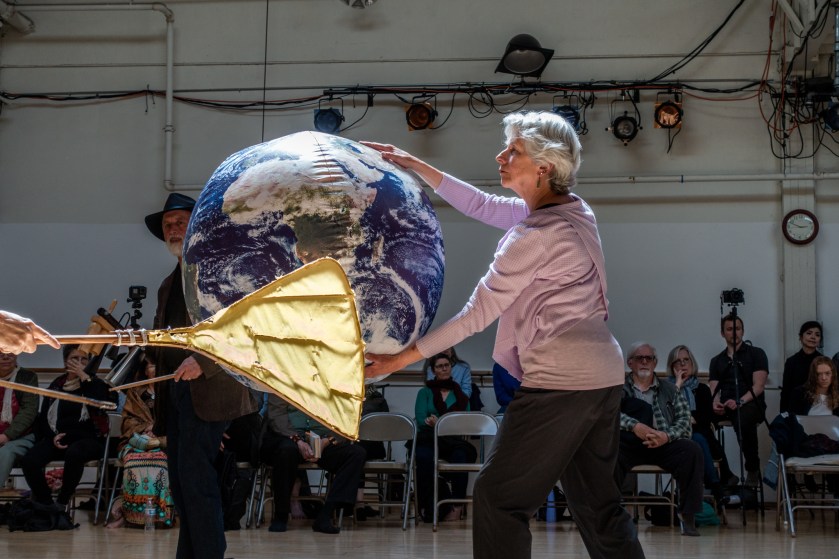
Global Cooling Event at Dance-A-Rama 2019.

It remains to be seen what effect our Global Cooling Event will have on global temperatures. If nothing else, we raised some awareness of global warming and had some fun in the process.

The event took place as part of Dance-A-Rama 2019, an annual open studio event with free dance performances. While I do not profess to be a dancer, I have been involved with Dance-A-Rama since 2003. I had been working with dancers on a dance photography project for several years and one of the dancers suggested that I do a performance piece.

At 2:45 this afternoon, I stepped out into the middle of the performance space and invited the audience to join me. After a few minutes assigning roles to the willing audience members, we had one person holding a large inflatable globe, three people with fans cooling the earth, two people holding a scroll with the words of Brother Eagle Sister Sky, an excerpt from a speech by Chief Seattle, and three people with cameras capturing images. At the sound of a chime, the earth begins orbiting the room. The fans, and photographers follow. A reader begins reading the words on the scroll. I continue to use the chime to direct the motion of the earth. When the reading ends I thank the participants and they return to their seats. I have yet to compile the video and still images into something presentable, but here are a few stills from the event.

Dance-A-Rama is sponsored by Terrain A Dance and Performance Collective. I would like to thank fellow Terrain members Mary Reid, Ruth Botchan and former Terrain member Ann Swigart for their help with today’s piece. I would also like to thank the members of the audience that were courageous enough to leave their chairs to join us on stage. Dance-A-Rama marks a 20 year anniversary with today’s event.