Unforgettable Six-Day Kayaking Adventure in Loreto

Our six-day kayaking adventure begins on the morning of March 22 when our guide picks us up at our hotel and takes us to our launch site, a beach, Playa El Quemado south of Loreto. Actually, we had met our guide the evening before for a briefing and to provide us with bags for our gear. We booked our trip through Paddling South/SeaTrek.

We were surprised to find that we were the only two guests on this trip, which meant we had rather personalized support with our guide Jorge and the boat driver Adrian. We had opted for a skiff supported trip, which meant that our gear went by panga and we had cold beer and fresh food.

At 10:15 AM on March 22 we were on the water. It’s about a three-mile paddle to Isla Danzante where we made a stop at Honeymoon Beach (Playa Luna de Miel). A gorgeous beach with clear turquoise water. We did a short hike here to a panoramic vantage point. We then returned to our boats and paddled to a beach further south, Playa Arenas, where we set up camp.

We spent two nights camped at Playa Arenas. On the second day of the trip we paddled to Isla del Carmen where we had lunch, put our wetsuits on and got in the water to do some snorkeling. Whenever we stopped, up went the tent to provide us shade from the sun and, of course, a cooler with cold drinks. Paddling to and from Isla del Carmen and snorkeling made for a long day. It was 5:30 when we returned to camp. Having logged 12 miles, we were feeling a bit tired.

I must say that the food that Jorge and Adrian prepared was excellent. We had fresh fish, fresh fruit and vegetables, and of course tortillas and beans. We were well fed.

The trip was billed as a kayaking, snorkeling and hiking trip. We had several opportunities to get in the water and marvel at the coral and tropical fish as well as a couple of opportunities for short hikes to explore the plant and animal life. For photography I had my recently purchased iPhone 17 which I kept in a dive case whenever we were on or in the water.

I had a few issues with the camera, seemingly having a mind of its own and changing modes on me. It took me a couple of days to get the hang of getting the camera to behave, but in the end, I was quite happy with the results.

On the third day we broke camp and paddled to a beach on the peninsula where we stopped for lunch. The intent was to camp there, but Jorge decided that the beach was not suitable, so we put the kayaks on top of the panga and motored to another beach, Playa Aquililla, a few miles south. Our last two nights were spent on a lovely beach four miles further south and our final takeout was at Playa San Cosme.

Here’s a map of our track over the six days with color segments representing different days. Over the course of trip, we did not see any other kayakers, and only an occasional fishing boat off the coast. It was a week of paddling and camping on remote and secluded beaches with amazing sunsets and sunrises. We did not spot any whales or turtles, but we did spot several pods of Pacific Bottlenosed Dolphins as well as a variety of birds. Overall, it was an adventure of peace and tranquility and an opportunity to be close to nature. More photos are available in an online gallery.

Camping in Cactus Wonderland

After a night on the beach at Fidel’s Palapas just south of San QuintĂ­n, we were on the road shortly after 10:00. About noon as we were contemplating lunch, we found Restaurant El Sacrificio. One thing I like about traveling in Baja is discovering places to eat.

North of the border it’s franchises surrounded by acres of asphalt with young kids behind the counter. When you order a Big Mac, you know exactly what to expect. Here it’s small family-run establishments by the side of the road with the charm of rural Baja, with posters about the Baja races and local treats. The food always seems to be delicious. We were the only guests for lunch. Excellent food and the opportunity to practice my broken Spanish. After lunch we were back on the road.

Shortly before reaching the town of Cataviña we pulled off onto a dirt road and explored possibilities to camp. We had camped here three years ago on our previous trip.

I wanted to return to spend a couple days exploring the desert. One of the apps we use for navigation, iOverlander, suggested that there were several locations suitable for camping. We explored a couple of dirt roads before settling on a spot. It was just short of 3:00 when we parked the rig.

This would give me two sunsets and two sunrises for photography. Temperatures were also more pleasant in the morning and evening, running about 65 degrees at sunrise. By mid-afternoon the temperature was 85 in the shade and 95 inside the camper. During the heat of the day we pulled out our journals and books and hunkered down in the shade.

Sunset provided some interesting photo opportunities with the cactus and cirios silhouetted against the western sky. Sunrise was not near as interesting. About 20 minutes before sunrise there was a faint glow of color which only lasted about five minutes, and I was not inspired to do much with the early morning light.

We did see a number of cactus in bloom as well as a few ocotillo with their spray of red flowers looking like flames on the tips of their thorny branches.

With the dark night sky, I was inspired to try my hand at astrophotography to see if I could capture part of the Milky Way. I think the resulting image of the cirios silhouetted by a cloud of stars is quite interesting. You can view more photos in an online gallery.

Paddling the Apostles

Our adventure starts on July 14. That’s when we met our guide and completed our safety check. The outfitters, Trek and Trail, require paddlers to demonstrate a wet exit and self-rescue to qualify to paddle single kayaks. Joann and I both successfully demonstrated the use the paddle float to get back in the boat.

The next morning, July 15 ,we arrived at the outfitters at 7:30 am to assemble the gear for our paddle. Once the gear was organized, we hopped in the van with kayaks in tow and headed to Sand Bay. We did a pretty quick job of packing all our gear for the three-day trip. At 9:30 we were on the water heading out to Sand Island.

On the Northeast corner of the island we paddled through some amazing sea caves. The red sandstone contrasting with the clear turquoise water was mesmerizing.

Once we were around the top of the island we stopped at the lighthouse, landing on some flat rocks. Nahon helped us beach our fully loaded kayaks. Actually, he single-handedly manhandled the boats.

We were treated to a personalized tour of the lighthouse from docent Laurie. With light rain falling and the forecast of a storm moving in, we didn’t dally too long at the lighthouse. We were back on the water shortly after noon, pressing on to get to our campsite for lunch.

On the last leg of our paddle, the sky continued to darken, and the skies exploded with thunder; not just occasional peal of thunder but a continual roar, as if the gods were tearing the skies apart. We were a bit anxious about being on the water with a thunderstorm in the distance. We pressed on and we were on the beach a short time later, landing at 12:30. We unpacked our gear and broke out lunch.

On July 16 we woke to wind, rain and the sound of surf pounding the beach. With small craft warnings up, we decided to explore the island on foot, hiking to the lighthouse and to East Bay. Dinner was pulled pork sandwiches. We ate well on the trip.

On July 17 we woke to sun and calm water. We broke camp, loaded the kayaks and continued our journey around Sand Island and back to the mainland.

Along the northwest side of the Bayfield Penninsua we found more sea caves to explore. We had fun paddling in and out of caves and through tunnels. The cliffs of red sandstone are covered with lush green vegetation and hanging gardens and waterfalls. I was struck by the sound created by the waves lapping into many miniature blow holes: plink, plop, ploink, squish, swish. It would be fun just to capture the sounds and compile them into a composition.

It was about 3:00 pm when we landed on Meyers Beach. There we unpacked and jumped in the van for the ride back to Trek and Trail in Bayfield. Our paddle out to the island and back logged a little over 22 miles. More photos are available in an online gallery. We were happy we had taken our drysuits with us. With the weather and cool temperatures, we stayed quite comfortable. The sign at Meyers Beach noted the water temperature at 41 degrees.

Big River Paddle

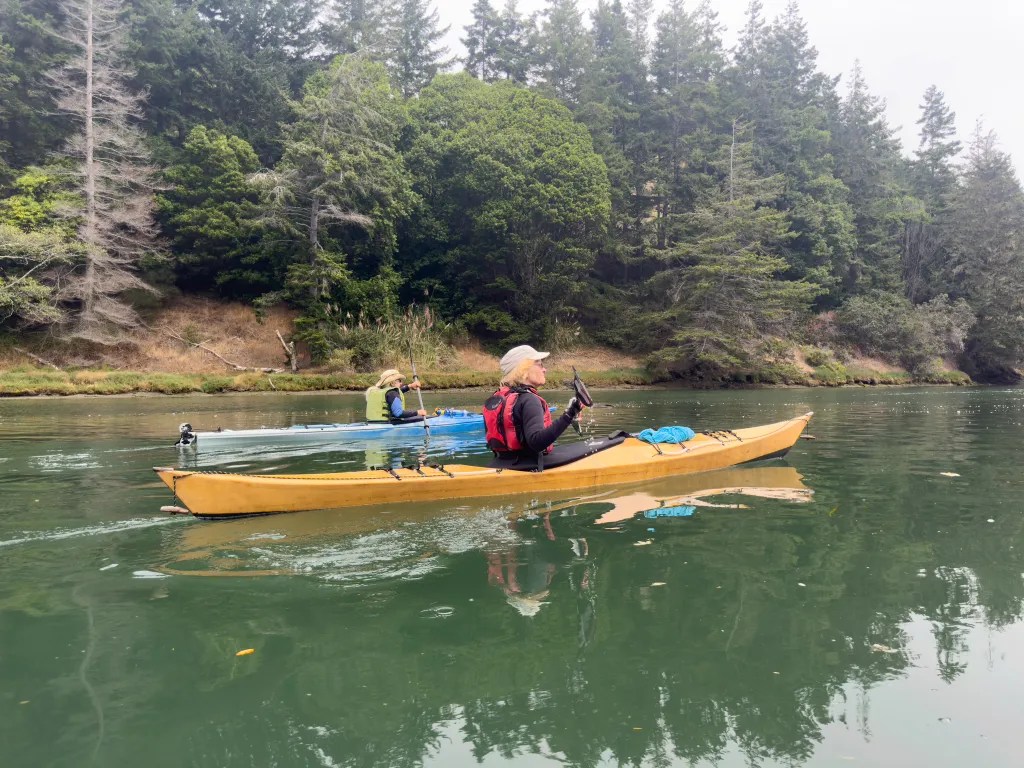
The Big River offers a spectacular opportunity for a calm water paddle in Mendocino. This is a favorite paddle for a number of our BASK club members, and an option when conditions on the coast are a bit challenging.

Today we had quite a group of paddlers launching from the beach, both well-seasoned, experienced paddlers and a few people new to kayaking. Paddling here feels like being in a canyon between the towering redwood and fir trees lining the river.

We split into two pods, with the faster paddlers in the lead and the slower paddlers poking along behind. This worked until we happened on a family of otters that were feeding along the bank and seemed to be oblivious to us. We watched for quite a while before continuing up the river. Trying to photograph the otters was a challenge. I did not capture anything of interest.

Along about noon we found a spot where we could land for lunch. There are not many places where one can land easily. After lunch we continued up the river until several paddlers decided it was time to turn back. Three of us split off from the main pod and paddled back.

It seems that a logging company had done some work maintaining logging roads. We explored a couple of culverts they had installed and poked our noses into a little waterfall that was flowing down the bank. We logged a little over nine miles by my recollection. My phone battery died before we got back to our landing, and I lost part of my GPS track.

BahĂ­a ConcepciĂłn

Today we arrived at Playa Santipac. At the gate we paid 200 pesos for one night thinking we would move on the next day, but we ended up spending two nights. The campground was fairly busy, but we did find a suitable site with a palapa about 1/2 mile down the beach.

Playa Santipac is a popular spot for big rigs but also suitable for smaller rigs and tents. We had fun visiting with fellow campers who were walking along the beach, many of them from Canada and other northern locations that come down to Baja for several weeks or more. One of the joys of traveling is hearing people’s stories. Everybody on the road seems to be quite friendly and happy to share information.

There is no running water at the campsites, but vendors drive along the beach in the morning and provide you with a blue barrel with as much water as you wish for a small fee. There are also vendors selling fresh fish and a variety of other things. We bought water to use for washing since we wanted to conserve the water we had on board for drinking and cooking. We also bought some fresh halibut which served us for a couple of dinners as well as a hammock and some carrot cake.

We did manage to get our boats on the water, paddling out from the beach and around several islands. In one of the photos, you can see Joann in the little wooden boat with a line of RVs on the beach in the background. The beach at our campsite was quite shallow at low tide, so we ended up dragging the boats until we had enough water to paddle. If I had been paying attention, I would have given priority to a campsite further west where the beach wasn’t quite so shallow.

After a few days of dry camping, it was nice to have a shower even if it was just pouring a bucket of cold water over my head. For lunch we walked down the beach to Armando’s, a rustic shack on the beach with delicious seafood tacos.

After a couple of days at Playa Santipac we moved on to Playa Coyote. This is a popular spot. We pulled into the campground at 10:30 in the morning and found the last open site. We were surprised to discover that the campers next to us were kayakers, fellow members of BASK (Bay Area Sea Kayakers). We pooled our resources for dinner. I fired up the Dutch Oven and baked up some Halibut. In the morning we paddled together around Isle Coyote. It was a gorgeous day to be on the water and the flat calm gave us the opportunity to look below the surface. We saw many sting rays.

And talking about sting rays, I managed to step on one. Ouch! Before we launched our kayaks, I was tossing the ball for Carson and the ball went in the water. Carson wouldn’t go in the water to get it, and while the water was only six inches deep, I forgot to do the sting ray shuffle. Fortunately, I was wearing sandals and after a little first aid I was on the water paddling. I think I was quite lucky, since sting ray wounds can be very painful.

While we did have thoughts of driving further south to Loreto, Playa Coyote was such an idyllic spot we decided to spend time there rather than adding more miles to our trip.

More photos of Bahia Conception are available in an online gallery.

Mendo Madness

We were hardly back from Scotland when it was time to pack up the kayaks to head for Mendocino. On September 20 we pointed our rig to Van Damme State Park to join our kayaking club for our annual Mendo Madness. Each year our kayak club takes over a good part of the campground for a week of paddling and socializing. There were about 70 of us, which makes for plenty of paddling opportunities with skill levels ranging from novice to expert, a great opportunity to get on the water with friends and to advance our skills.

On Wednesday we paddled up the Albion River. It’s such a peaceful feeling paddling on the quiet river past the redwood trees, with a variety of wildlife to view. We saw plenty of birds, but no seals or river otters.

On Thursday conditions were perfect to paddle on the coast, so we joined a group of experienced paddlers, launched from Russian Gulch, and paddled south exploring caves, tunnels and other features on the Mendocino Headlands. I had a GoPro camera mounted on my helmet, so stay tuned for some video of our paddling through caves and tunnels.

Our club has occasionally been referred to an eating club with a kayaking disorder. True to form there was an abundance of food with two pizza ovens and charcoal grills going. We came prepared to cook our own meals, but who wants to cook when you can simply nosh while sharing stories with friends. Friday night was Bourbon and Brine, hosted by two club members who are very creative mixing drinks suitable for the occasion. They were assisted by a half-dozen bartenders.

On Sunday, September 25, we broke camp to head for home. Passing through Cloverdale at noon gave us a good reason to stop for burgers, fries, and shakes at Pick’s Drive in. Great burgers.

More photos are available in an online gallery.

Mendo Madness

Each year our kayaking club, Bay Area Sea Kayakers (BASK), takes an extended weekend in Mendocino to do what we do best, eat food and paddle. Some members say we are an eating club with a kayaking disorder. Nevertheless, the event is great fun in a beautiful location with great camaraderie and fellowship. We headed to Mendocino on Wednesday September 18 making our way to Van Damme State Park. The next morning we were on the beach at Van Damme with our boats ready to get on the water. There was a good swell running and a number of paddlers opted to go hiking or paddle on calm water rather than deal with the wave energy being displayed on the coast. Joann and I took up the invitation to follow some of the more experienced paddlers who were offering a “Newbie Paddle,” for those new to the Mendocino coast.

This gave us some exposure to the rocky coast and we got to feel what it’s like to play in the rocks with waves with water surging this way and that and waves crashing on rocks. Mind you we stayed clear of the really active water. See my previous post Through the Washing Machine for more about that.

The next day, September 20, we opted for some quiet water after our rather adventuresome day on the coast. We joined a group of paddlers for a paddle on the Big River. The round trip paddle up the river and back was 11 miles and we were back in camp mid-afternoon to drink beer and soak up the sun.

Friday evening marks Bourbon and Brine, a social event with bar tenders concocting some unique mixed drinks. I had a Storm Cag with rum, ginger liqueur, Averna and orange juice. Joann had a Sea Palm with Gin, lemon juice, elderflower liqueur , celery bitters and a sprig of sea palm. Nathan and Krista, two club members hosted the event. Nathan outdid himself with his creativity as a mix master.

With most of these folks wishing to get on the water in the morning without suffering hangovers, drinking was done with moderation. I for one, did not want to find myself sloshing about in the waves suffering the after effects of alcohol.

Saturday night marked the club potluck dinner. With some 70 or so kaykers in camp it was an amazing feast.

Sunday was another flat water paddle on the Albion River. Our journey took us up the river past several houseboats, stopping to was river otters at play. We had a quiet paddle on smooth calm water. The paddle up and back covered six miles

You can view more photos of the BASK Mendo Madness activities here.

Two Weeks in the Desert

Alamo Canyon. Organ Pipe National Monument.

We’re on our return trip from two weeks in the desert. Our adventures have taken us through Red Rock Canyon State Park, Anza Borrego Desert State Park, Organ Pipe Cactus National Monument and the Mojave Desert Preserve. Organ Pipe represents the Sonoran Desert with the iconic Saguaro Cactus, while Joshua Tree stands as the icon of the Mojave Desert. In Organ Pipe I was hiking in shorts and T-shirt, while in Mojave we woke to snow and 22 degree temperatures with howling winds.

We have WiFi access at the moment, so I thought I’d put up a short post to give you a preview of what to expect as I cue up the posts for the various segments of our trip. We’ve been traveling in our Four Wheel Pop-up Camper which has proven to be a comfortable way to travel. Stay tuned as I cue up more photos and stories about our trip.

Basilica of St. Joseph

If you are interested in architecture or you are looking for something to do in downtown San Jose, then a visit to Cathedral Basilica of St. Joseph is the thing to do. The cathedral is listed as a California Historical Landmark and as well as the National Register of Historic Places.

Dome of the Cathedral Basilica of St. Joseph

I arrived on a Thursday afternoon and found very few visitors, which made it easy to capture photos of the architecture with out people.

The first church on this location was called San Jose de Guadalupe built in 1803. Earthquakes and fires took their toll of the original and several successive buildings. The existing structure was consecrated in 1877. In 1985 following a major renovation it was elevated to the status of cathedral and made a minor basilica by Pope John Paul II in 1997. The church is open to the public with no fee, although you may want to pay attention to the events happening at the church since it is an operating church with worship services and other events.

Merry Christmas from the Alabama Hills

Merry Christmas from the Alabama Hills.

Wishing you a Merry Christmas. We are camped in the Alabama Hills in the Eastern Sierra with what appears to be an annual ritual. We were here last year. This year we represent three generations of Johnsons, the the newest addition, Annabelle, being five months old. We arrived the afternoon of Christmas Eve, set up camp, got the camp fire going along with the coals for the Dutch Oven. Dinner was Chicken Cordon Bleu, with wine to wash it down.

We were surprised by a rain storm passing through in the middle of the night, but we were snug in our beds when the sound of rain on the roof woke us. We woke to find that water that had collected in the camp chairs had frozen solid. Even so we took our time getting the campfire and Dutch Oven coals going, being torn between the photo opportunities of the early morning light and the anticipation of breakfast. Breakfast was quiche cooked in the Dutch Oven. After breakfast we poked around the hills and rocks, A cold wind was starting to find it’s way through our jackets, so we broke camp and headed back to Big Pine.

The Alabama Hills are located in the Eastern Sierra, just west of the town of Lone Pine. The Alabama Hills is managed by the U.S. Bureau of Land Management as the BLM Alabama Hills Recreation Area. There is no fee for camping and there are also not much available for services. No picnic tables, no outhouses, no water. It is also dog friendly; our two dogs were happy to wander around camp off leash. I’m always surprised to see how many people camp here over the Christmas holiday, but that said there is no shortage of spaces to camp. Last year we picked a spot that was exposed and had had a view of Mount Whitney, the tallest mountain peak in the lower 48 states. This year, with the prediction of wind we found a more protected spot with an outcrop of rocks to block the north wind.

This is a popular spot for photographers who wish to photograph the classic morning light on Mount Whitney, Lone Pine Peak and the adjacent Sierra Nevada Mountains. The granite outcroppings also provide endless opportunities for photography. This is also a popular filming location, especially Westerns. Since the 1920s, 150 movies and a dozen or so television shows have been filmed here. There are also dozens of natural arches, with one of the more popular arches being Mobius Arch. The location is also noted it’s dark skies which makes it poplular for astronomy and astro-photography. Not far the North on Highway 395 is the Manzanar National Historic Site, another location worth a visit.