Back from Baja

We arrived home on the afternoon of March 28 having logged 3012 miles over the course of 23 days: three of us, Joann, me and our dog Carson. We were a little concerned about taking our dog, but Baja turned out to be quite dog friendly. Along the way we had some amazing adventures, and I captured many photos to sort through and share.

Before we could obtain our Mexican Tourist Cards (FMMs) we had to make a stop in San Diego to renew our passports. If you are planning on traveling to Mexico, check your passport. You need to have at least three months on your passport to apply for an FMM. We discovered this just a few weeks before our trip and we had to scramble to get our passports renewed.

On the trip south we decided to take a quick detour to Anza Borrego to check out the wildflowers. We were not disappointed.

Our traveling rig consists of a pop-up Four Wheel Camper on our Toyota Tacoma. The camper is outfitted with a refrigerator, heater and cooktop. There is no toilet or shower on board, but we’re comfortable taking a shovel out in the woods (or desert) if we are boondocking or taking advantage of facilities including showers in established campgrounds. We also have the rig set up to carry two kayaks.

For planning both prior to the trip and on the road, we used the app iOvelander for locating facilities and Maps.Me for route planning. We discovered a hack that let us import the iOverlander pins into Maps.Me, which proved to be quite useful when we were offline without cell phone signal or Wi-Fi. We also found the Baja California Road and Recreation Atlas from Benchmark Maps useful, as well as Google Maps when we had a cell phone signal.

And of course, sharing travel information with fellow travelers is also fun and informative.

Some of the highlights along the trip included a fabulous lunch with a bottle of wine at Encuentro Guadalupe shortly after crossing the border, camping in the cactus gardens near Catavina, and whale watching in San Ignacio Lagoon.

We had our share of fabulous sunsets and sunrises and we managed to get our kayaks on the water at Bahia Conception and Gonzaga Bay.

Over the course of the trip, we spent 23 nights in our camper. On a couple nights, we were happy to have the camper as protection from fierce winds. The southern-most point in our trip was Playa Coyote on Bahia Conception. Three weeks is just not enough time to see much of Baja. We’re already thinking about our next trip.

Bahía Concepción

Today we arrived at Playa Santipac. At the gate we paid 200 pesos for one night thinking we would move on the next day, but we ended up spending two nights. The campground was fairly busy, but we did find a suitable site with a palapa about 1/2 mile down the beach.

Playa Santipac is a popular spot for big rigs but also suitable for smaller rigs and tents. We had fun visiting with fellow campers who were walking along the beach, many of them from Canada and other northern locations that come down to Baja for several weeks or more. One of the joys of traveling is hearing people’s stories. Everybody on the road seems to be quite friendly and happy to share information.

There is no running water at the campsites, but vendors drive along the beach in the morning and provide you with a blue barrel with as much water as you wish for a small fee. There are also vendors selling fresh fish and a variety of other things. We bought water to use for washing since we wanted to conserve the water we had on board for drinking and cooking. We also bought some fresh halibut which served us for a couple of dinners as well as a hammock and some carrot cake.

We did manage to get our boats on the water, paddling out from the beach and around several islands. In one of the photos, you can see Joann in the little wooden boat with a line of RVs on the beach in the background. The beach at our campsite was quite shallow at low tide, so we ended up dragging the boats until we had enough water to paddle. If I had been paying attention, I would have given priority to a campsite further west where the beach wasn’t quite so shallow.

After a few days of dry camping, it was nice to have a shower even if it was just pouring a bucket of cold water over my head. For lunch we walked down the beach to Armando’s, a rustic shack on the beach with delicious seafood tacos.

After a couple of days at Playa Santipac we moved on to Playa Coyote. This is a popular spot. We pulled into the campground at 10:30 in the morning and found the last open site. We were surprised to discover that the campers next to us were kayakers, fellow members of BASK (Bay Area Sea Kayakers). We pooled our resources for dinner. I fired up the Dutch Oven and baked up some Halibut. In the morning we paddled together around Isle Coyote. It was a gorgeous day to be on the water and the flat calm gave us the opportunity to look below the surface. We saw many sting rays.

And talking about sting rays, I managed to step on one. Ouch! Before we launched our kayaks, I was tossing the ball for Carson and the ball went in the water. Carson wouldn’t go in the water to get it, and while the water was only six inches deep, I forgot to do the sting ray shuffle. Fortunately, I was wearing sandals and after a little first aid I was on the water paddling. I think I was quite lucky, since sting ray wounds can be very painful.

While we did have thoughts of driving further south to Loreto, Playa Coyote was such an idyllic spot we decided to spend time there rather than adding more miles to our trip.

More photos of Bahia Conception are available in an online gallery.

Whale Watching: San Ignacio Lagoon

We made reservations ahead of time to go whale watching on San Ignacio Lagoon with Antonio’s Ecotours. We arrived on the afternoon of March 14 and set up camp, which simply means putting the top up on the camper. The drive from San Ignacio is 48 km with 17 of it on gravel. Our rig handled the gravel road just fine, although we did hear comments about the washboard road from people in passenger vehicles.

Our campsite was on a bluff overlooking the lagoon. There was one other campsite occupied when we arrived. We had reservations for two nights camping and a whale watching tour. We had reserved an afternoon whale watching tour on the 15th. Upon arriving, though, we discovered that we could join an earlier tour, so we signed up for 8 a.m.

Camping facilities at Antono’s are rather spartan. There is no electricity or water at the sites. There are composting toilets and a solar heated bucket shower. The staff is very friendly and accommodating. There are also a number of small cottages available to rent. We had dinner in the restaurant with live music before dinner.

While enjoying the view from our campground, we were entertained by a pair of Osprey that were wheeling around just overhead.

In the morning we were at camp headquarters at 7:40 to get outfitted with life jackets. Then we climbed aboard one of the pangas for the 20-minute ride to the whale watching location. I had both my Sony RX100 and a GoPro with me to document the event. Here’s a short video:

It’s just simply amazing to be sitting in one of these small boats with the Grey Whales cruising by, most often pairs with mothers and calves. They will occasionally come so close to the boat that you can reach out and touch them. In the morning, with the sun shining, the spouts would create rainbows. We spent 90 minutes with the whales, and then it was back to land. It’s astounding to think that while we were here as friendly observers, 150 years ago these animals were hunted.

Watching the sun set over the lagoon was beautiful.

Catavina: Cactus Wonderland

We wanted to spend two nights in the vicinity of Catavina. The Cirios and cactus here are fascinating and, along with the rock formations, I thought this would be rich with photo opportunities. I figured two nights would give us opportunity to experience two sunsets and two sunrises and time to explore the cave paintings.

There are plenty of places to boondock in the desert here. We picked a spot that iOverlander identified as “Cactus Wonderland.” We found one other camper here, but we simply drove around to the other side of a rock outcrop and found a quiet spot to camp.

The next morning we walked to the cave paintings. Rather than walk on the highway, we decided to follow a dirt road that appeared to parallel the highway. This worked for a while until we started heading away from the highway. Using a GPS track on my phone from a previous trip, we were able to make our way over some rocks and head in the direction of the cave. Going over the rocks we encountered a rattlesnake hidden in the rocks. He let his presence be known with an alarming rattle.

We kept our distance and continued on to the cave. The cave is a bit of a climb up from the road and the parking area. We were happy to spend a few minutes in the cool respite of the cave since we were feeling the heat of the desert on the hike. As the crow flies, the walk to the cave was just over a mile. We managed to turn that into a 4-mile round trip hike with our meanderings.

True to expectations, this area provided many fascinating photo opportunities. The Cirios or Boojum trees, sometimes called Doctor Seus trees, were quite interesting and fanciful. More photos are available in an online gallery.

Baja Bound

Today is my birthday. Birthday number 73. We’re headed to Baja California, the three of us: my wife Joann, our dog Carson and myself. My birthday wish is to see a rainbow. So, as we are headed south on I5 near Firebaugh, there it is, a rainbow off to the east. That has to be a good omen for the start of our 23 day trip. Of course, we have to find a highway off-ramp to take a photo.

We make our first overnight stop at Buena Vista Aquatic Recreational Area. Not a bad spot for an overnight given the lack of camp sites along our route. This time of year, finding a site in not a problem, but in summer this can be quite a popular spot.

The next morning, we broke camp and hit the road. We needed to stop in San Diego to renew our passports; since our appointment with the passport agency is on March 8, we discovered that we have an extra day. This gave us the opportunity check out the wildflowers at Anza Borrego. The campground at Borrego Palm Canyon was full, but we managed to boondock at Peg Leg Smith, a popular spot for boondocking, which turned out to be quite close to some of the better flower displays.

Also enjoying the flowers was painter Stephen Stauffer who spends his time traveling the country and painting.

From Anza Borrego it’s a two-hour drive to San Diego, where we had booked two nights at Campland on the Bay. Campland turned out to be quite a comfortable place to camp even though it is an RV park.

On the morning of March 8, it was an easy matter to break camp and head to downtown San Diego. We were at the San Diego Passport Authority well ahead of our 8:00 a.m. appointment and already there was a line. With our applications submitted, we drove over to Fiesta Island to take Carson for a walk at the Fiesta Island Dog Park and then launch our kayaks for a paddle on Mission Bay. Later in the afternoon we returned to the passport agency to pick up our passports. Rather than go back to our campground for dinner, we discovered the Pacific Beach Fish Shop that had excellent fresh fish. Then it was back to camp to get an early start crossing the border the next day.

Ferry Point to Point Isabel

When we arrived at the parking lot at Ferry Point, we were amazed at how many of our fellow BASK members were getting ready to paddle. It looked like a record turnout for a Thursday lunch paddle. We were on the water at 10 a.m. I counted 12 boats on the water. We paddled out a short distance to the shipping channel and held up waiting for a tugboat with a barge to pass. Shortly thereafter we broke into two pods. One paddler was trying a new boat and discovered that it was not working for him. Fortunately, he was able to paddle back to the beach accompanied by several others and swapped the boat for something more stable. That left the remainder of us waiting. Using our radios to communicate, one pod opted to continue on. The second pod would follow.

We paddled around the end of the breakwater and headed for Brooks Island. On the way we noticed flocks of Cormorants flying about. I don’t recall seeing Cormorants in such numbers. With calm water and no wind, we had an easy paddle. We landed at the Point Isabel boat ramp at 11:40 and with the low tide we had plenty of exposed beach. The second pod was not far behind. They landed about the time we got our boats up above the tide line.

When we arrived on the beach, we were delighted to be greeted by one of our members who had arrived by car, taking a break from paddling due to a back issue. Given the fact that many of us are past 70, I’m about to turn 73, it’s amazing that we can get on the water as often as we do. I keep telling myself to go paddling when I can. My paddling days are numbered. In the morning I will find myself questioning whether I’m up for paddling, given various aches and pains and the desire to just take it easy. But after a paddle I feel ten years younger. I consider paddling part of my physical and mental health regime.

After lunch we were back on the water, taking the inside route back to Ferry Point, landing on the beach about 2:30. Our day’s paddle covered 8 miles.

More photos are available in an online gallery.

Yosemite

On February 7, we made our way to Yosemite, with reservations to stay in Upper Pines Campground, site #46. We arrived in time to get set up before dark. With bear warnings posted about not leaving food in the car, we were concerned about what to do with the food in the camper. We certainly weren’t going to move our entire pantry to the bear box. A ranger assured us that food in the camper would be fine, but food in the cab was an issue.

In the morning we were in no hurry to get out of our cozy sleeping bags. The outside temperature was 32, but we had the heater going in the camper. Since we need the sun to charge our camper battery we drove to a sunny location where we could leave the camper and go for a hike, parking near Yosemite Falls.

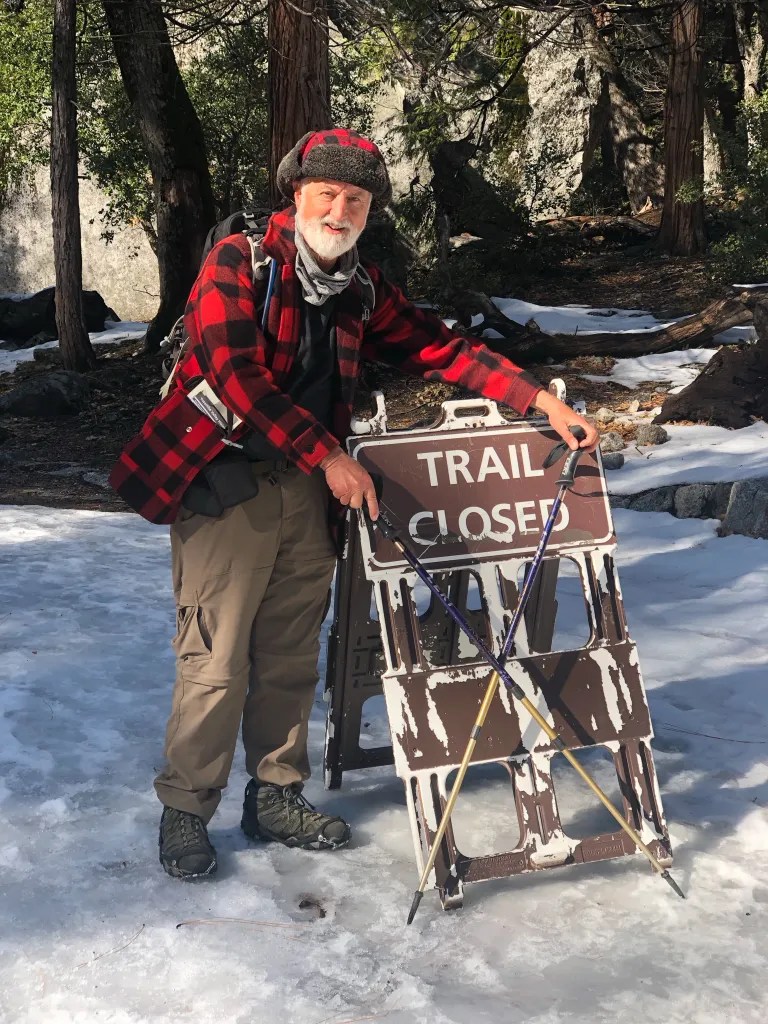
We discovered that the trail to the base of the falls was closed and, since we had our dog Carson with us, we were limited to trails that were paved or marked for bicycles. Even so we found plenty of places to walk. We did find that ice cleats, the kind that you can slip on over your boots were quite helpful for walking on icy trails and around camp.

On the second night the heater went out. I woke up at 4 a.m. feeling cold. The heater had shut down. Apparently, the battery went dead. This is a mystery. We should have had ample battery capacity to keep the heater fan going, but here we were with no power. We were prepared for the cold, so while we missed the comfort of a heated camper, we had our winter clothes and we carried on. After some hot coffee, eggs, and sausage we took a hike to Happy Isles.

While Yosemite Valley is an awesome location any time of year, I was not inspired with the iconic views of Yosemite Falls, Bridalveil Falls, Half Dome and El Capitan. It’s hard to beat the drama I’ve captured on previous trips.

What did capture my attention was more intimate landscapes, snowcapped rocks and flowing water at Happy Isles, a leaf in the snow, and Fern Spring.

After a day of exploring a variety of locations – Happy Isles, Swinging Bridge, and a few other sights – the plan was to stay out taking photos until dinner time and then have a nice meal before popping up the camper for the night. We were surprised to find the Ahwahnee closed for renovations, and the restaurant in Curry Village was closed as well. We ended up eating at the Base Camp at Yosemite Lodge. While it served our needs, it was not on par with our previous experiences.

On Friday, February 10, we had a very pleasant hike to Mirror Lake, even if it was a bit chilly. We were on the road heading home shortly after noon. As we left the park, we noted the arrangements that were being made to accommodate the throngs of people who would be coming to photograph the fire fall, a phenomenon that happens with the setting sun shines on Horsetail Falls making it look like it’s on fire. This phenomenon happens in mid to late February.

Train Spotting on Elkhorn Slough

With a high tide of 6.2 feet, much of the marsh at Elkhorn Slough is underwater. We found ourselves paddling over fences and right up to the railroad tracks. I wonder if the train engineers pay attention to the tide tables.

We launched from Moss Landing, assembling on the beach near Monterey Bay Kayaks. We were on the water at 9:30 a.m. Being a large group, about two dozen people, we formed several pods of kayakers. We paddled along mid-channel watching the sea otters. There were more sea otters than I recall from previous trips, and they seemed quite playful. Then we paddled over the marsh and up an inlet, passing through a fence.

Having explored the north side, we made our way to the south side of the slough where the water was lapping at the rails of the train tracks. Paddling on along the tracks we waited for an approaching freight train. The train was moving quite slowly, out of caution for the high water I would imagine.

It was 11:30 a.m. when we landed at Kirby Park, with the boat ramp completely underwater. The current was just starting to ebb, which was a disincentive to paddling the remaining 1.5 miles to the railroad bridge.

After lunch we gathered for a group photo and then made our way back down the estuary, riding a growing ebb current. We were back at our launch site at 1:45 p.m. having logged 9 miles round trip. Along the way we saw plenty of bird life including terns, seagulls, herons, egrets, and a variety of other shorebirds, as well as sea otters and a few harbor seals.

We did have one kayaker capsize under the highway bridge on the return. The current apparently pushed her boat up against the bridge pylons and she flipped over. Fortunately, a couple of experienced kayakers were close at hand and managed to get her back in her boat.

More photos are available in an online gallery.

Winter Paddling

People seem to be amazed that we go kayaking in the middle of winter. While much of the country is gripped by cold temperatures, the San Francisco Bay Area is often mild. Even this January with a constant parade of atmospheric rivers and their deluge of rain and wind we’ve had some fine weather for paddling. In the spring the wind comes up and that can be a challenge for kayaking.

Yesterday we had rain. Tomorrow we’ll have more rain. Today we have a break in the weather. Seven of us launched from Point San Pablo Yacht Harbor. There was some discussion about water quality, given the reports of raw sewage spilling into the bay, as well as debris and who knows what else coming down the river. Even so, we decided the risk was low.

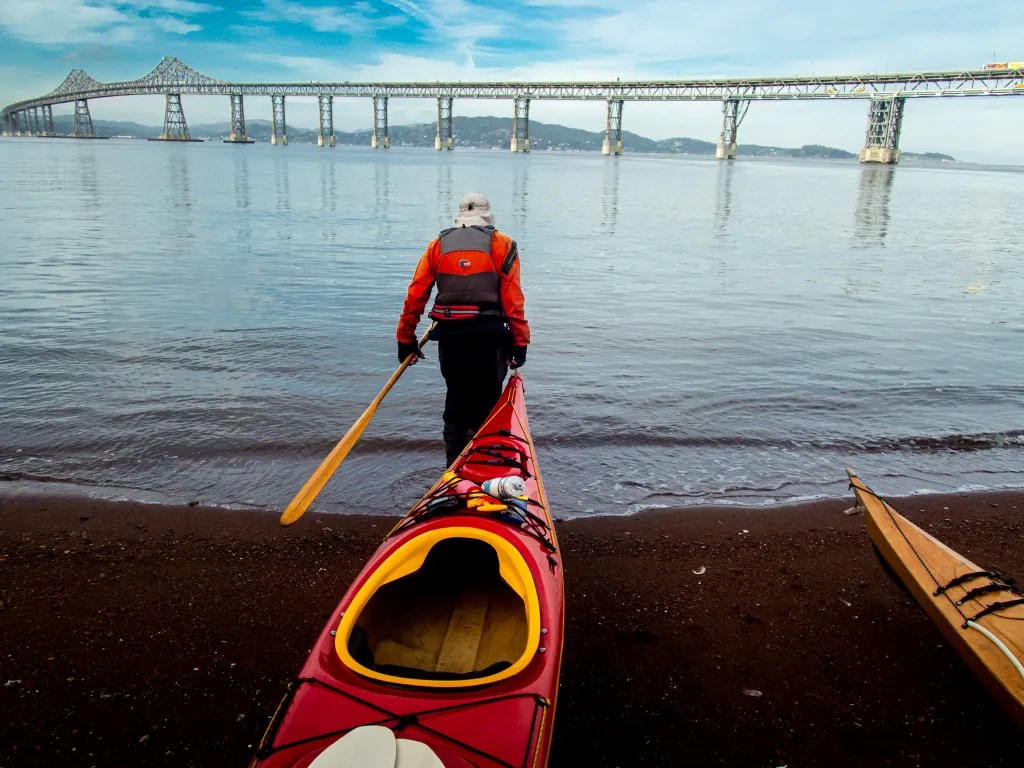
We were on the water at 10:00 a.m., paddled out around Point San Pablo and over to The Brothers.

After passing between The Brothers, we picked up the ebb current and headed south towards an island near the Richmond-San Rafael Bridge. Those of you that know the bay will know the location, otherwise you can check the track of the trip on the map below. The island is privately owned and landing on the island is not advised. It was 11:00 a.m. when we rounded the island. We made good time with a 2-knot current giving us an assist.

After lunch we made our way back. After passing back through The Brothers, two of our party split off and headed over to The Sisters in order to add a few miles to the day. The remaining five of us headed back to our launch site. The current prediction had slack water at 12:13 at Point San Pablo, although the additional water coming down the river may have had an effect on the currents. We had no current at 1:00 p.m. when we passed back through the islands.

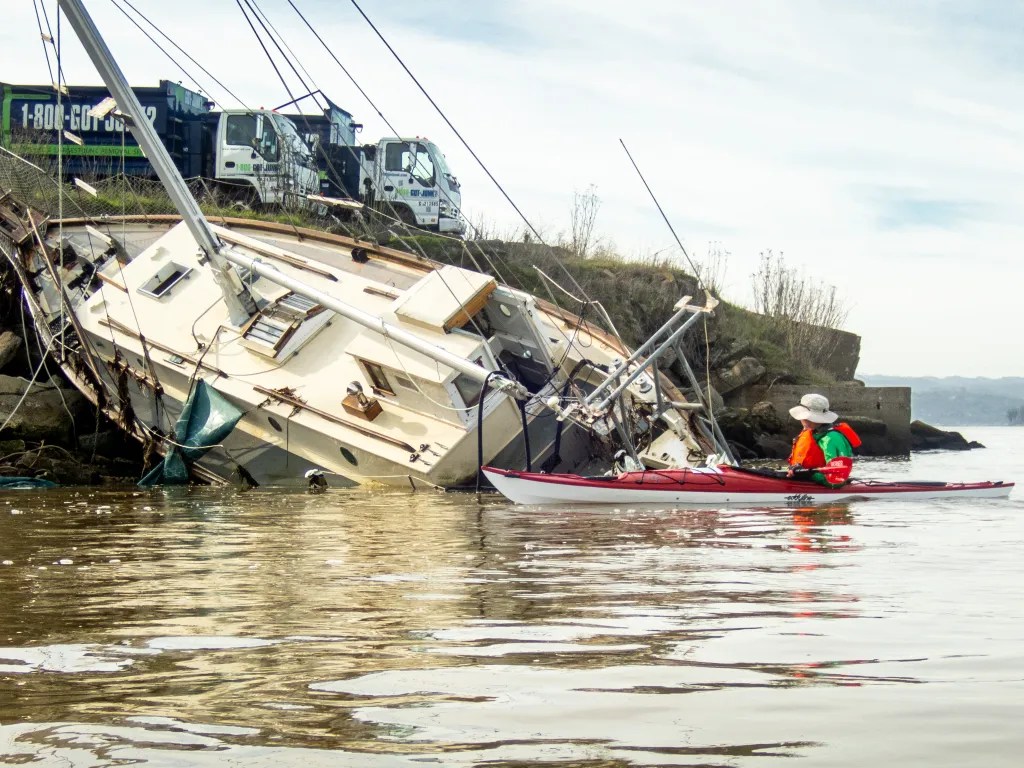
Coming back around Point San Pablo we stopped to look at a sailboat that was on the beach, presumably a casualty of the recent storm activity. We did see a fair amount of debris in the water: driftwood, bottles, and plastic bags. Our paddle covered 6.9 miles, with a maximum speed of 7 mph when we had the ebb current with us. We were back on the beach at 1:25 p.m.

More photos are available in an online gallery.

Roof Rack Failure & Windsurfer

Sometimes it seems that the hardest part about kayaking is getting the boat to the water. Getting the boat on top of the car and getting it off and to the water at the launch site can be a challenge. Today I had an added challenge. As I tugged on one of the straps to cinch the boat into the saddles on the car top carrier the cross bar came loose. On inspection I discovered that the support tower that secures the crossbar to the roof was broken. It would be easy enough to just pack it in, but a little voice in my head was saying, “Treve, if you really want to go paddling you have another vehicle you can use.” The racks for the truck were sitting in the driveway, so I accepted the challenge to see if I could get the kayak on the truck in time to make it to the launch site. Our intended launch time was 10:00 a.m. Google Maps was telling me that it was a 21-minute drive, which meant I might just make it. Sure enough, I was able to get the kayak on the camper and on the road in a timely fashion. It was 10:03 when the six of us pushed off from the beach.

With a constant parade of storms coming our way, we found a weather window with perfect conditions for paddling. Our course took us past San Quentin State Prison, then under the Richmond San Rafael Bridge and on to Loch Lomond Marina. Just for fun we tried squeezing our boats through a narrow gap in the pilings at the end of the Yacht Harbor’s breakwater.

Time for lunch…but in my haste to get on the road after the rooftop debacle, I did not have time to make a lunch. Andy’s Market has a fine selection of deli foods; a bowl of Italian Wedding Soup and a loaf of Judy’s bread hit the spot. And don’t forget the chocolate that seems to be ubiquitous on our paddles.

On our return paddle we had calm water and building clouds. We paddled out around the Marin Islands and then back to our launch site, watching for ferry traffic since Windsurfer Beach is close to the Larkspur Ferry Terminal.

My story starts with car top racks, so it’s only appropriate to end with a photo of my boat on top of my camper after the paddle. We covered 8.5 miles over the course of our paddle. Here’s a map that shows our track.

More photos are available in an online gallery.