Mendo Madness 2025

Every September our kayaking club, Bay Area Sea Kayakers (BASK), heads to Mendocino for a week. Over the course of the week there were some 70 or so club members camping at Van Damme State Park. Joann and I arrived on the afternoon of Monday, September 22. Events of the week included a number of organized paddles on the coast and on the rivers. I participated in four paddles, two river and two coastal.


September 23. Big River. The Big River empties into the ocean just south of the town of Mendocino. Nine of us were on the water at 10:00 launching from the sandy beach to the east of the highway.

This is a winding lazy river which feels the effects of the tides. Redwood trees come right down to the water, and the banks are lined with ferns and alders as well as redwoods. Paddling here is a serene and peaceful experience. Most of the group stopped for lunch at the “second culvert.” There is a dirt logging road that runs along part of the river, and the road goes over a couple of culverts that are big enough to paddle through. Rather than join the others for lunch, Joann and I opted to continue paddling up the river riding the tail end of the flood. At 11:30 we noted that the current had stopped going upstream. It was time to stop for lunch. I caught a glimpse of a river otter as we were preparing to stop. Other paddlers reported seeing a number of otters and a bear.

We found a shallow spot with a downed log, pulled our kayaks up out of the water and sat on the log while we ate lunch. As we were eating the water level was rising and our boats were threatening to float off without us. The dry log that we were sitting on was no longer dry. We hopped back in our boats and paddled back down the river. We seemed to be chasing a Great Blue Heron down the river. He would alight and fly down the river a few handed yards, only to repeat as we approached again. We were back at our launch site about 3:30 having logged 14.5 miles.


September 24. Open Coast. While the rivers are calm and serene, the coast can be quite dynamic. Some spots give you the sensation of being in a washing machine with water sloshing back and forth with the wave action. We joined a paddle led by two of our more experienced members, Tom and Ellen, launching from Van Damme Beach at 10:30. Eleven of us paddled south exploring a couple of caves and tunnels. There was plenty of dynamic water with a significant swell spicing things up. Fortunately, there are some reefs and rocks that provide protection for some of the features.

One popular feature is a pour over called Disney. A pour over is a feature where, with proper timing, you can ride a wave over a rock. I have watched many people execute this pour over on previous trips but never had the nerve to try it myself. Today it looked like something I could manage, so I went for it.

I positioned myself for the ride and was holding position while watching the waves, looking for the wave that I would ride. As a wave approached all the water in the hole I was in disappeared, and then with a whoosh a wave caught me and took me over the rock. I was quite happy that I stayed upright. Having a good bracing stroke saved me from capsizing. One of the pictures above shows Ellen riding over Disney.


September 25. Albion River. The Albion river is another lazy tidal river south of Mendocino. Nineteen of us launched from a boat ramp at the Albion River Campground. There are several houseboats on this river which gives it a sense of humanity although most of the houseboats are abandoned and deteriorating which gives them a ghostly feel.

We paddled up the river and found a dry marsh where we could haul out for lunch. After lunch we continued up the river until we were stopped by a downed tree at the 4 1/2 mile mark. Several people decided to haul their boats over the logs and continue exploring. That looked like quite an exercise, getting out of the boat, climbing up on the log and dragging a boat over. A couple of people ended up in the water, or hanging onto the log like drowned sloths. You can see a photo of Deborah hauling her boat over a log. Most of us were content to call this the end of the road and we headed back down the river.


September 27. Rock Gardening 101 and Potluck. Today I was happy to have made the list for Bill Vonnegut’s Rock Gardening 101 Class. This is all about learning how to read the water and making decisions about what features to explore given conditions and skill. I opted to leave my camera on the beach, since I wanted to be unencumbered by any equipment that might be a liability should I capsize. It was actually refreshing to concentrate on paddling without my mind always looking for photo ops.

One of the thrills was doing the elevator ride. Waves that come into a vertical surface such as a cliff lose their forward energy as they reflect off the cliff. You can actually point the bow of your boat at the cliff, holding it just inches away while the waves take you up and down. It’s an amazing experience. Conditions were such today that we did not execute any pour overs or explore any caves.

In the evening the club had a potluck dinner with more food than you can imagine. We participated in the Dutch Oven Cookoff, entering our Enchilada Casserole as an entree. After dinner, with our eyes drooping, we were off to bed before the awards were announced. We woke the next morning to discover that we had won the best entree. The award was a bottle of Silver Wood 2002 Cabernet. What an excellent wine! Cheers!

More photos are available in an online gallery.

Exploring Hvar: A Culinary and Cultural Journey

We spent four nights on Hvar, arriving in Jelsa by ferry the evening of May 19. On the morning of the 20th we slept in. The previous day was a hard day, and we needed the rest. Breakfast at B&B Aurora included hard boiled eggs, ham, salami, croissants, fruit, and cereal among other things. No shortage of food.

We opted for the easy day, walking to Vrboska. Oddly enough I can’t find any photos from that walk. I must have been overzealous in purging files. No shortage of other photos from the trip, so we’ll just move on. Even a seasoned professional can make mistakes. We dined at Murvica, just a short walk from our B&B. We discovered that with enough notice they could prepare Peka, a traditional Croatian dish. We put in our reservation for the next night and returned to feast on lamb Peka.

Peka is traditionally made with octopus or lamb. Joann opted for lamb. This dish is slow cooked in an iron pot, much like a Dutch oven. The dish we were served included lamb, potatoes, onions, carrots and brussels sprouts. Very tasty. After dinner I wandered around town looking for photo opportunities, always something I enjoy in a medieval town.

On the morning of May 21, a taxi picked us up at our B&B and drove us to the top of the island to start the day’s walking tour. This walk led us through two mostly-deserted towns, Velo Grablje and Malo Grablje. These towns were established to produce lavender and rosemary.

There are still a few people living here, but for the most part they are ghost towns. The abandoned buildings provide some interesting photo opportunities.

From Malo Grablje we continued down the mountain to Hvar City where we checked into our accommodations at Villa Nora. We had an excellent dinner just a few feet from our accommodations, feasting on a delicious baked sea bass. You can see more photo in an online gallery.

Croatia: Walking – Day 1

The day before our tour began, we met a representative from the tour company for an orientation. He went over logistics, maps and other details. This included a binder with maps and detailed instructions. We also had an app on our iPhones we could use to guide us. We booked the tour through Macs Adventures; however, they contract with the local company MeridienTen to manage the trips. Both companies provide maps and guides. We discovered that there were a few slight discrepancies between the guides. For additional navigational help we used the app GaiaGPS to track our travels and to resolve the few occasions where the instructions left us confused.

On May 16 we grabbed our day packs and our trekking poles and started our walking journey around Marjan Hill and the Marjan peninsula.

The walk starts along the waterfront along the path of the Olympians. Here every Croatian Olympian medal winner is commemorated with a plaque.

From there our walk took us past a couple of churches and on to Ivan Meลกtroviฤ‡’s estate. Ivan was a renowned Croatian sculptor. We stopped and toured the grounds to see some of Meลกtroviฤ‡’s works. The gallery was closed so we were not able to view the main exhibits. but a short distance further along our route was Meลกtroviฤ‡’s Crikvine, a unique religious and artistic complex with more of Meลกtroviฤ‡’s work.

A panoramic view of a coastal city with terracotta roofs, lush greenery, a harbor with a cruise ship, and mountains in the background under a blue sky.
Panoramic view of Split from the top of Marjan Hill

The walk meandered around the penninsula taking us to the top of Marjan hill for a spectacular view of Split and the surrounding coast.

When we reached the western most point of the walk, we were hoping to find a cafe where we could stop and enjoy some refreshments. Unfortunately, since we were early in the season, we did not find any facilities open. We broke out our emergency energy bars and water and enjoyed a few minutes on the beach. Our return walk took us along the north side of the peninsula where the wind kicked up, throwing up whitecaps on the water. We continued our walk, deviating from the prescribed course a bit, looking for a place to have dinner. We found a Pizza place that fit the bill. Once we were back in Split it was time to find some Gelato. Over the course of the day, we walked 12.2 miles. With all of our stops to explore sites the walk took us just shy of 12 hours.

More photos are available in an online gallery.

Exploring Korcula: A Journey Through History and Cuisine

On the afternoon of May 12 we boarded the ferry from Dubrovnik to Korcula. We spent most of our time in Korcula in the Old Town. Founded by the ancient Greeks, it later became part of the Roman empire and eventually a key southern outpost for the Venetian Republic.

The narrow streets are laid out like fishbones to take advantage of the cooling breezes and to provide shade. Having been traveling for a few days, our Air BnB (M&J Central Suites) had a washing machine which we took advantage of, hanging the laundry to dry on the outside clothesline.

After exploring the Old Town on foot, we were feeling quite hungry. It seems that most of the restaurants required reservations, but Pensatore Kitchen & Wine was able to seat us for an early dinner. We had a delightful meal and an introduction to the wines of Korcula. We managed to finish off a bottle of a 2024 Tasovak. Mind you it’s very rare that we ever have more than a glass or two. This was a very fine white wine.

Of course any visit to Korcula has to include a view from the tower of Saint Mark’s Cathedral. I also wandered the Old Town at night to capture some evening photography. More photos are available in an online gallery.

London

It wouldn’t seem right to visit England without seeing London. We arranged to spend two nights at the Premier Inn at London Heathrow Terminal 4 in order to afford us one day in London. We took the Underground to Hyde Park. Our goal was to get to Buckingham Palace by 11 a.m. to watch the changing of the guard.

Wow. I do my best to avoid crowds. This event is all about crowds. Perhaps we should have arrived earlier, but even so, where’s the best place to watch the event? Once I got over my initial disappointment over securing a vantage point, I decided that the people were part of the story. I pulled out my Sony RX100 and started experimenting with some intentional camera movement. I think these images capture more of the feeling of the event. Throngs of people, many with their smartphones poised to capture photos. The changing of the guard dates back to Henry VII (reigned 1485-1509). We were surprised at how much music was involved with a mix of traditional and popular tunes.

Then we were off to see Westminster Abbey, although with the dispersing crowd it took a few minutes to navigate our way. We were lucky to be able to buy tickets for an afternoon tour, and we added a visit to the Queen’s Diamond Jubilee Galleries located high above the Abbey floor in the beautiful 13th century triforium. Photos are not allowed in Jubilee Galleries; however, Joann was able to capture a view out the window as we climbed down the stairs.

Since 1066, Westminster Abbey has been the location of the coronations of 40 English and British monarchs, and a burial site for 18 English, Scottish, and British monarchs. Quite a bit of history here with exquisite architecture.

After visiting the Abbey, we took a walk past the Tower of Big Ben and across the Westminster Bridge over the River Thames. Then it was back on the Underground for the return trip to our hotel.

More photos are available in an online gallery.

Cornwall Highlights

Our time in Cornwall traveling with my aunt Sue took us well off the beaten track, visiting places where she had connections. One of our stops was at Waterperry where Sue attended horticultural college. Here’s a photograph of the church of St. Mary the Virgin at Waterperry. Inside the church is a plaque listing of vicars of the church going back to 1235. We also visited the beautiful Sherborne Abbey. Like Sherborne Abbey, many churches house shrines and reliquaries.

We spent several days in the town of Kilkhampton. Much of our travels involved riding in a car with the view hemmed in by stone walls and hedgerows. Our time in Kilkhampton afforded me the opportunity to wander around on foot with my camera. I was fascinated by the Parish Church of St. James the Great and also by the stone buildings and the treelined lanes.

At one point in my wanderings, I was able to find a view of the rolling hills as the sun was about to set. Our adventures also took us to the fishing town of Mevagissey. The tide was out and the boats were sitting on the bottom.

And while exploring Kilkhampton, I was intent on capturing an images of a stream passing through the woods. More photos are available in an online gallery.

SFMOMA: Diego Rivera

November 22 was a day to play tourist in our own back yard. We had reservations to see the Diego Rivera exhibit at the San Francisco Museum of Modern Art. We also included a visit to Salesforce Park, an amazing park situated 70 feet in the air and spanning four blocks.

Our outing started with a short drive to the El Cerrito Plaza BART Station. We were concerned about parking, but when we got to the station at 11 a.m., there was an abundance of empty parking slots. We rode the train into the city and got off at Montgomery Station. It was noon when we exited the BART station. Downtown San Francisco was like a ghost town. There were very few people and many of the restaurants were closed. We walked the short distance to SFMOMA and headed to Cafรฉ 5 on the fifth floor.

We both ordered the Chicken and Cilantro soup and then found a table outside in the Jean and James Douglas Family Sculpture Garden. One of the gingko trees was in full fall display and the “Love” sculpture seemed to be calling me. I’m hearing “can’t buy me love,” by the Beatles.

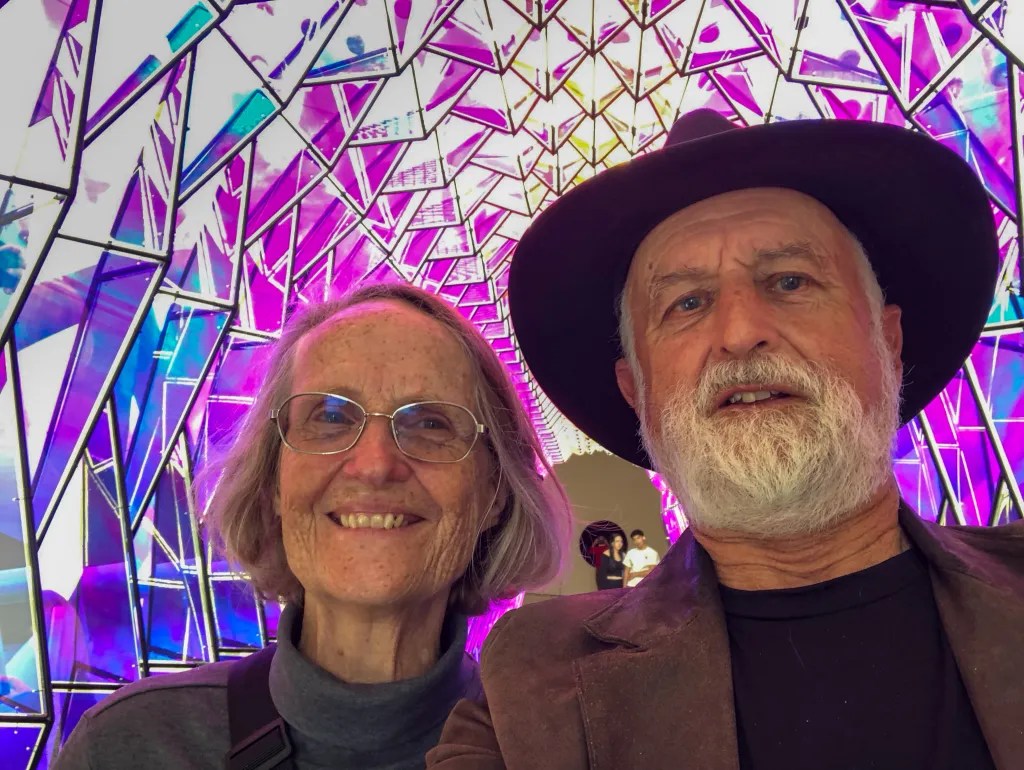
The soup was delicious, although it was a bit tepid by the time it reached us. Our tickets for the Diego Rivera exhibit were for 2 p.m. so we had some time to explore the museum. The Oculus Tunnel by Olafur Eliasson was fun.

Then it was time to explore the Diego Rivera exhibit. I was able to pull up the audio tour on my iPhone and listen to the discussion about Rivera’s work. My hearing aids act as wireless earbud, which makes for easy listening. While I was aware of some of Rivera’s work, I had forgotten about his involvement with communism and the influence he had on the art world. It is quite an extensive display and well worth a visit.

One of the pieces on display is the Pan American Unity mural which is huge. I thought it would be interesting to see if I could photograph it in sections and stitch the sections together. My effort worked better than I had imagined, although I ended up losing some of the top and bottom of the work.

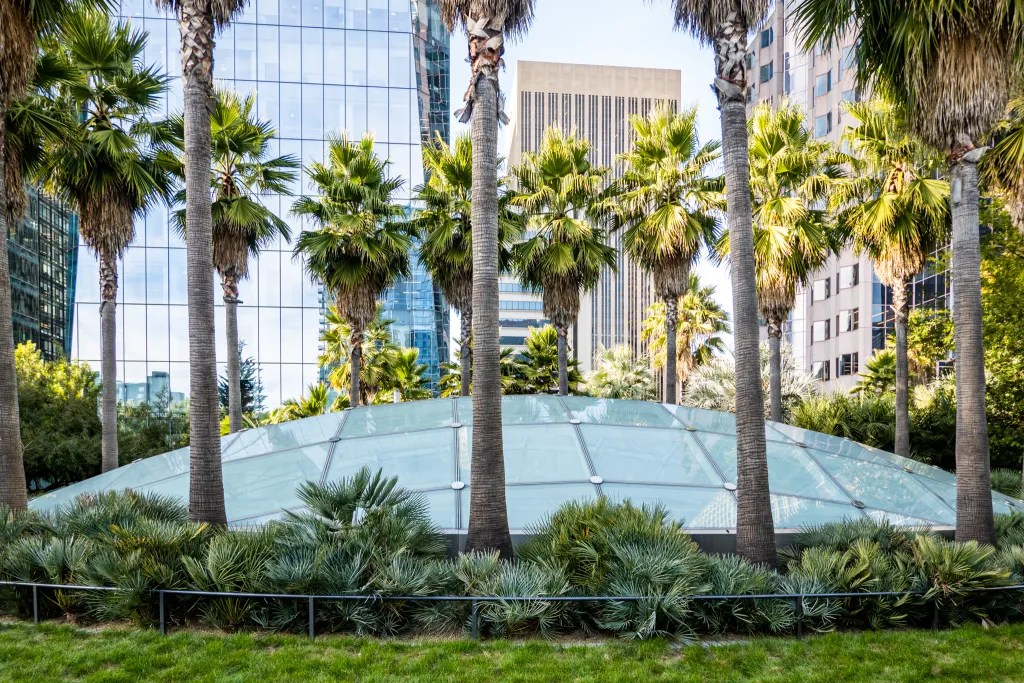
From SFMOMA we walked to the Salesforce Transit Center where we found our way up to the park, home to 600 trees and 16,000 plants arranged in 13 different ecological zones. I was intrigued with the “Bus Fountain” that dances to the movement of the busses on the lower level.

Playing tourist in our own back yard was fun. Sometimes we forget how much there is to see and enjoy here. We’re making a list of more things to do locally so stay tuned. In the meantime, feel free to view more photos online.

Carnassarie Castle

Today, September 11, marks our 22nd day of travel in Scotland. We’ve had many adventures over the past three weeks. Some of those adventures will eventually make their way into this blog, but for today, I’ll share our walk to Carnassarie Castle. And, of course, at the top of the news is the passing of Queen Elizabeth II. That caused us to revise our plans for returning to the Edinburgh airport for our flight home. Nevertheless, it didn’t stop us from lacing up our hiking boots and going on a walk after a hearty Scottish Breakfast at our B&B here in Kilmartin, Old Manse.

Our track led us along several country paths, up into the hills, through woods and past babbling streams. Then we climbed a hill to the castle where we spent quite some time going up and down many flights of narrow circular stairs to admire the view. The castle was built between 1565 and 1572 by John Carswell who had been granted the land by the Earl of Argyll. Carswell would become the Bishop of the Isles and was instrumental in translating the Book of Common Order into Gaelic, which became the earliest book to be translated into Scots Gaelic.

The overcast sky with threat of rain provided some nice soft lighting to set the castle in a surrounding landscape of green rolling hills and woods.

After climbing all the stairs and poking into rooms and windows, we found a spot to break out our lunch of cheese and crackers.

We returned to the town of Kilmartin by retracing our steps, walking by an apparently abandoned caravan which seems to have a picturesque spot along the track. Back in town we stopped at the museum cafรฉ for a bowl of hot lentil soup, muffins and coffee. The museum is closed at the moment for renovation, but that didn’t deter us from enjoying a cool pleasant day in the area of Scotland known for its archeological significance, with ruins going back over 5,000 years.

The Turquoise Trail

On July 17 our route took us through Taos, where we stopped at Ranchos de Taos to see the San Francisco de Asis Catholic Mission Church; always a notable stop with the abode buttresses and surrounding architecture providing plenty of photo opportunities in both color and black and white.

Then we passed through Santa Fe, making a brief stop for ice cream. Consulting the map we noticed an alternate route, so rather than blasting through on I25 we headed for Highway 14, also known as the Turquoise Trail. The drive took us through several small towns. We stopped Los Cerrillos, where we explored the grounds of the church and some of the colorful buildings around town. The town was very quiet during our visit, but it was clear that a number of art galleries and artists would make this a busy spot when tourists are out.

We had to do a double take as we passed a herd of colorful origami horses. Having driven past, we made do a U-turn to take a closer look; something that’s not uncommon, and one of the reasons we like the less travelled routes. I wouldn’t even think about doubling back if we were on a four-lane divided highway. The Outside the Box Studio was closed, but we had a clear view to look over the barbed wire fence.

Continuing on we were struck by a small church near Golden, and again stopped to take a few photos.

Then it was back on the main highway, I25, to make our way through Albuquerque and on to our campsite at The Golden Rose Ranch near Prewitt, New Mexico.

Quixote Winery: A Hidden Napa Valley Gem

The Quixote Winery is a hidden gem among the better known wineries of the Napa Valley. It’s located on the east side of the valley in the Stags Leap District. Having returned from Spain in June with a fascination for Antoni Gaudi’s designs, a friend suggested we check out the winery.

The whimsical architecture is like nothing else in the valley. The original winery owner, Carl Doumani, was fascinated by Don Quixote the Novel by Miguel de Cervantes. In his search for somebody that could create a winery to fit his vision he commissioned Friedensreich Hundertwasser, a Viennese artist and architect.

We visited the winery on August 27, having made a reservation the day before. Tasting is by reservation only, although you might be able to get same day reservations. We signed up for the White Label Experience that included an estate tour and a tasting of five wines paired with a plate of gourmet cheeses. With just two of us we had a rather exclusive tasting. It was a delightful experience and we left with three bottles of wine. This is a small winery. The estate vineyards cover 27 acres with Cabernet Sauvignon and Petite Sirah, Malbec, Cabernet Franc and Petit Verdot.

If you are planning on visiting the Napa Valley keep in mind that there are some 400 wineries with tasting rooms, and the valley includes some 16 distinctive appellations, each with it’s own distinctive soils and climate that lend themselves to different varieties of grapes.

The Los Carneros AVA at the southern end has a cool climate moderated by marine winds from the Bay and soils dominated by a clay-hardpan. This region produces Chardonnay, Merlot and Pinot Noir. Thirty miles to the north the Calistoga AVA with warmer temperatures and rocky volcanic soil is better suited to thicker skinned grapes such as Cabernet, Zinfandel, Syrah and Petite Sirah.

If you are thinking about wine tasting check out the Napa Valley Winery Map and the Napa Valley Vintners.

Oh, and after our wine tasting we drove the short distance to Yontville where we split a Pulled Pork Sandwich at the R+D kitchen; a delight to the palate after the wine tasting. There’s no shortage of options for wine and food in the Napa Valley and the surrounding areas.

More photos here.