Croatia: Walking – Day 4 – Gazul to Bol

At 9:00 our driver meets us at the Velaris Hotel in Supetar on the island of Brac. We jump in the van and are off on narrow winding roads that lead to the very top of the island. A half-hour later we reach the start for today’s hike, Gazul, a tiny village of sheep herders. We don our day packs for the day’s hike down to Bol. Our luggage stays in the van. We’ll reunite with our luggage at the ferry terminal in Bol later in the day.

Our hike takes us over the “highlands” of Brac, over meandering dirt roads and paths, through pine forest and over mossy rocks. Our route leads to Vildova Gora, the highest point on the island at 2559 feet and a spectacular view overlooking the Adriatic and the island of Hvar. As picturesque as the location is, I don’t manage to capture any photos that gave the view justice. It’s a daunting view though. We’re looking over the edge of a sheer cliff and wondering where the trail will take us. Neither of us are fond of steep rocky trails and that’s what this trail promises with its steep drop down to the water. We take our time, happy to have our hiking poles to assist us.

It is a steep walk down a trail which, given the rock curb, has been in use for centuries and shows centuries of erosion and wear. My shoes, which I have worn every day since I bought them two months ago, prove to be a bit light for the job. Fine for most walking but some more substantial boots would be a better choice for this trail. The steep descent causes my toes to jam into the toes of my shoes.

With our slow pace down the steep trail, we feel a little pressured by time given our tickets for the 5:30 ferry to Hvar. It is 4:30 when we reach the ferry dock, and at 5:15 our driver, who had dropped us off at the Gazul trailhead, shows up to reunite us with our luggage. Later that evening when I take off my shoes, I discover three bruised toenails. Over the course of the day, we logged 8.13 miles dropping 2500 feet over the last three miles.

Map of the hiking route from Gazul to Bol on the island of Brac, showing Vidova Gora and surrounding terrain.

Croatia: Walking – Day 2

At 8:30 we were on our way to the Ferry Terminal in Split for our ferry to Brac. We disembarked at Supetar, consulted our walking tour instructions and started our walk along the waterfront. Today’s tour is a loop walk on west side of Brac.

Our walk took us along the coast where we admired sculptures along an azure sea. As we approached the town of Mirca our route turned inland. Mirca had an interesting mix of traditional and contemporary houses. Leaving Mirca our route turned inland. Our directions were a bit confusing so we may have wandered off the prescribed route. Our track then took us back along the coast. A little after 2:00 we reached the town of Sutivan, a charming town of fishermen and farmers with a thousand-year-old tradition closely intertwined with the sea.

From there we started our return leg climbing up into the hills, following stone-lined roads and trails past fields of ancient olive trees.

It was after 6:00 when we finished our loop walk back in Supetar having walked 10 miles. More photos are available in an online gallery.

Croatia: Walking – Day 1

The day before our tour began, we met a representative from the tour company for an orientation. He went over logistics, maps and other details. This included a binder with maps and detailed instructions. We also had an app on our iPhones we could use to guide us. We booked the tour through Macs Adventures; however, they contract with the local company MeridienTen to manage the trips. Both companies provide maps and guides. We discovered that there were a few slight discrepancies between the guides. For additional navigational help we used the app GaiaGPS to track our travels and to resolve the few occasions where the instructions left us confused.

On May 16 we grabbed our day packs and our trekking poles and started our walking journey around Marjan Hill and the Marjan peninsula.

The walk starts along the waterfront along the path of the Olympians. Here every Croatian Olympian medal winner is commemorated with a plaque.

From there our walk took us past a couple of churches and on to Ivan Meštrović’s estate. Ivan was a renowned Croatian sculptor. We stopped and toured the grounds to see some of Meštrović’s works. The gallery was closed so we were not able to view the main exhibits. but a short distance further along our route was Meštrović’s Crikvine, a unique religious and artistic complex with more of Meštrović’s work.

A panoramic view of a coastal city with terracotta roofs, lush greenery, a harbor with a cruise ship, and mountains in the background under a blue sky.
Panoramic view of Split from the top of Marjan Hill

The walk meandered around the penninsula taking us to the top of Marjan hill for a spectacular view of Split and the surrounding coast.

When we reached the western most point of the walk, we were hoping to find a cafe where we could stop and enjoy some refreshments. Unfortunately, since we were early in the season, we did not find any facilities open. We broke out our emergency energy bars and water and enjoyed a few minutes on the beach. Our return walk took us along the north side of the peninsula where the wind kicked up, throwing up whitecaps on the water. We continued our walk, deviating from the prescribed course a bit, looking for a place to have dinner. We found a Pizza place that fit the bill. Once we were back in Split it was time to find some Gelato. Over the course of the day, we walked 12.2 miles. With all of our stops to explore sites the walk took us just shy of 12 hours.

More photos are available in an online gallery.

White Pocket

One of the destinations for our trip is the Vermillion Cliffs National Monument in Northern Arizona. The website the monument says This remote and unspoiled 280,000-acre monument is a geologic treasure with some of the most spectacular trails and views in the world. We spent several days here. The first night we found an amazing spot to boondock in Marble Canyon right on the edge of a cliff overlooking the Colorado River. This is a location we found using iOverlander.

This is one of those situations where when you think you’ve found a good spot to camp, it’s nice to see what’s further down the road. We had this place all to ourselves. In fact, we felt so isolated I fired up the water heater and hooked up the outside shower.

There are no paved roads within the monument and with deep sand, high clearance and four-wheel drive is essential. I was intrigued with the area called White Pocket so we set off the explore that area.

From US Highway 89A, which skirts the southern edge of the preserve we left the paved road and headed north on House Rock Road. Our first stop along this route was a condor viewing station. We scanned the skies. No Condors. Driving on we found the White Pocket Road. I had downloaded the maps for GaiaGPS, my favorite app for navigation, and we found this quite useful in navigating. We followed the dirt road, and it wasn’t long before we put the Tacoma in four-wheel low and dialed the Multi-Terrain control for sand. That provided a confident ride through the sand.

It was a bumpy. When we opened the back door of the camper to fix lunch, we discovered that all of our silverware had disappeared, and even the drawer which is designed to stay secure had bounced out of the cabinet.

Hiking around White Pocket is basically walking over slick rock. There are no trails, but we had no problem hiking around and exploring various features. These formations consist of twisted and convoluted layers of colorful sandstone which are simply astounding.

After exploring the White Pocket, we found an alternate route, a route that was marked one-way on some maps. I wouldn’t want to meet somebody on these narrow deep sand roads. As the sun was getting lower in the sky, we started to look for a place to boon dock and we found a suitable place to pull the rig off the road and set up camp.

More photos are available in an online gallery.

Gylen Castle

Getting sick while traveling put a kink in our plans. On September 2, about 12 days into our trip, I woke up feeling quite ill. We had a COVID test kit with us and I tested positive. We were able to extend our stay at the Pennygate Lodge in Craignure. After a few days there we moved to an apartment in Oban for a few more nights. This meant we would not be spending time at the Iona Abbey as planned, but it did give us a few more days to explore Oban. Once we were feeling better, we decided a trip to the Isle of Kerrera was in order. To get to the island we walked the short distance to the Oban wharf where we hailed a taxi to take us to the Kerrera Ferry.

This is a small ferry that can only carry a dozen or so people. We ended up having to wait for a few crossings, which didn’t amount to much time since the ride across the channel takes all of 10 minutes. That said, if you do plan to visit the island allow plenty of time in the event that you end up waiting.

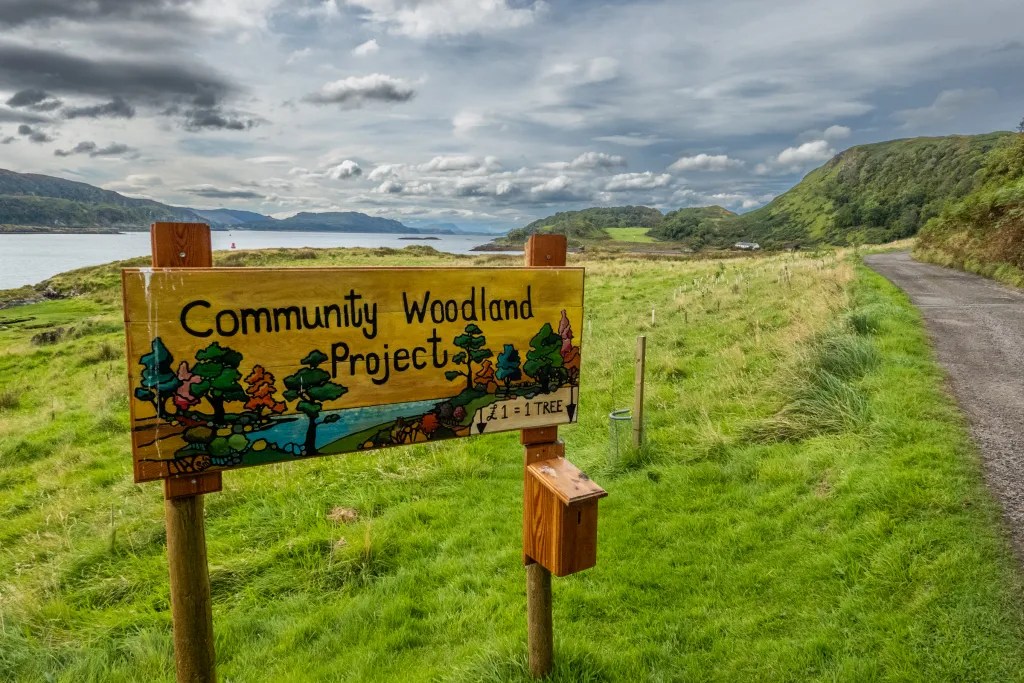
Once on the island it’s a two mile walk to Kerrera Tea Room and the castle. It’s a very pretty walk past farms and pastures overlooking the Sound of Kerrera. We passed through a number of gates, being sure to close them after passing through. At the top of a rise just before reaching the tea room we found a gate with a sign “It’s all downhill from here!”

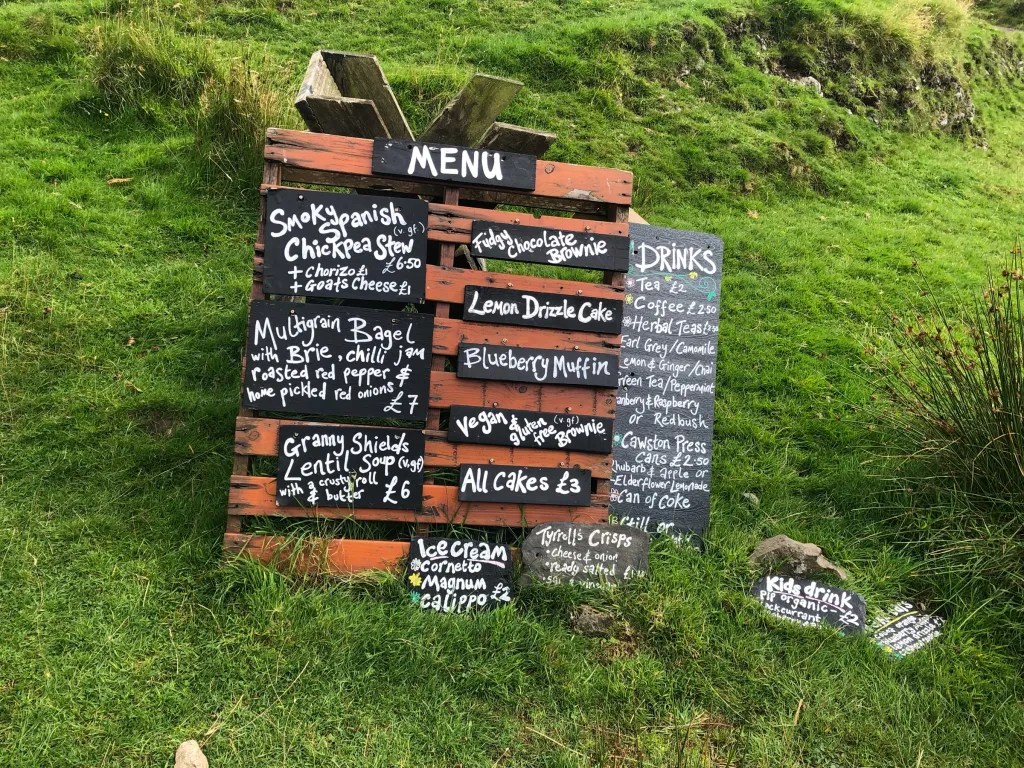
It was just after noon when we reached the tea garden. Smoky Spanish Chickpea Stew and fresh bread were a welcome treat after the walk. After lunch it was a short walk to the castle where we spent some time exploring the ruins.

The castle overlooking the Firth of Lorn was built in 1582 by the Clan MacDougall, but was only occupied for a short time. It was burned by the Covenanters in 1647 during the Wars of the Three Kingdoms.

Once we had explored the castle and peeked through the windows, we made our way back to Oban and on to Kilmartin on the afternoon bus. You can view more photos online. Here’s the track of our walk on the island.

Carnassarie Castle

Today, September 11, marks our 22nd day of travel in Scotland. We’ve had many adventures over the past three weeks. Some of those adventures will eventually make their way into this blog, but for today, I’ll share our walk to Carnassarie Castle. And, of course, at the top of the news is the passing of Queen Elizabeth II. That caused us to revise our plans for returning to the Edinburgh airport for our flight home. Nevertheless, it didn’t stop us from lacing up our hiking boots and going on a walk after a hearty Scottish Breakfast at our B&B here in Kilmartin, Old Manse.

Our track led us along several country paths, up into the hills, through woods and past babbling streams. Then we climbed a hill to the castle where we spent quite some time going up and down many flights of narrow circular stairs to admire the view. The castle was built between 1565 and 1572 by John Carswell who had been granted the land by the Earl of Argyll. Carswell would become the Bishop of the Isles and was instrumental in translating the Book of Common Order into Gaelic, which became the earliest book to be translated into Scots Gaelic.

The overcast sky with threat of rain provided some nice soft lighting to set the castle in a surrounding landscape of green rolling hills and woods.

After climbing all the stairs and poking into rooms and windows, we found a spot to break out our lunch of cheese and crackers.

We returned to the town of Kilmartin by retracing our steps, walking by an apparently abandoned caravan which seems to have a picturesque spot along the track. Back in town we stopped at the museum cafĂ© for a bowl of hot lentil soup, muffins and coffee. The museum is closed at the moment for renovation, but that didn’t deter us from enjoying a cool pleasant day in the area of Scotland known for its archeological significance, with ruins going back over 5,000 years.

Ruby Mountains

Continuing on our road trip to New Mexico, on the afternoon of July 10 we left Highway 80 near Elko Nevada and drove 35 miles up into the Ruby Mountains. Our campsite at Thomas Canyon Campground was situated at an elevation of 7,600 feet. While most of the drive across Nevada is arid desert, Thomas Canyon is in a lush grove of aspen surrounded by wildflowers. We spent two nights here, giving us one day to take a delightful hike up the canyon.

We were happy to find that fires were permitted and we bought firewood from the camp host. These days one isn’t guaranteed a campfire, given dry conditions with high fire risk. The next morning we fired up the Dutch oven for a breakfast of hash brown crusted quiche. A delicious breakfast before we set off on our hike. The hike goes 2.25 miles up the canyon, so up and back we logged 4.5 miles.

The hike climbs from about 7,600 feet to 8,900 feet through aspen groves and meadows of wildflowers, following Thomas Creek for much of the way. Here’s the track of our hike.

In the evening I took my big camera out and grabbed my tripod to see what I could find in the late afternoon light. Lo and behold I found a sunlit grove of trees that looked like fall color in the last rays of light. Some of these image will be in my art store shortly. You can view more photos in an online gallery.

San Bruno Mountain

On May 16 we met a few friends for a hike on San Bruno Mountain. This is a state park covering 2,400 acres, an island of rugged open space in the middle of a highly urbanized environment. It is also home to a number of plants and animals that are endemic to the mountain.

It promised to be a warm sunny day as we departed Berkeley, but when we parked at the trail head we were confronted with a chilly and blustery wind with fog billowing over the ridge. I promptly broke out all my layers. We hiked the Summit Loop Trail starting at the parking lot just off of Guadalupe Canyon Parkway.

I was surprised at the diversity of habitats. This included coastal scrub, oak woodland, chaparral and riparian habitats. There are also a variety of wildflowers. This year the spring wildflower display was not as magnificent as it can be. Even so we saw a variety including iris, aster, foxglove, lupine, and poppies.

I was also surprised with how lush and green the the mountainsides were. We hiked through tree tunnels and past glens of ferns. Quite a difference from our usual hikes in Tilden Park. Perhaps since the mountain captures the fog off the coast it gets more moisture than the East Bay Hills, providing more diversity.

We stopped where the trail crosses Battery 59 Road just short of the summit and opted to retrace our route back to the car. This was deemed to be the preferred route, rather than continuing the loop with the idea that the rest of the loop is not quite as interesting. We were on the trail for a little over two hours and logged 4.5 miles. Definitely a place to revisit with its diversity of plants and animals.

More photos are available in an online gallery.

A Hike in Fern Canyon

We spent the week of September 12 in Mendocino with members of our kayaking club. On Wednesday the 14th we took a break from paddling to go for a hike in Fern Canyon.

This is a lovely hike that follows the Little River. The trail winds along the river, crossing the stream a number of times on bridges and meandering through tall redwoods and the fern-lined canyon. Once we had hiked up the canyon, we opted to continue on the trail up to the Pygmy Forest. Here the tall redwoods give way to pines and cypresses stunted by extremely acidic, low-nutrient soil that sits on top of a layer of low-drainage iron hardpan.

We were happy to have some overcast since it can be quite warm in the Pygmy Forest. The soft light from the overcast also made for excellent photography. I prefer the soft light to the harsh shadows and highlights that can happen with direct sun. I also found that the railings on the bridges were a perfect place to park my Gorilla Pod and my trusty Sony RX100 camera in lieu of my tripod. Walking through the dwarf trees feels like walking through an enchanted forest.

We returned to Fern Canyon by an alternate trail, making a loop. When we returned to camp we had logged 11 miles. You can view more photos of our hike here and you can view more details of our track here.

Calella to S’Argo

Continuing our walking tour of the Costa Brava, this post covers our walk from Calella de Palafrugell where we spent two nights at the Hotel Sant Roc, the nights of June 16 and 17 and on to S’Argo where our tour ends.

At Hotel Sant Roc we had a lovely dinner on the terrace with a view of the town below with some color in the sky as the sun set. With a day off from walking we spent some time exploring the local environs including the the beautiful botanical gardens at Jardins de Cap Roig; also the home of a renown music festival. A trip to the beach was in order also where I rented mask, fins and snorkel from a local dive shop to explore some of the underwater life around the rocks just off the beach. We could easily have spent a few more days here, or a few weeks. A beautiful spot overlooking a picture postcard city. And even though we weren’t on the walking route we logged 9 km just touring the gardens and the town.

Alas, on June 19 we put our hiking boots on and continued our walking tour, hiking over rocky headlands, and along the clear turquoise waters of the Mediterranean, past quaint fishing hamlets and beautiful beaches. It seems that swimsuits are optional on many of the beaches along this stretch. We observed that nude sunbathing seemed to be more popular with middle age men.

The evening of June 18 found us at Hotel Ancora in La Fosca. Having logged 10 km. With some of the day left we walked to the waterfront in Palamos where we were hoping to watch the fishermen unload the day’s catch. We arrived well after the last boat had unloaded, so we toured the Museu de la Pesca, which turned out to be quite an exhibit and well worth the time and the cost.

June 20 we were once again on the trail, walking from La Fosca to Hotel San Pol in S’Argo. This stretch of the tour took us along miles and miles of white sand beaches, walking along the promenades adjacent to the beach. Many apartment buildings and hotels that line the beaches have their windows shuttered with the tourist season yet to come. Many carnival rides and vendors were setting up on the beach, and it looks like this is going to be a busy place soon.

Between the long stretches of white sand we climbed up steps, over trails, across rocky headlands down steps to tiny sandy beaches, up more steps, around more rocky headlands. Up and down, up and down. Each headlands giving a postcard view of the beaches below and the turquoise waters of the Mediterranean.

Along the promenade in Palamos we ran into several other people that were on the same walking tour as us. They recognized us by the “Macs Adventure” luggage tags we had on our day packs. We walked with them for several miles for the last stretch of our walk to S’Argo. They were staying in a different hotel, the S’Argo Hotel, having booked a “deluxe” package through Macs Adventures, we went on to Hotel Sant Pol which while not “deluxe,” certainly met our needs. We had walked 20 km (12.4 miles). In the evening we raised a glass of wine to toast completing our “Hidden Gems of the Costa Brava” walking tour having logged 77.4 km (48 miles).