Last Paddle for the Year

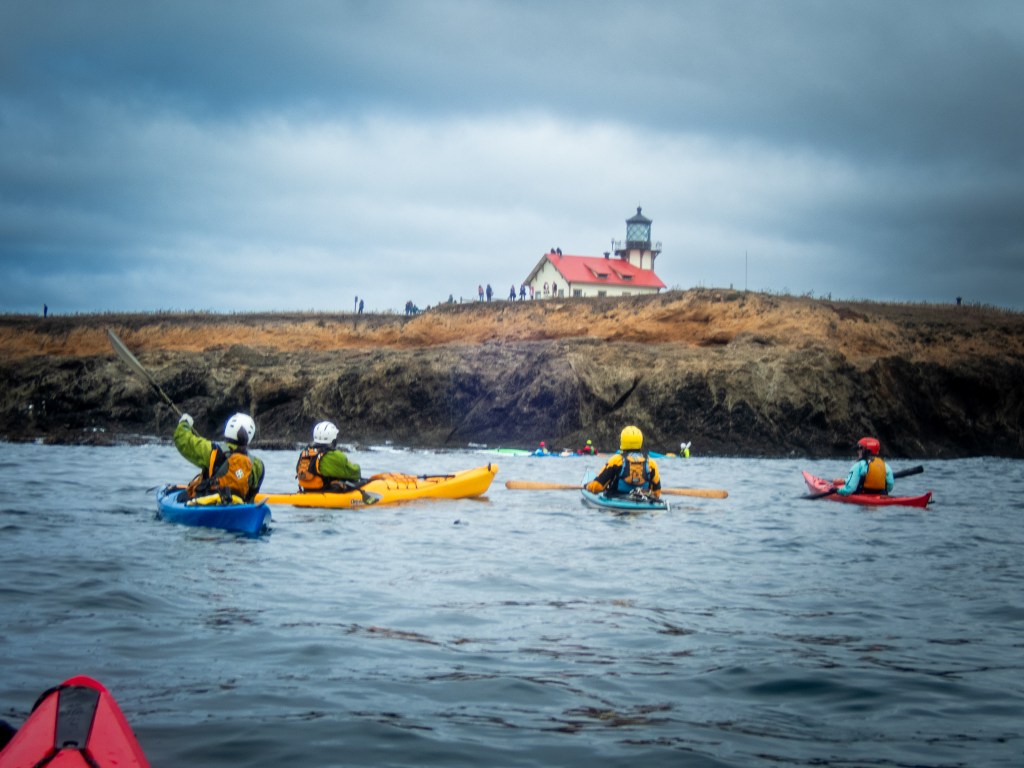
At 9:50 nine of us had our boats on the beach ready to launch. After a short safety talk and a radio check we were on the water at 10:00. Our plan was to paddle out across the shipping channel and then head north towards Red Rock and then on to Point Molate. We would be riding the end of the flood with slack water about 11:00. Alan was appointed our navigator, having set some waypoint on his GPS to help us stay clear of the shipping channels. The instructions were to “follow Alan.”

That said, it seemed like Alan was following the rest of the pod. I seemed to be lagging behind preoccupied with poking at my cameras. I’m using an iPhone 14 in a dive case and my trusty Olympus TG-5, trying to figure out which arrangement I like better. More on that later.

We paddled out to Bouy #6 marking the starboard side of the Richmond shipping channel and turned north towards Red Rock, rounding another Bouy #6 marking the Southampton Shoal Channel. We crossed a couple of eddie lines with some confused water, paddling into a light wind and riding over the wake of a couple of ferries.

From Red Rock we made our way to Point Molate Park landing on the beach at 11:45. With the high tide we didn’t have much beach so we took pains to get our boats well above the waterline. During lunch Evelyn asked for photographic proof that we were enjoying a delicious persimmon bread with bourbon a friend of hers had provided. After lunch we were anxious to get back on the water, since it was a chilly day, despite the sun.

Our return course took us past Castro Rocks where we gave some space to the harbor seals sunning themselves on the rocks. We then paddled past the Chevron wharf and back to our launch site. We were back on the beach at 1:45 having logged 8.4 miles. More photos are available in an online gallery.

Winter Road Trip to Bishop: Memories and Challenges

We missed the Bishop contingent of our family over Thanksgiving since they were hunkered down with Covid. This prompted us to clear our calendars to make the trek over the mountains for a visit. Since the camper had been sitting idle in the driveway for three months, it was no surprise that the battery was dead. A quick trip to the local auto parts store and we were ready to roll. We decided we’d break the drive up over two days.

We like to take our time. It was 10:30 am when we rolled out of the driveway. Highway 89 was open, so we drove over Echo Summit on Highway 50 and then took 89 over Luther Pass and down through Markleeville. It was 5:30 pm when we parked the rig for the night on National Forest land near Mono Lake. It was dark, but we found a spot to camp without much trouble. Four-wheel drive is recommended here since there is soft sand. This is dispersed camping, boondocking if you like. No services. We cooked dinner, turned the heater on and hunkered down for the night. It was 18 degrees when I stepped out of the camper at 7 am the next morning. I wandered around with my camera, fascinated by the stark beauty of our location.

We arrived in Bishop at 10:30 am with plenty of time to get settled before the evening Winter Tradition program at granddaughter Annabelle’s school.

Holiday activities also included a visit the Laws Railroad Museum, where we rode the train and sang Christmas carols with Santa. Daughter-in-law Serena got to show off a quilt project that she participated in.

On December 15 it was time to head home. A winter storm had dumped snow on the mountains, leaving the roads icy. We started our return journey by heading north on 395, but the ice on the roads was intimidating even with four-wheel drive and snow tires.

We turned around and headed south, arriving back in Bishop about noon where we rendezvoused with family for lunch at the Pupfish Cafe. This is one of our favorite local restaurants, noted for their Belgian waffles. From there we continued south going over Walker Pass. We found a gorgeous little campground, Sandy Flat Camp, on the Kern River and spent the night there. We were the only campers in the campground. More photos are available in an online gallery.

Back in the Boat

My last paddling venture was on August 24. I wrote about that in a previous post. On August 29 I underwent surgery for a knee replacement. Today marks my first time back in the boat, 77 days post-surgery. Joining my BASK paddling buddies, nine of us assembled on the beach at Eckley Pier and launched at 10:30.

Given the hiatus, I was anxious about getting to the launch with all of my gear, my ability to get in and out of the boat, and my stamina for the paddle. We managed to launch without missing any piece of gear, although my wife and I picked up the wrong paddles. We were both thinking something wasn’t quite right until I noticed I was using her paddle. My paddle is a little longer and has a little bigger shaft. Amazing how much this affected our sense of well-being.

My knee is still a bit stiff, but by sitting on the back deck and sliding into the cockpit I was able to get into the boat comfortably. From the beach we paddled towards the middle of Carquinez Strait to pick up the current. As we passed Benicia Shoals, we were riding a 2.5 knot current. Making quick time, we landed at the Martinez Marina boat ramp at 11:30.

Once we had all the boats off the boat ramp, we broke out our lunches. It seems to be a tradition in this group to share chocolate, and today there was no shortage: Ghirardelli, Baby Ruth, chocolate-covered caramel and more!

After lunch it was time to move the boats back down the boat ramp and onto the water. Our plan was to stay close to shore and eddy hop as needed until the current changed. It seems the current was with us on the return, so we made good time.

We didn’t get very far on the return leg before my camera battery died. (Note to self: change the battery during the lunch stop.) With the dramatic clouds and lighting, I didn’t want to miss the photo opportunities, so I made a quick dash to the little beach at Port Costa and changed the battery.

Staying close to shore gave us the opportunity to play in the pilings. Those of us that didn’t mind risking scratches on our boats made our way through the pilings, while a few with composite boats decided to stay outside and avoid the risk.

We were back at the beach at Eckley Pier at 2:05, having logged close to nine miles. After sitting in the boat for an hour, I found that I could hardly stand; my knee had stiffened up from sitting. With the help of friends, I got out of the boat, and we got the boats off the beach and back on the top of the car. I don’t quite have the range of motion I’d like to have to get in and out of the kayak easily, but that will come with time. It was great to be back on the water paddling with good friends. Here’s the track of our course.

More photos available in an online gallery.

Photographing the Peter Iredale Shipwreck at Fort Stevens

After leaving Whidbey Island on July 12, we headed to Fort Stevens on the northwest tip of Oregon. My motivation to visit this location was based on photos I had seen of a shipwreck on the beach. This is the wreck of the Peter Iredale, a four masted square rigger that ran aground in 1906. One of the rangers told us that this is the most photographed shipwreck in the country. I had envisioned a photo of the wreck against a glorious sunset.

Alas, we had fog. This put the wreck in a whole new light and offered some opportunities that I had not anticipated. I had my Nikon D850 and tripod as well as my trusty iPhone 14 and my Sony RX100. I put all these devices to use.

I had an idea to capture the scene as a long exposure to blur out the surf while keeping the wreck in sharp focus. That’s the first variation you see here.

For the second variation I wanted to use the soft light of the overcast to bring out the rusty color. This being a popular location, some patience was required to find an opportunity when people were not swarming over the wreck. Then as people were exploring the wreck I thought it might be interesting to employ some Intentional Camera Motion (ICM) to create a blurry image. This turns out to be my favorite images from this photo session. The blur and the people seem to add a sense of mystery. In the morning the sun came out and that created a whole new feeling to the scene.

In addition to the wreck, some of the old military installations make for fascinating subject matter for photography. Here are several images I captured at West Battery which seemed to lend themselves to a black and white presentation.

Exploring Oregon Coast: A Family Road Trip Adventure

On July 1 we pointed our rig north for a road trip up the Oregon coast with the destination of Whidbey Island, where we would join family for a reunion. We had marked out 17 days to give us time to explore part of the Oregon coast and time to visit with family and to have a leisurely return drive.

For our first night we had reservations for Abalone Campground at Sue-Meg State Park, site 40. We arrived shortly before 6 pm, logging 295 miles over six hours.

The next morning, we woke up to fog and overcast and took our time getting started. We had reservations for Fern Canyon, a popular hike, just a short drive from our camp. The drive out to Fern Canyon is a one lane dirt road for the most part, and not a road I’d want to drive with much traffic, since passing oncoming traffic can be an issue in some places.

The hike up Fern Canyon is well worth the effort. The canyon walls are graced with ferns. We were advised to wear water shoes, since you are walking up the creek and likely to get your feet wet. We wore our regular walking shoes and carried our water shoes. There were plenty of boards to walk on and rocks to hop and we managed the hike without getting our feet wet. We logged 1.4 miles. Not bad for my gimpy knees. In hindsight I would have gotten an earlier start. The trail gets quite busy in the late morning which means that getting photos of the canyon without people is a challenge, and the light is a bit softer earlier in the morning. I carried my iPhone 14 and my Sony RX100 with a tripod. I was anticipating long exposures in the confines of the canyon. The canyon opens at 9:00 am.

Following two nights at Sue-Meg, on July 3 we were off to Bullards Beach State Park on the Oregon Coast, a well-established campground. From our camp we walked out to the beach to watch the sunset. It was very windy on the beach, so we took refuge in a makeshift driftwood shelter somebody had made.

The next day we explored the Coquille River Lighthouse and took a short walk on the beach. The wind and blowing sand discouraged us from spending much time on the beach. Bullards Beach State Park has over 100 camp sites and caters to equestrians and bicyclists. More photos from this trip are available in an online gallery.

Irving Penn: A Journey Through Seven Decades

I’m trying to keep my posts in chronological order, and while we visited this exhibit in June at the de Young Museum, it’s now mid-September. It’s been a busy summer and while this exhibit closed on July 24, it’s still worth noting.

Irving Penn’s work spanned seven decades, and this exhibit includes about 175 pieces that cover his entire career. It includes early documentary scenes, portraits of cultural figures, travel work, fashion studies, still life photography, and personal projects. It also includes photographs made during Penn’s 1967 trip to San Francisco.

To quote Nadja Sayej There is no photographer in history quite like Irving Penn. He built a bridge between commercial photography and fine art photography. He helped define the Vogue aesthetic and overwrote popular ideas about beauty with his trailblazing fashion photography. And he shot everything, from celebrities to still lifes, with the same thoughtful intensity. He’s arguably one of the top artists of the 20th Century, and his work is as relevant as ever.

From still lifes to hippies, to Hells Angels to Celebrities and even the natives of New Guinea, Penn’s ability to connect with his subjects and to create compelling images is extraordinary.

Our visit to the museum started with lunch in the cafeteria before moving on to the exhibit.

While Penn’s photos are well represented in various media, I decided to try to capture the feeling of the exhibit with some intentional camera movement (ICM).

Paddling to Paradise

Our paddle today takes us to Paradise. Paradise Beach on the Tiburon Peninsula. Our Lauch site is Windsurfer Beach. Given the tide prediction for the day we decided to launch at 11:00. Yea! I can miss the morning commute traffic on the Richmond-San Rafael Bridge. It took me less that 30 minutes to get to our launch site. There were 12 of us assembled on the beach at 11:00, quite a turnout for our recurring Thursday paddle.

The temperature was a bit chilly, so I put a second thermal top on under my drysuit and glad I did. I was quite comfortable despite the chilly overcast.

Our course took us across the ferry channel. We stopped to let ferries go by going both directions, then it was across the channel, past Paradise Cay, and on to Paradise Beach.

We landed at 12:05, grabbed our lunches and made the short walk up the hill to the picnic tables in the park.

The overcast sky provided nice lighting for portraits, and a nice view of Mount Tamalpais and we made our way back to Windsurfer Beach. I’m experimenting with my iPhone in a waterproof dive case. It seems some moisture condensation inside the case resulted in a soft-focus effect.

We were back on the beach at 2:30 having logged 8.5 miles. The battery on my iPhone went dead on our return leg, so I lost my GPS log i normally track with GAIA GPS. I was also carrying a Garmin InReach and an Olympus TG-5 camera. It was good to have a backup, both for the GPS log and for photos. More photos ae available in an online gallery.

Back from the UK

On October 3 we boarded a plane from San Francisco to Heathrow. The purpose of our trip was to escort my aunt Sue back to England to visit family and friends. Sue came to the US in 1964 after graduating from a horticultural school. She and one of her classmates were hired to work for a wealthy estate owner in New York. She eventually married my uncle, hence becoming my aunt. She is now 87 and asked us to escort her back to England.

Once we were on the ground at Heathrow, Sue’s nephew Peter met us with his car and drove us around much of the south part of England.

One of our first stops was in Chelmsford, just northeast of London where we visited with Sue’s cousin Tricia. Tricia served us Elevenses, which is what the English call tea when served in the morning. Tricia is in the blue sweater, with her son-in-law pouring tea. Sue is on the right. From there we made our way to Witney where we visited with Margaret, with whom Sue had come to the US to work on the Greentree Estate in Manhasset, NY. The two of them eventually went on a yearlong road trip around North America after working at the estate. Margaret served us a home cooked meal of venison stew. That’s Peter serving up a bowl of stew. Our trip included many stops in the south of England and Cornwall. The orange marks on the map indicate places I captured photos. I’m in the process of sorting through some 1400 photos, so there will be more stories to tell.

We covered a little over 1000 miles by car and added a trip to Edinburgh where Sue had more friends to visit. Much of our traveling was on country roads over the rolling hills of Cornwall with green fields, quaint villages and hedgerows. We also managed to visit Oxford and Sherborne Abbey.

One of the highlights of the trips was visiting Mevagissey. Sue’s nephew Andrew did the driving stint to Mevagissey where his singing group, Barrett’s Privateers, were participating in a sea chanty festival. Andrew is the third person from the left. What fun!

And, of course, while in Cornwall I had to have a pasty, the national dish of Cornwall, a flakey pastry pocket filled with steak and potatoes. We did get out for a few walks in the countryside including a walk on the Camel Trail between Wadebridge and Padstow. Here’s a photo of the trail as it passes through a tunnel of trees.

Mendocino Tunnel Vision

Seven of us gathered on the beach at Russian Gulch to explore the coast north to Point Cabrillo. When paddling around rocks we wear helmets and prefer plastic boats that are more forgiving when banging into rocks. We also wear wetsuits or drysuits should we end up going for a swim. We were on the water about 9 a.m. After a few days of rough water, we had calm conditions with little wind and wave action. This afforded us the opportunity to explore just about every cave and arch between Russian Gulch Beach and Point Cabrillo.

We did have one person go for a swim early in our paddle. A good opportunity to practice a T-rescue.

We paddled north along the coast noodling into every feature we could find. I had a GoPro camera attached to my helmet and was able to record much of our cave exploration.

We did find a couple of channels that offered some dynamic water. A few members of our pod opted to avoid the surging and sloshing water by paddling outside the rocks where conditions were calmer. Those of us that paddled inside the rocks had some fun bracing and practicing boat control.

We arrived at Point Cabrillo just before noon and found a very protected beach on which to land for lunch. After lunch we noodled our way back down the coast, once again taking advantage of the conditions to paddle in and out of the many caves and tunnels.

We were back on the beach a little after 3 p.m., having logged 7.7 miles. You can see the track of our paddle on the map. An excellent day on the water with some good paddling friends.

Back from Bishop

Our adventures recently took us over the Sierra to visit family and celebrate birthdays. We left Bishop on the afternoon on July 29 for our return trip, with a stop at Donna the Dog Lady to pick up our dog Carson. Carson spent the night there since we were involved in some activities where Carson was not welcome.

With daytime temperatures of 100 degrees, we were hoping to gain elevation and find some trees for shade. Green Creek near Bridgeport seemed to offer a good bet for the night. We turned off onto Green Creek Road and followed the well-graded dirt road for a little over six miles, finding a level spot to park the rig for the night at 7900 feet. Carson was happy to wander around camp off-leash. Having set up camp, we discovered that the mosquitos were quite abundant, so we did our best to cover any exposed skin and break out the repellent.

Green Creek is a gorgeous spot with Jeffrey pines, aspen and willows. The California Department of Fish and Game maintains the Green Creek Wildlife Area, a 720-acre protected area that includes habitat for mule deer migration and fawning. It’s also home to black bear, beaver, bald eagle, grouse, mountain quail and various waterfowl. We decided to camp outside of the wildlife area, which is marked with signs.

I wandered around our camp in the evening and again in the morning with my camera, in this case an iPhone 14. I was intrigued by the lush green vegetation, the aspen trees and the wildflowers. We saw lupine, penstemon, and prickly poppies. Once the mosquitos became annoying, it was nice to take refuge in the camper with its screened windows that still offer a view.