Bahía Concepción

Today we arrived at Playa Santipac. At the gate we paid 200 pesos for one night thinking we would move on the next day, but we ended up spending two nights. The campground was fairly busy, but we did find a suitable site with a palapa about 1/2 mile down the beach.

Playa Santipac is a popular spot for big rigs but also suitable for smaller rigs and tents. We had fun visiting with fellow campers who were walking along the beach, many of them from Canada and other northern locations that come down to Baja for several weeks or more. One of the joys of traveling is hearing people’s stories. Everybody on the road seems to be quite friendly and happy to share information.

There is no running water at the campsites, but vendors drive along the beach in the morning and provide you with a blue barrel with as much water as you wish for a small fee. There are also vendors selling fresh fish and a variety of other things. We bought water to use for washing since we wanted to conserve the water we had on board for drinking and cooking. We also bought some fresh halibut which served us for a couple of dinners as well as a hammock and some carrot cake.

We did manage to get our boats on the water, paddling out from the beach and around several islands. In one of the photos, you can see Joann in the little wooden boat with a line of RVs on the beach in the background. The beach at our campsite was quite shallow at low tide, so we ended up dragging the boats until we had enough water to paddle. If I had been paying attention, I would have given priority to a campsite further west where the beach wasn’t quite so shallow.

After a few days of dry camping, it was nice to have a shower even if it was just pouring a bucket of cold water over my head. For lunch we walked down the beach to Armando’s, a rustic shack on the beach with delicious seafood tacos.

After a couple of days at Playa Santipac we moved on to Playa Coyote. This is a popular spot. We pulled into the campground at 10:30 in the morning and found the last open site. We were surprised to discover that the campers next to us were kayakers, fellow members of BASK (Bay Area Sea Kayakers). We pooled our resources for dinner. I fired up the Dutch Oven and baked up some Halibut. In the morning we paddled together around Isle Coyote. It was a gorgeous day to be on the water and the flat calm gave us the opportunity to look below the surface. We saw many sting rays.

And talking about sting rays, I managed to step on one. Ouch! Before we launched our kayaks, I was tossing the ball for Carson and the ball went in the water. Carson wouldn’t go in the water to get it, and while the water was only six inches deep, I forgot to do the sting ray shuffle. Fortunately, I was wearing sandals and after a little first aid I was on the water paddling. I think I was quite lucky, since sting ray wounds can be very painful.

While we did have thoughts of driving further south to Loreto, Playa Coyote was such an idyllic spot we decided to spend time there rather than adding more miles to our trip.

More photos of Bahia Conception are available in an online gallery.

Cataviña: Cactus Wonderland

We wanted to spend two nights in the vicinity of Cataviña. The Cirios and cactus here are fascinating and, along with the rock formations, I thought this would be rich with photo opportunities. I figured two nights would give us opportunity to experience two sunsets and two sunrises and time to explore the cave paintings.

There are plenty of places to boondock in the desert here. We picked a spot that iOverlander identified as “Cactus Wonderland.” We found one other camper here, but we simply drove around to the other side of a rock outcrop and found a quiet spot to camp.

The next morning we walked to the cave paintings. Rather than walk on the highway, we decided to follow a dirt road that appeared to parallel the highway. This worked for a while until we started heading away from the highway. Using a GPS track on my phone from a previous trip, we were able to make our way over some rocks and head in the direction of the cave. Going over the rocks we encountered a rattlesnake hidden in the rocks. He let his presence be known with an alarming rattle.

We kept our distance and continued on to the cave. The cave is a bit of a climb up from the road and the parking area. We were happy to spend a few minutes in the cool respite of the cave since we were feeling the heat of the desert on the hike. As the crow flies, the walk to the cave was just over a mile. We managed to turn that into a 4-mile round trip hike with our meanderings.

True to expectations, this area provided many fascinating photo opportunities. The Cirios or Boojum trees, sometimes called Doctor Seus trees, were quite interesting and fanciful. More photos are available in an online gallery.

Baja Bound

Today is my birthday. Birthday number 73. We’re headed to Baja California, the three of us: my wife Joann, our dog Carson and myself. My birthday wish is to see a rainbow. So, as we are headed south on I5 near Firebaugh, there it is, a rainbow off to the east. That has to be a good omen for the start of our 23 day trip. Of course, we have to find a highway off-ramp to take a photo.

We make our first overnight stop at Buena Vista Aquatic Recreational Area. Not a bad spot for an overnight given the lack of camp sites along our route. This time of year, finding a site in not a problem, but in summer this can be quite a popular spot.

The next morning, we broke camp and hit the road. We needed to stop in San Diego to renew our passports; since our appointment with the passport agency is on March 8, we discovered that we have an extra day. This gave us the opportunity check out the wildflowers at Anza Borrego. The campground at Borrego Palm Canyon was full, but we managed to boondock at Peg Leg Smith, a popular spot for boondocking, which turned out to be quite close to some of the better flower displays.

Also enjoying the flowers was painter Stephen Stauffer who spends his time traveling the country and painting.

From Anza Borrego it’s a two-hour drive to San Diego, where we had booked two nights at Campland on the Bay. Campland turned out to be quite a comfortable place to camp even though it is an RV park.

On the morning of March 8, it was an easy matter to break camp and head to downtown San Diego. We were at the San Diego Passport Authority well ahead of our 8:00 a.m. appointment and already there was a line. With our applications submitted, we drove over to Fiesta Island to take Carson for a walk at the Fiesta Island Dog Park and then launch our kayaks for a paddle on Mission Bay. Later in the afternoon we returned to the passport agency to pick up our passports. Rather than go back to our campground for dinner, we discovered the Pacific Beach Fish Shop that had excellent fresh fish. Then it was back to camp to get an early start crossing the border the next day.

Yosemite

On February 7, we made our way to Yosemite, with reservations to stay in Upper Pines Campground, site #46. We arrived in time to get set up before dark. With bear warnings posted about not leaving food in the car, we were concerned about what to do with the food in the camper. We certainly weren’t going to move our entire pantry to the bear box. A ranger assured us that food in the camper would be fine, but food in the cab was an issue.

In the morning we were in no hurry to get out of our cozy sleeping bags. The outside temperature was 32, but we had the heater going in the camper. Since we need the sun to charge our camper battery we drove to a sunny location where we could leave the camper and go for a hike, parking near Yosemite Falls.

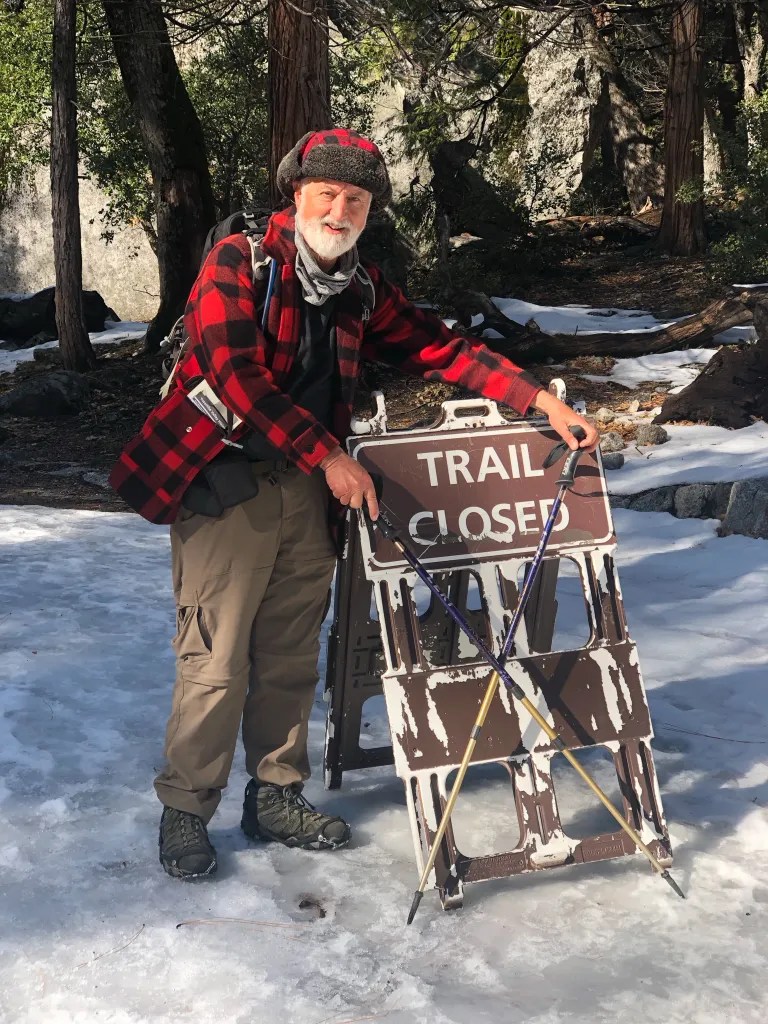
We discovered that the trail to the base of the falls was closed and, since we had our dog Carson with us, we were limited to trails that were paved or marked for bicycles. Even so we found plenty of places to walk. We did find that ice cleats, the kind that you can slip on over your boots were quite helpful for walking on icy trails and around camp.

On the second night the heater went out. I woke up at 4 a.m. feeling cold. The heater had shut down. Apparently, the battery went dead. This is a mystery. We should have had ample battery capacity to keep the heater fan going, but here we were with no power. We were prepared for the cold, so while we missed the comfort of a heated camper, we had our winter clothes and we carried on. After some hot coffee, eggs, and sausage we took a hike to Happy Isles.

While Yosemite Valley is an awesome location any time of year, I was not inspired with the iconic views of Yosemite Falls, Bridalveil Falls, Half Dome and El Capitan. It’s hard to beat the drama I’ve captured on previous trips.

What did capture my attention was more intimate landscapes, snowcapped rocks and flowing water at Happy Isles, a leaf in the snow, and Fern Spring.

After a day of exploring a variety of locations – Happy Isles, Swinging Bridge, and a few other sights – the plan was to stay out taking photos until dinner time and then have a nice meal before popping up the camper for the night. We were surprised to find the Ahwahnee closed for renovations, and the restaurant in Curry Village was closed as well. We ended up eating at the Base Camp at Yosemite Lodge. While it served our needs, it was not on par with our previous experiences.

On Friday, February 10, we had a very pleasant hike to Mirror Lake, even if it was a bit chilly. We were on the road heading home shortly after noon. As we left the park, we noted the arrangements that were being made to accommodate the throngs of people who would be coming to photograph the fire fall, a phenomenon that happens with the setting sun shines on Horsetail Falls making it look like it’s on fire. This phenomenon happens in mid to late February.

Point Reyes Retreat

Christmas was an opportunity to gather together as family. We had our two kids, their spouses, two grandkids and two dogs. On Christmas day we opened gifts and feasted on turkey and roast beef. After spending a day exploring local attractions including the Oakland Zoo, we piled into two cars and drove to Inverness, a 45-mile drive, where we had reserved a vacation rental for the better part of the week.

One morning I got up early to go photograph the tree tunnel. This is a feature that has been on my list to explore for some time. Not your typical tourist attraction, it’s simply a road lined with Monterey cypress trees planted in the 1930s. It caught my attention after seeing photos posted on Instagram.

It was a foggy morning, and I was hoping that the fog would create a sense of mystery. My plan was to arrive during the blue hour and to be done when the sun came up. The foggy mood I was anticipating didn’t happen but getting an early start did pay off. When the sun came up the light added drama that I was not anticipating. It turns out the tunnel is oriented almost east-west, so the morning sun creates an interesting effect. This image is available as a fine art photo in my art store at store.treve.com.

No visit to Tomales Bay is complete without a visit to the Bovine Bakery, a favorite haunt for pastries and coffee. Then we had a day with a break in the rainy weather and we headed to Limatour Beach, one of the few beaches in the Point Reyes National Recreation Area that is dog friendly.

And no family adventure is complete without grandma reading stories in front of a warm fire. On our last morning together, we piled into two cars to brave the fog and stormy weather to drive out to the lighthouse. You can see the car ahead with half of our crew is nearly lost in the fog. It was a blustery walk from the parking lot to the viewing platform. The lighthouse was lost in the fog, so we created our own Point Reyes Light with an iPhone. More photos are available in an online gallery.

Hot Creek

East of the Sierra Nevada Mountains, not far from Mammoth Lakes, is an area known as the Long Valley Caldera. This is a geologically active area with steam vents, geysers, and hot springs, the remnants of an ancient volcano. I’ve been visiting the Eastern Sierra for several decades and only this year decided to check out the area known as the Hot Creek Geologic Site.

My plan was to scout the location with the intention of returning in the morning when the steam from the many vents would be visible in the cool morning air. As it turned out, we had some dramatic weather with rain and hail and that was enough to appease my photographer’s eye.

There are a number of trails you can hike in the area with signs warning you to stay out of the water. Some of the pools are boiling hot. Despite the warnings we did see several people in the creek.

From the Hot Creek site, we decided to head for camp. Our intended camping site was a spot referred to as Laurel Springs on iOverlander, a “wild” campsite site just off of Highway 395. In trying to locate the site we apparently drove past it. Rather that turn around, we decided to follow the forest service road to see if we could find another suitable spot to park our rig. It wasn’t long before the road deteriorated a bit and I shifted into four-wheel drive. Then as the road got a bit rockier it was four-wheel low. You can see a photo of my shadow on the road looking east with Crowley Lake in the distance. We climbed up a valley to a ridge and there at the end of the road was a campsite with a picnic table and an incredible view. On one side of the ridge we could look east with a view of Crowley Lake, on the other side was a view of Convict Lake. In the morning I put the drone in the air to capture a view of our rig with Laurel Mountain and Convict Lake in the background.

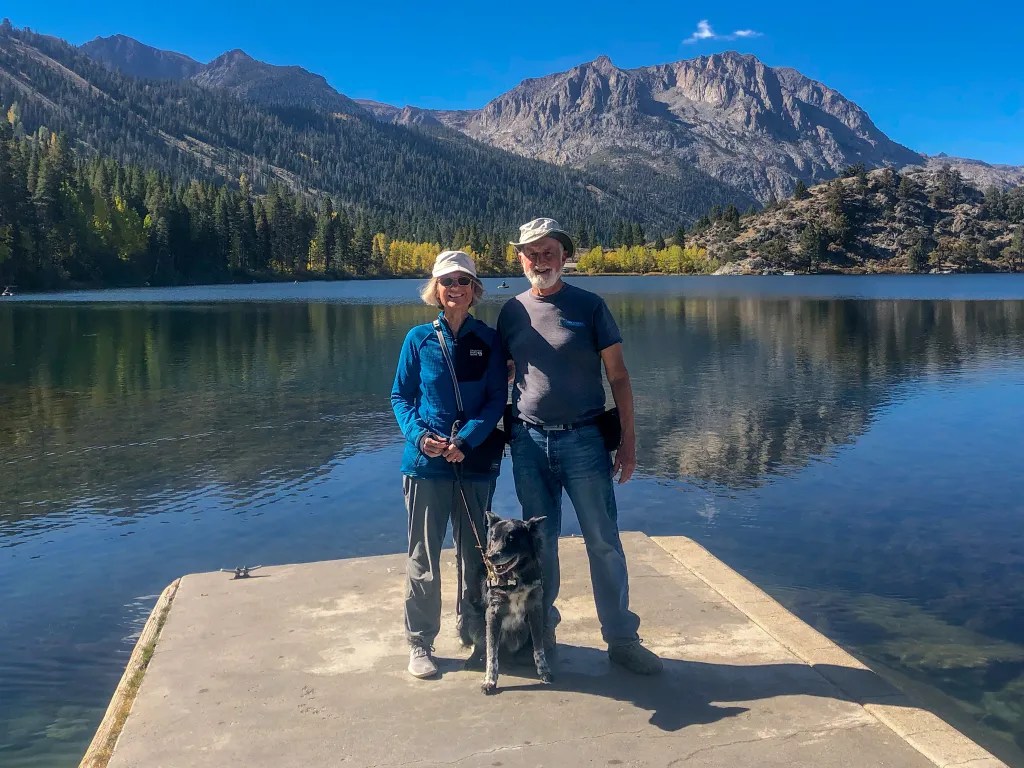
That morning, October 11, we broke camp and continued our journey home. We made a quick tour of the June Lake Loop, stopping at Gull Lake to walk the dog and admire the view. We found quite a few pockets of fall color, but for the most part the aspens were still green.

Our route home took us over Tioga Pass on highway 120. Near the summit we stopped for one last peek at the fall color on the mountainside. Then we drove down into Yosemite Valley thinking there might be a remote chance of camping. We were impressed by how busy the valley was. No luck finding camping, so we headed home. More photos are available online.

Dazzled by Yellow

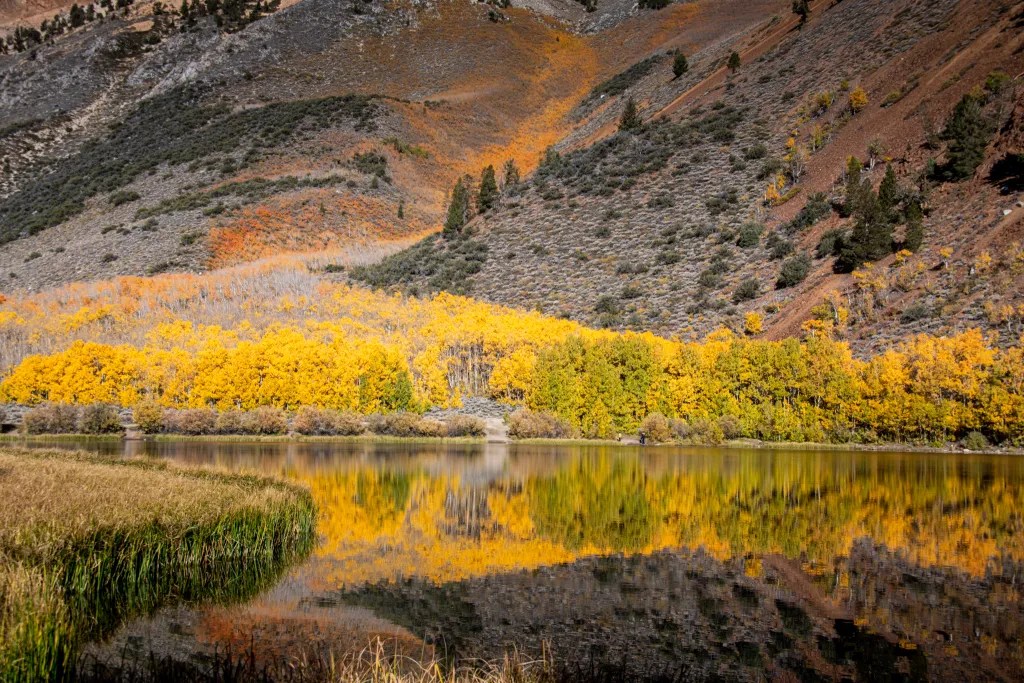
After three days of chasing fall color I was starting to feel overwhelmed. I felt like I had to give my eyes a rest, and yet we’d find another grove of aspen in full splendor, I’d grab my camera and start snapping photos. And then I’d be asking myself how the image I’m capturing differs from the many thousands of photos I’ve captured over the past 50 years. In any event, every photo is another adventure and the magnificence of the changing seasons never gets old. I’m always looking for a way to create unique photos that celebrate the glory of God’s creation.

Fall color in the Eastern Sierra usually starts in mid to late September with the aspen at the higher evaluations changing color first, and the color progressing down the canyons over the course of several weeks. I usually start to watch the fall color reports in mid September. This year October 4 was the earliest date we could get away, so we stocked the camper with food for a week and hit the road.

From our home in Albany, CA, we decided to take California State Route 108 over Sonora Pass. After passing the summit we stopped briefly near a grove of aspen, admired the view, and then decided to head to our intended camping destination on Green Creek. We were hoping to camp at the Green Creek Campground. Why? Because we wanted to fire up our Dutch Oven to cook dinner; for that we needed a fire ring in an established campground. The campground was closed. There are plenty of places to boondock along Green Creek so we found a comfortable spot to park our rig. We implemented “plan B” for our menu which did not require a fire ring. I was a little annoyed, though, when campers not too far away from us lit a campfire, something that’s prohibited in the dry conditions. I was too shy to confront them. What would I say?

We were so impressed with the fall color along Green Creek, we decided to spend a second night although we moved our rig a mile down the road. The road into Green Creek is a dirt road. For the most part it is navigable by passenger car, although close to the campground it gets a little rocky.

From Green Creek we headed towards Bishop by way of Dunderberg Meadow Road. We admired the aspen along the way and set up camp at the Sabrina Campground in the afternoon. The fall color was about peak there. In the morning we drove to North Lake where I spent some time with my camera and tripod capturing fall color. We also gave our dog Carson the opportunity to hike with us off-leash.

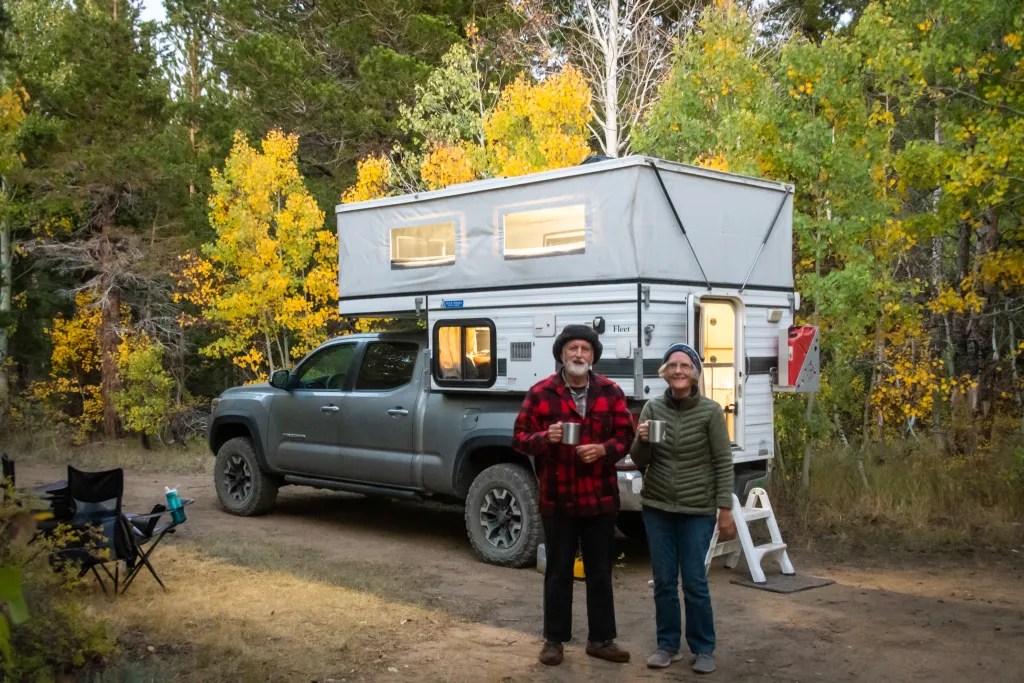
From Bishop Creek we drove to Bishop where we spent the weekend with family. Then we headed home after a night camping on a ridge overlooking Convict Lake. We had intended to spend more time on the road but the furnace in our camper was not working; getting up in the morning with the temperature in the 30s was wearing on us.

More photos are available in an online gallery.

A Week at Loon Lake

Nestled high in the Sierra Nevada Mountains at 6,400 feet is a gorgeous lake, Loon Lake. Crystal clear water surrounded by forests, granite boulders, and patches of wildflowers. Twenty-eight miles up a windy road takes you off the main highway deep into the Sierra Nevada mountains not far from the Desolation Wilderness. We anticipated meeting a number of fellow kayakers, members of Bay Area Sea Kayakers (BASK), for a week of paddling, hiking, wildflower hunting, birdwatching, and camaraderie.

We arrived on Sunday evening, June 12, dropping off our boats near the boat ramp and finding campsite 44. We parked, popped the top up on the camper and joined one of our camp buddies, Eoin, who was preparing dinner for our cook group. The next morning, I put my drone in the air to capture a photo of our campsite.

June 13 – Rubicon Trail Hike

Monday we opted to explore the north end of the lake on foot, driving to the Rubicon Trail Staging Area and making our way partly around the lake. The Rubicon Trail is widely recognized as the premiere OHV route in the United States. As hikers, we decided to stay off the jeep trail and try to find a route that was hiker friendly. We ended up off-trail, making our way over bare rock, through thickets of trees and down through a bog. It was spectacular country but slow going as we bushwhacked. After a couple of hours, we managed to cover 2.5 miles.

June 14 – Paddle – North End of Lake

Tuesday morning we were up early to fire up the Dutch Oven and cook a breakfast of mushroom and brie breakfast strada, one of our favorite camping breakfasts. With breakfast out of the way we assembled at the boat ramp. Our route took us along the eastern shore of the lake, noodling along and poking into coves and inlets, passing a small waterfall at one point. We stopped at Pleasant Campground for lunch and then continued exploring the north end of the lake.

With the wind starting to build in the afternoon, we decided to make our way back to our launch point. We covered 10 miles in the five and half hours of our adventure.

June 15 – Paddle – South End of Lake

Having explored much of the north end of the lake, today we explored some of the islands at the south end of the lake, making our way north to a lovely lunch spot on a granite spit. We had fun doing some flatwater rock gardening in a group of rocks. I even managed to get the drone in the air to capture some aerial views, something that I’ve wanted to do for some time, but usually the logistics of paddling take priority over the logistics of flying a drone.

Again, the wind came up after lunch and we made haste back to camp, hugging the shore to avoid the brunt of the wind. We logged 6.9 miles over the course of our paddle.

June 16 – Loon Lake Trail

With two days of paddling behind us it was time for a hike. Our dog Carson had two days in the camper and it was time to give him some off-leash time. We followed the Loon Lake Trail along the east side of the lake, paralleling the route we had paddled two days before. This hike took us through some lovely forests, through glens of freshly sprouted bracken fern, over sections of bare granite rock with occasional views of the lake.

We stopped for lunch just shy of Pleasant Campground on a slab of granite with a view of the lake. There we watched the white caps on the lake and were glad we had done our paddling earlier in the week. We admired many wildflowers along the trail and covered 7.3 miles.

Please view more photos of the trip in an online gallery.

Tassajara Ridge

Photos I had seen of some yellow lupine on Tassajara Ridge prompted us to go on a search. On the morning of April 5, we climbed in the car and drove to San Ramon. We were hoping to get an early start and find a bakery with some delectable baked goods. We ended up at a Starbucks which, while lacking the amazing fresh baked muffins where were hoping for, did suit our needs. Then it was off to find the trailhead. Our navigation seemed to be off a bit, and we discovered that access to the open space is limited. It was about 9:30 a.m. when we finally parked at the Tassajara Ridge Staging Area. This is a dog-friendly hike with dogs on leash. The hike goes through grazing areas, and we did pass a few cows on the trail.

The trail meanders along rolling hills, green from winter rains. At about a mile and a half we found our first batch of yellow lupine, probably Lupinus arboreus. We weren’t the only people out. We crossed tracks with a number of people carrying cameras and tripods.

After spending some time capturing the beauty of these flowers, we decided to continue our hike. More photos are available in an online gallery, by the way. The map we were following indicated that we could make a loop hike. We followed the Tassajara Ridge Trail to a junction with the Upper Hidden Valley Trail. Shortly after the trail junction we stopped and broke out our lunch.

At the four mile mark or thereabouts, we found a second field of yellow lupine.

Then it was time to complete the loop and head for home. We followed the Upper Hidden Valley Trail, which seemed to be heading past a water tank down into a residential area. We didn’t want to be walking in somebody’s back yard; assuming we must have missed a trail marker, we backtracked. Eventually we joined a trail that took us the direction we wanted to go, but then we scrambled through the barbed-wire fence where we found a gate at the junction of the loop trail. There we found a sign saying “Windemere Ranch Preserve… No Access Allowed at this Location.” Oops. What can I say?

From the junction we ended up walking through part of the residential development before we found our way back to the first section of the Tassajara Ridge Trail. When we started out, we were thinking a short morning walk, back before lunch. It was 3 p.m. when we returned to the car having logged 9.5 miles.

Joseph D. Grant County Park

When spring arrives, I often plan a trip to the Carrizo Plain which in some years will have a dazzling display of wildflowers. This year the report was not promising so the idea of the five-hour drive did not bode well. With the hills around the Bay Area showing green, I was reminded about a trip I made to Mount Hamilton some years ago and recalled the green hills and oak trees flush with new leaves.

So on March 28 we jumped in the truck and headed to Joseph D. Grant County Park. We arrived following a light rain with plenty of camping available. We parked our rig in site #9, suggested by the ranger at the entry kiosk. The camp facilities were quite nice, with level parking places well-suited for our camper. The restrooms were clean and even had showers.

Once we had the camper set up, we explored a bit of the trails around the camp, making a 3.5-mile loop via parts of the Hotel Trail, the Barn Trail, and the Snell Trail. There are 51 miles of trails in the park, so no shortage of hiking opportunities.

Dogs are allowed in the park, and we had our dog Carson on a leash as required. With the soft light from the cloud cover, I was intrigued with the oak trees festooned with lichens. The trees reminded me of Druids or Ents (if you are a fan of J.R.R. Tolkien). One of those photos, Mossy Tree #1, is now available in my art store at store.treve.com. Along our hike we startled a drift of wild pigs. We had seen signs of wild pigs all over the park. Their activities leave the ground looking like a rototiller has passed through.

The next day, March 29, a longer hike was in order. We walked to Grant Lake passing the Grant Ranch House on the way, then over to the lake where we stopped and had lunch.

We returned to camp via the loop trail, passing a couple of ponds along the way. This is pasture land for cattle, so we had our share of gates and styles.

With our meandering we covered 6.7 miles. We did find a number of wildflowers along our walk including poppies, lupine, mustard, shooting stars, and mule’s ears. We also saw a few deer and rabbits. Check out the online gallery for more photos.

On March 30 we awoke to fog and decided we’d take the back road home by going over the top of Mount Hamilton, then following San Antonio Valley Road and Mines Road. This made for an interesting drive. We stopped in the fog for a short walk through the mist shrouded oaks, and then drove up out of the fog to the Lick Observatory.

As we drove down the east side we were impressed by how much fire damage we saw from the SCU Lightning Complex Fire that occurred in August of 2020. The fire threatened the observatory on top of the mountain and burned 396,624 acres. We were driving through the burned area for quite some time.

There seems to be little public space on the east side of the mountain, so when it came time for lunch, we found a side road with space wide enough to park and pull out our camp chairs. This turned out to be a rewarding trip for a quick getaway with much to see.