Galapagos: Day 1

April 27. Our day begins early. At 5 am the twelve of us on the tour assemble in the lobby of the Patio Andaluz hotel in Quito for a van ride to the airport. We land at the Seymore Airport on the tiny island of Baltra. By noon or thereabouts, we arrive at the El Chato Ranch Giant Tortoise Preserve in the highlands. It’s lush and green here, a contrast from the more arid lowlands. After a delightful lunch we trade our shoes for rubber boots for a walking tour of the preserve.

We spend an engrossing afternoon walking around the preserve, learning about the natural history of the tortoises, and exploring a lava tube.

Then it’s back in the van to drive to Puerto Aroya where we have a look at some baby tortoises. Then we hop in a panga for a ride to out to the Passion, our floating home for the next week.

After a safety drill where we learn out to don our life jackets we are introduced to the crew before our first dinner onboard. More photos are available in an online gallery.

Galapagos: Summary

From April 27 through May 4 we participated in a Wilderness Travel tour of the Galapagos Islands. The tour started with a day exploring Quito and on April 28 we flew to the Galapagos. With many stories to tell and adventures to share I’ll start with a brief summary.

Those of us on board the Passion for our Galapagos adventure were in unanimous agreement that the highlight of our tour was our guide Rafael Pesantes whom we called Rafa. His depth of knowledge, passion and concern for the guests made for an extraordinary experience. Rafa is a native to the Galapagos, having fished the waters with his uncle when he was a kid. He brings 30 years of experience as a tour guide, having guided tours all over the world including National Geographic tours. He also worked with David Attenborough. His knowledge of the natural history and the cultural history of The Galapagos is extraordinary.

Here he is using the scull of a sea turtle to talk about how the turtles navigate and how they can return to the exact spot where they hatched. You can also see him enticing a giant tortoise to extend his neck by mimicking a fluttering bird. In the third photo he’s pointing out baby sea turtles that are just emerging from a nest.

Our base for our Galapagos adventures was the Passion, a 160 foot yacht, chartered by Wilderness Travel. We were on board the passion for a week, with daily trips by panga to snorkeling and hiking location. There were twelve of us and we became one happy family shortly into the adventure. Meals were prepared by a gourmet chef with lunch served on the upper deck.

Our cruise took us from Isla Santa Cruz, to Floreana, Isabela, Fernandina and Santiago. Among the highlights of the trip were tortoises, swimming with marine iguanas, watching Blue Footed Bobbies and watching molten lava spew into the ocean on Fernandina.

Each day was a rich adventure. I’ll be posting blog entries for each day of the trip so stay tuned.

Ferry Pt to Pt Isabel

Today was a glorious day for a paddle on San Francisco Bay. We have had several days of stormy wet weather, so it was nice to have some relief from the rain. A low tide meant that some of our favorite launch sites would be muddy, so we opted to launch from Ferry Point. Google Maps refers to this spot as the Point Richmond Pier, part of the Miller Knox Regional Shoreline.

Seven of us were on the water at 10:30. We had flat calm as we paddled out to the end of the jetty, with a little wave action from the wake of passing boats. This was my first day paddling with a Greenland Paddle. You can see the paddle hanging out of the cockpit of my wooden boat.

Once we were out past the jetty we headed east, rounding Brooks Island and then making our way to Point Isabel. I couldn’t resist capturing photos. The blue sky and clouds were dramatic. Every time I take a photo though, I have to stop paddling, and if I’m not paddling, I’m not going anywhere. Meantime, my paddling buddies keep their cadence, so I’m always playing catch-up.

As we passed Bird Rock, we kept our distance, so as not to disturb the harbor seals that were basking on the rocks. We landed at Point Isabel one boat at a time. The tide and rocks didn’t afford us much beach, but it didn’t take much time to get all the boats off the water.

While we were eating lunch the wind picked up, kicking up some wind waves and making work for us as we slogged into the wind and towards Brooks Island. We paddled to the north of Brooks Island, using the island and the breakwater to cut the wind.

As we paddled up the Richmond Channel, we passed the ferry, and we had a bit of rain. Over the course of the day, we logged 8.28 miles. The Greenland Paddle served me well. It felt a bit awkward for the first 20 minutes, but by the end of the day I had grown accustomed to it. I’m also finding that my iPhone 14 in a dive case seems to provide excellent quality photos. More photos are available in an online gallery.

Adventures in Lobbying

Most of my adventures are of an outdoor nature, however I was recently invited to join a lobbying effort to promote climate legislation in Sacramento. For the most part I have been ignorant of our legislative processes and have considered lobbying to be the domain of special interest groups with deep pockets.

Can those of us with little financial clout make a difference in public policy, particularly when it comes to climate and environmental issues? After this experience I have to say YES!

This was a two day event sponsored by The Climate Center. March 19 we spent the day listening to presentations as part of the California Climate Policy Summit 2024 and the 20th was devoted to visiting legislative offices to promote several bills. I attended the conference as a representative of First Presbyterian Church of Berkeley. There were three of us, Cherie, Katie and me.

The morning of the 20th we gathered into teams of four or five and headed over to the legislative offices to promote three bills, AB 2256 – Value of Solar, SB 233 – Bidirectional EV Charging and SB 252 – Oil and Gas Divestment. We also talked about budget issues and the possibility of a climate bond. Our lobbying efforts took us to Assembly member Ortega’s office where we dropped off information.

We then went on to Senator Eggman’s office where we met with legislative assistant Alison Kostusak, and then on to Senator Durazo’s office and Assembly representative Lisa Calderon’s office where we met with Maryana Khames and Arnell Rusanganwa.

I was impressed by how attentive the legislative personnel were. They seemed genuinely interested in the information we were providing, took notes and asked intelligent questions. I left this experience feeling like our presence made a difference.

Cactus and Red Rock

We recently returned from a 19-day road trip that took us to the heart of the Sonoran Desert near Ajo Arizona, and then north into the red rocks of the Vermillion Cliffs. We covered 1778 miles leaving on February 8 and returning on February 26. The focus of our trip was to travel a bit off the beaten track, to see some natural wonders and to visit places that were dog friendly. Dog friendly meaning, when we park the rig for the night, we can let Carson run free, off-leash. Here’s a glimpse of some of the highlights of our trip. I’ll be posting more about specific portions of the trip so stay tuned.

The Saguaro cactus is the keystone species in the Sonoran Desert, it’s just amazing to see these huge plants growing like they do, up to 50 feet tall.

One of our camping locations near Ajo was on the Barry M Goldwater Range. The range consists of 1.9 million acres of relatively undisturbed Sonoran Desert. While this is a military range, there are some areas that are open to the public. We found this site through iOverlander, one of the resources we use for locating camping.

Camping here requires a permit which is easy to obtain online. Once you have successfully obtained the permit you are given a gate code to unlock a gate. We accessed this location through Gate 15, area B. We boondocked here for two nights. A beautiful spot, although the silence was occasionally punctuated by the sound of fighter jets.

After a few days in the Ajo area we drove north to the Vermillion Cliffs National Monument. There are no paved roads in the Monument, and we put our four-wheel drive to good use driving through deep sand and rough roads. We drove into the Monument to explore the White Pocket, and amazing geologic formation of twisted colorful sandstone. We also explored the Maze Rock Art Site, with several large panels of rock art.

From the Vermillion Hills we made a quick foray into the Escalante Grand Staircase National Monument to explore the old Paria Townsite.

Over the course of the trip, we managed to vary our accommodations a bit. We spent four nights with family and friends, one night in a motel, four nights in paid camp sites, although one of those was essentially dry camping on private property, with a location we found on Hipcamp and we spent 11 nights boondocking. It was refreshing to visit places of natural wonder away from the crowds of so many of the popular locations. While most of the driving was on paved roads we did put our four-wheel drive to good use in several locations. Temperatures ranged from a low of 28 degrees near Joshua Tree to 79 degrees at the visitor center in Death Valley National Park.

White Pocket

One of the destinations for our trip is the Vermillion Cliffs National Monument in Northern Arizona. The website the monument says This remote and unspoiled 280,000-acre monument is a geologic treasure with some of the most spectacular trails and views in the world. We spent several days here. The first night we found an amazing spot to boondock in Marble Canyon right on the edge of a cliff overlooking the Colorado River. This is a location we found using iOverlander.

This is one of those situations where when you think you’ve found a good spot to camp, it’s nice to see what’s further down the road. We had this place all to ourselves. In fact, we felt so isolated I fired up the water heater and hooked up the outside shower.

There are no paved roads within the monument and with deep sand, high clearance and four-wheel drive is essential. I was intrigued with the area called White Pocket so we set off the explore that area.

From US Highway 89A, which skirts the southern edge of the preserve we left the paved road and headed north on House Rock Road. Our first stop along this route was a condor viewing station. We scanned the skies. No Condors. Driving on we found the White Pocket Road. I had downloaded the maps for GaiaGPS, my favorite app for navigation, and we found this quite useful in navigating. We followed the dirt road, and it wasn’t long before we put the Tacoma in four-wheel low and dialed the Multi-Terrain control for sand. That provided a confident ride through the sand.

It was a bumpy. When we opened the back door of the camper to fix lunch, we discovered that all of our silverware had disappeared, and even the drawer which is designed to stay secure had bounced out of the cabinet.

Hiking around White Pocket is basically walking over slick rock. There are no trails, but we had no problem hiking around and exploring various features. These formations consist of twisted and convoluted layers of colorful sandstone which are simply astounding.

After exploring the White Pocket, we found an alternate route, a route that was marked one-way on some maps. I wouldn’t want to meet somebody on these narrow deep sand roads. As the sun was getting lower in the sky, we started to look for a place to boon dock and we found a suitable place to pull the rig off the road and set up camp.

More photos are available in an online gallery.

2023 In Print!

Here it is! All the blog entries from 2023 in a book. This marks the ninth year for my blog and the eighth book. In 2023 I posted 35 times.

Where’s Treve 2023

Travels included Baja California to Lopez Island in the Pacific Northwest. We also make a trip to England. We made good use of our Four Wheel Camper, carrying our kayaks to Baja and Lopez Island.

It’s such a great feeling to pick up the book off the coffee table and browse through last year’s adventures, remembering travels and details that have already grown faint.

The book is 85 pages long. There’s no point in showing much of the book since you can simply view all the original posts on this website. We’ve been using the service Intorealpages.com which makes turning a blog into a book a breeze.

Adventure is worthwhile – Aesop

Geezers Go Paddling

At 73 years of age, I’m the youngster on today’s paddle. The five of us range in age from 73 to 81. Never mind that Alan tapes up his hands with duct tape before climbing in his boat. Our launch point is Jean & John Starkweather Shoreline Park near the west end of the Richmond-San Rafael Bridge. We were on the water at 10:30 launching on calm water under blue skies, a welcome change following several days of rain.

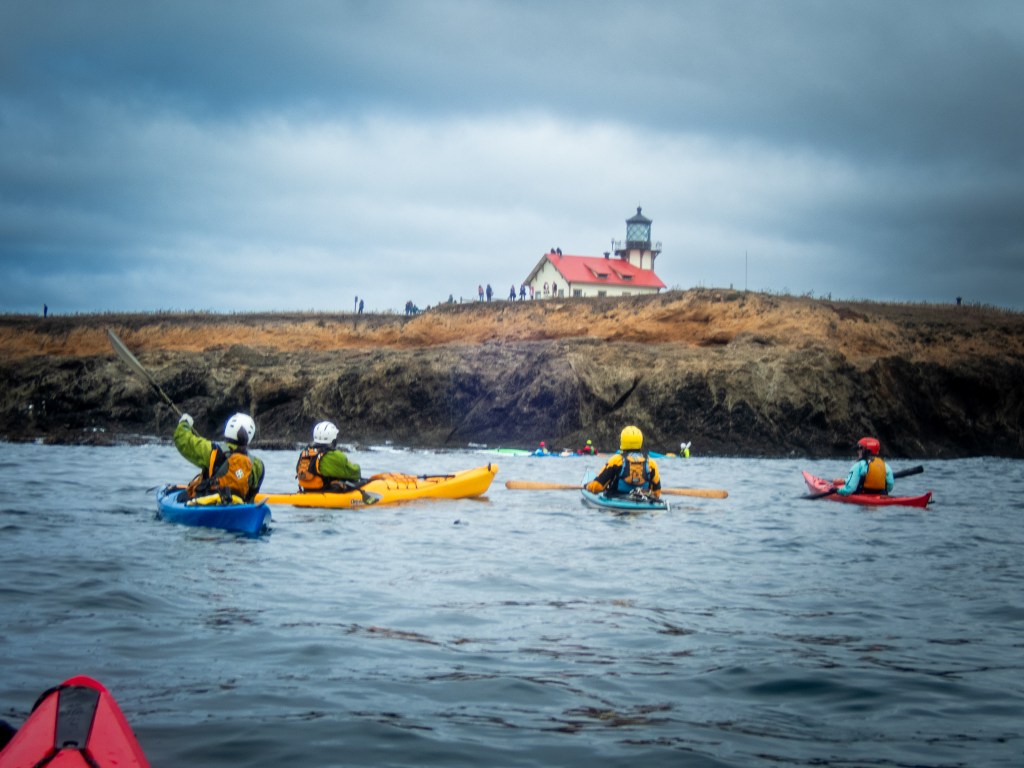
Our course took us out past the Marin Islands, padding by several barges and some dredging equipment. We paddled on to Point San Pedro. From there The Sisters looked quite inviting. Two paddlers decided to head to our designated lunch site at Loch Lomond. Three of us paddled out and around The Sisters, stopping to play in the slot in the rock called Grendel’s Needle. We had a high tide and very little current. Sometimes there can be some dynamic water here. Today it was quiet.

Then it was time to head for Loch Lomond Yacht Harbor for lunch, landing on the boat ramp and carrying our boats up the ramp and out of the way to keep the ramp clear for other boaters.

After lunch it was back on the water. Alan had acquired a unicorn figurehead for his boat. Then it was back across San Rafael Bay to our launch site.

We were back at our launch site at 2:15 pm having logged 9 miles. More photos available in an online gallery. I had to look up the definition of “Geezer,” Vocabulary.com says “A geezer is an old person. It might hurt your grandfather’s feelings if you refer to him as a geezer, since he thinks of himself as being youthful.” So, apologies to my paddling buddies; paddling keeps us young.

Mendocino Tunnel Vision

Seven of us gathered on the beach at Russian Gulch to explore the coast north to Point Cabrillo. When paddling around rocks we wear helmets and prefer plastic boats that are more forgiving when banging into rocks. We also wear wetsuits or drysuits should we end up going for a swim. We were on the water about 9 a.m. After a few days of rough water, we had calm conditions with little wind and wave action. This afforded us the opportunity to explore just about every cave and arch between Russian Gulch Beach and Point Cabrillo.

We did have one person go for a swim early in our paddle. A good opportunity to practice a T-rescue.

We paddled north along the coast noodling into every feature we could find. I had a GoPro camera attached to my helmet and was able to record much of our cave exploration.

We did find a couple of channels that offered some dynamic water. A few members of our pod opted to avoid the surging and sloshing water by paddling outside the rocks where conditions were calmer. Those of us that paddled inside the rocks had some fun bracing and practicing boat control.

We arrived at Point Cabrillo just before noon and found a very protected beach on which to land for lunch. After lunch we noodled our way back down the coast, once again taking advantage of the conditions to paddle in and out of the many caves and tunnels.

We were back on the beach a little after 3 p.m., having logged 7.7 miles. You can see the track of our paddle on the map. An excellent day on the water with some good paddling friends.

Albion River Paddle

This was our first full day in Mendocino, having arrived the evening before to join our fellow BASK members (Bay Area Sea Kayakers) at Van Damme State Park. The fog was just starting to clear as we launched from the boat ramp at the Albion River Campground. This is a private campground and there is a $10 fee to launch a kayak here.

There were 11 of us and we were on the water at 10:20. What makes this paddle fun is following the meandering river through the coastal forest and passing houseboats that have untold stories to tell. There are also plenty of pilings and remnants from logging days. Along about noon it was time to find a landing spot for lunch.

Three paddlers opted to land early at a convenient spot on the bank. The rest of us paddled on until we found the waterway blocked by a downed tree. With no convenient spot to land we paddled back down the river to join our fellow paddlers who had stopped earlier.

We were back at our launch site at 3 p.m. having logged nine miles. You can see more photos in an online gallery. You can also read about previous adventures here.