Oix to Sales de Llerca

On June 8 our hike takes us from Oix to Sales de Llierca. Our accommodations in Oix is a 16th century farm house that has been converted to a small hotel. Nothing fancy in the way of accommodations but comfortable. Likewise the food is good, but nothing fancy. The view from our balcony looks out over tile roofs to the green hills beyond.

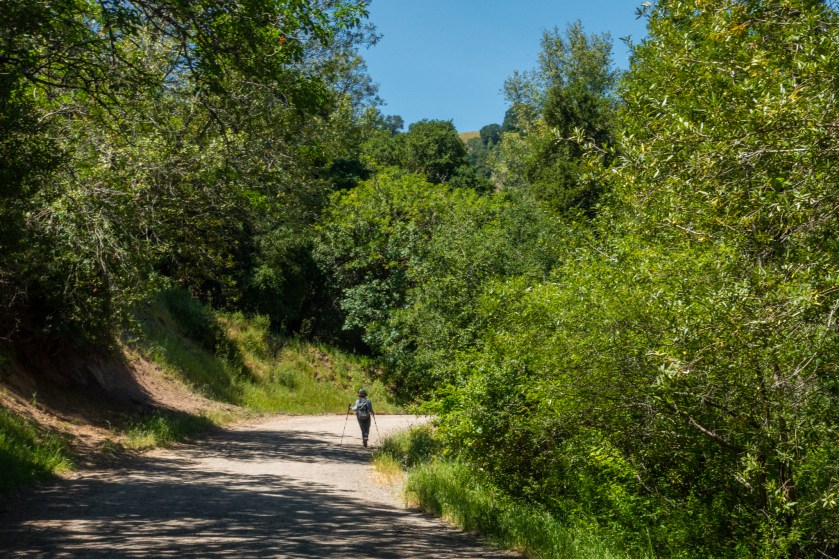
Oix is a tiny hamlet with no stores so we ask the manager to make us lunches. We’re on the trail at 9:50 am. Hiking through oak woodlands and grassy meadows, past white, blue and yellow wildflowers. We also see yellow Scotch Broom and I wonder if it’s an invasive here like it is in California.

I’m dragging a bit, perhaps too much wine with dinner. It takes me awhile to get my hiking stride. Mid-morning we stop for a snack in the shade of some small oak trees that look much like the live oaks of California, except much smaller in stature. At 12 pm we stop near an abandoned farm house and we each eat half a sandwich saving the second half for a later snack, since we’re anticipating a long day.

Later in the afternoon we cross a ridge and the town of Sales de Llerca comes into view. We’ve seen nobody on the trail since leaving Oix. As we approach the medieval bridge over the river Llierca we see a few hikers and a few people swimming in the river.

We reach our accommodations at Can Serola at 6:35 in the evening having logged 12.8 miles (20.3 km). Can Serola is on a hill about 2 miles above Sales Sales de Llierca. A beautiful old house in a beautiful setting. Here we’re served an exquisite five course dinner with olive paste on toast, creme of broccoli, green salad with goat cheese pastries (simply out of this world, like little philo dough pastries stuffed with cheese and fried), a beet dish with julienne beets, walnuts and goat cheese, and the main course of roast duck with fruit, and wine. My mundane English descriptions hardly do the meal justice. Our Macs Adventure itinerary may include meals with some locations and other locations we may be free to eat in local restaurants, depending on what facilities are near our lodgings.

Santa Pau and a Loop Hike

On June 3 we made our way from Girona to Santa Pau by bus, finding the local bus stop near our apartment in Girona. For this leg of our trip we’re carrying all our luggage. I carry a day pack and a travel pack. Once we start our walking tour our luggage will go by taxi and we’ll go on foot with just our day packs.

We transferred buses in Olot where we had few minutes for a snack; coffee, apples and coke. Once in Santa Pau we found our lodging at Hotel Sal Sastre right across the street from the castle. We spent some time walking around the medieval town.

On June 4 we began our Macs Adventures walking tour with a loop hike from town up to a high point at Santa Maria Finistres. Here there is a hermitage which has some historical significance. We had a very quite picnic lunch here. This is truly a place of solitude. From the time we left town at 10 am and when we returned at 3:45 pm we had the entire trail to ourselves. The trail was a moderately steep track up the mountainside passing through beechwood and oak forests. Our feet crunched through the leaves on the trail and there was no sign of anybody else having used the trail recently. We clambered over a couple of fallen trees and passed a number of sections in the trail that had been rooted up by wild pigs, as if a roto-tiller had gone through. I would imagine that some sections of the trail could be slippery following a rain, with slippery leaves and mud but with dry conditions we had good footing. It’s a very pretty hike through the cool shade of the forest, passing by farms and pastures closer to town. When we came out of the forest we could see our town on the hill in the distance.

Having returned to town, we had logged 10 miles. The Macs Adventure hike is a nine mile loop. We manged to add a mile with a trip to town in the morning to buy bread, cheese and salami for our picnic lunch. After 10 miles it was time for a cold beer.

La Pedrera

May 28. Our first day of touring in Barcelona starts with a tour of La Pedrera, one of the architectural wonders created by Antoni Gaudi. Casa Mila, or La Pedrera as it is commonly known was built in the early 20th century. Construction began in 1906 and the building was finished in 1912. Well worth the tour if you are visiting Barcelona. Get your tickets ahead of time though. We arrived at 9:00 am, a little flustered since we started off on the wrong direction on our walk, and then discovered that we had left the tickets in the motel room. Internet connection was sparse so we had trouble pulling up the confirmation email on Joann’s iPhone. It seems that the clerk at the counter was gracious enough to believe our story and we were able to tour. The tour is self-guided with handsets to listen to narration about the features of the building. Gaudi in known for drawing inspiration from nature and his devotion to the Church.

The tour starts on the roof of the structure with the fanciful design of the roof vents. From there you go down the the attic where you can see the rib like structures that support the roof. The attic served as the work area for servants. The building itself was designed as an apartment building.

From the attic you go down to one of the apartments which is furnished as it might have been in the early 20th century.

Watch your Pockets

May 31, 2019. Waking up from a sound nights sleep. I’m wondering what time it is. I look at my phone and I’m flabbergasted. 10:40! I had no idea we had slept that late. For the previous two days we had tour tickets for 9:00 am both days, so we were up at 7 am to grab a bite to eat and then off on foot to find our destinations. On Tuesday it was La Pedrera at 9:00 am then on to the Picasso Museum at 12:30 and the Palau de la Musica Catalana at 3 pm. At 9 pm we went out in search of Tapas, having our first taste of acorn fed Iberian Ham. On Wednesday it was Sagrada Familia for our 9:00 am tour, followed by a spontaneous walking tour and then a bus up to Park Guell at 6:30 to see more of Gaudi’s work. We logged 10 miles on foot over the course of the day and decided we’d forego the alarm in the morning and get up when we felt like it.

We had numerous warning about pickpockets in Barcelona, both prior to the trip and and while touring. We did have an experience that bears sharing. While learning to navigate the Metro we got on the wrong train. After getting off and feeling a bit disoriented a young woman came up to us and told us we needed to take the elevator up a level to get to the right train. We were on the elevator with her and two of her friends when one of them attempted to access Joann’s purse. She thought they might have taken a notebook , but on later inspection nothing had been taken. Just a lesson to be careful. We’ve been traveling lightly. Leaving our backpacks in the room. I carry my small Sony RX100 camera in a Ripoffs brand holster on by belt with a strong Velcro flap. My pants have zippered pockets and I keep my iPhone in one of those pockets. Even so, I feel a bit bare without the camera support items like the tripod and such, and on both Tuesday and Wednesday I exhausted my camera batteries with the spares in the my backpack in the room. Passport, credit cards and such I keep in a pouch that hangs around my neck and kept inside my shirt. Probably not foolproof but so far so good.

La Pedrera, Palau de la Musica Catalana, Sagrada Familia and Park Guell will require separate blog posts so stay tuned. Pacing myself between touring, editing photos and writing is a challenge.

Gaudi’s Lizard at Park Guell

Shakedown for Spain

These boots are made for walking

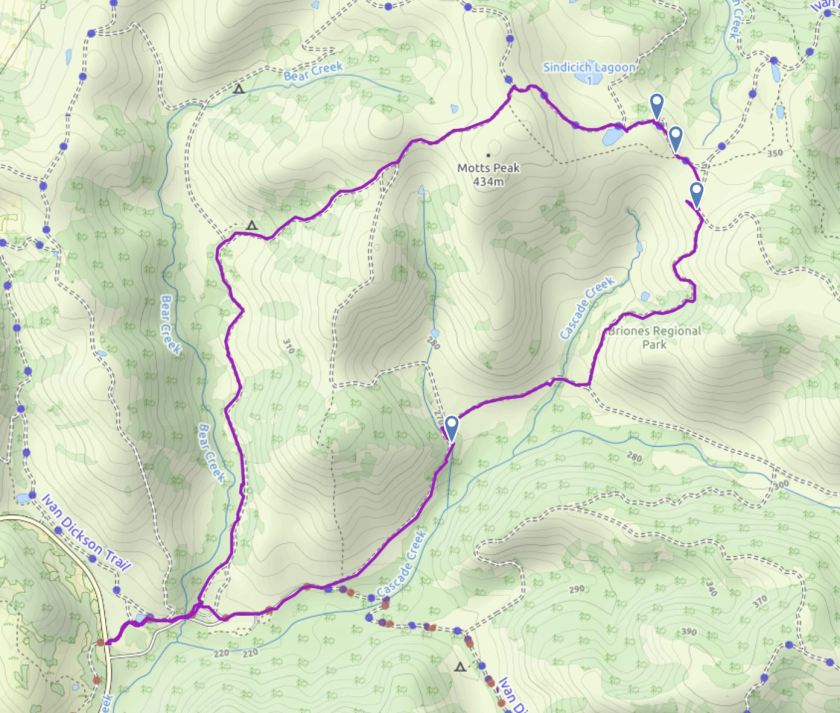
In the weeks ahead we’ll be walking about 100 miles along the Costa Brava and in the foothills of the Spanish Pyrenees. We’ll be following two self-guided tours offered through Macs Adevntures:  Foothills of the Spanish Pyrenees and Hidden Gems of the Catalan Coast. As a shakedown I decided to put a few miles on my new hiking boots so on May 12 we put the dog in the car and drove to Briones Regional Park. The goals were to give our Carson some off-leash time, log five miles and check out the wild flowers. Briones Regional Park is a 6,225-acre park in the hills of Contra Costa County. It’s about a 20 mile drive from our house. In spring it’s a stunning park with oak canyons, and green rolling hills. The ridges along the top of the hills afford wide sweeping panoramic views. Later in the year the green grass becomes a golden brown and the temperature can be quite warm.

At one point on our hike Carson decided to get a drink in one of the cattle watering troughs and ended up taking an unintentional swim. Along one of the ridges we passed a herd of cows, and Carson did his best to hike in Joann’s shadow acting a bit shy. There were a couple of steep sections of trail where I was glad I had my hiking poles, and even so, I took my time descending the steepest sections of trail.

Over the course of our walk we logged 4.9 miles. You can see a map or our course above or view more details about the track here.

On the Trail to Spain

We’ll be on the trail in Spain in June. It’s time to limber up the legs. We’ve had a very wet winter, which has kept us off the muddy trails, but with a few days of sun I decided to stretch my legs in Tilden Regional Park. It’s just three miles up the hill with 26 trails ranging from less than a mile to close to 14 miles, spread out over 2079 acres. Many of the trails are dog friendly with dogs off leash, so it’s a favorite for hiking with Carson. Tilden Park also boasts a steam train, a merry-go-round, a botanical garden and a lake to swim in. And one of the roads that transits the middle of the park closes each winter for the newt migration. The newts are not dog friendly though, they are poisonous to dogs.

In June we’ll be following two walking routes in Spain Foothills of the Spanish Pyrenees and Hidden Gems of the Catalan Coast, both walks are through Macs Adventures. In the fall of 2017 we did a walking tour of the Dordogne region of France care of Macs Adventures.

Organ Pipe

January 31. We arrived at Organ Pipe Cactus National Monument just as the sun was setting. Just in time to find a campsite before dark and to grab a few quick photos with my point-n-shoot Sony RX100. The photo above was taken on our third night in camp, using a Nikon D800 on a tripod. I only had to walk to the perimeter trail just east of the camp to capture this image. The Sony photos are posted below.

Not knowing what the camping situation was we decided to reserve three nights at Twin Peaks campground. Twin Peaks Campground has 34 tent-only sites and 174 RV sites. There is also a primitive camp at Alamo Canyon with four sites. More on that in a later post. It seems this time of year there are plenty of open campsites, so perhaps reservations aren’t needed. I would expect later in the season the camp may fill up. There is also dispersed camping north of the park on BLM land. We appreciated the hot showers at the camp. We’re often in primitive camps without water.

As with most national parks, dogs are not permitted on the trails, although there is a perimeter trail that loops around the camp and dogs are permitted on that trail, on a leash, as well as the trail to the visitor center. There were plenty of dogs in camp. We managed to log close to four miles with Carson just walking to the visitor center and back and around camp.

In the morning we fired up the dutch oven, Joann prepared the fixings for Hash Brown Crusted Goat Cheese and Scallion Quiche. Another recipe out of Robin Donovan’s book The Camp Dutch Oven Cookbook. We put the oven in the coals and 45 minutes later we had breakfast.

After visiting Anza Borrego, Organ pipe is a whole different experience. This is the Sonoran Desert, with it’s iconic Saguaro cactus. The Sonoran Desert is relatively frost free and it get’s a bit more water than the other deserts of the southwest. Organ Pipe National Monument boasts the highest biodiversity of any north american desert. That means there’s plenty to see in terms of both plant and animals.

Anza Borrego: Palm Canyon

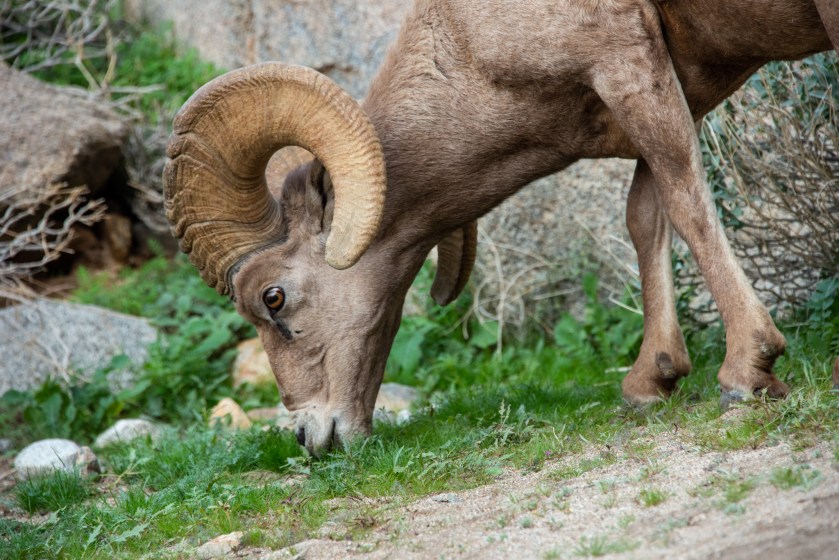
Peninsular Desert Bighorn Sheep in Palm Canyon

January 30. With two of us and our dog Carson, we decided we’d take turns hiking. Dogs are not permitted on the trails in Anza Borrego Desert State Park. Many of the trails run through canyons that are home to wildlife. Joann hiked the trail the previous evening and reported seeing sheep. I opted for a morning hike thinking I’d be more likely to see sheep then, and I thought the soft morning light might be conducive to photographing wildlife. Once the sun was over the canyon I imagined the lighting would be harsh.

It’s a mile and a half from the trail head at the campground to the palm oasis. Along the trail there are numbered post that correspond to descriptions in a printed guide. I had picked up a guide at the visitor center the previous day and I used the guide to learn more about the desert environment.

For this hike I decided to carry my Nikon D800 and a 28-300mm lens. For day hikes I usually carry a little Sony RX 100 which is a great camera for travel and hiking. For this hike I thought the opportunity to photograph wildlife warranted the bigger camera.

I wasn’t too far down the trail before I heard rock falling which I interpreted to mean sheep were near. Sure enough, scouting the cliffs above the trail I could see sheep cavorting in the rocks. Then I rounded a bend in the trail and I could see a ram ahead hidden partially through the bushes. I stopped and slowly brought my camera up to my face and started taking photos. The ram didn’t seem to take much notice of me. Then I spied a ewe with a baby lamb making way down the hill side. I found a palm log to sit while I took a few photos, trying to be quiet and still so as not to startle the animals. After a few minutes I could hear breathing behind me, almost down my neck, I turned slowly and there were two rams munching on the grass just five feet away. I was in awe. These animals are supposed to be shy and reclusive, but it seems here they have become habituated to people. They just seemed to go about their business munching the lush grass while people walked up and down the trail taking photos.

After watching the sheep for some time, I decided I better continue to the palm grove. If I were ever going to get back to camp at a reasonable time I needed to get moving. At the end of the trail is a lush oasis of palm trees.

More photos are available on my website.

Anza Borrego: Sheep Canyon

January 28 marked our first day in Anza Borrego Desert State Park, having arrived the previous evening. We thought it would be fun to take a drive up Sheep Canyon. I had been following the wildflower reports and it looked like we might find Ocotillo in bloom in the canyon. We were thinking it would be a short drive and we would be back in camp for lunch. The park maps shows the road as a “Primitive Road,” and the road was in good shape for the most part. A few miles in we stopped at Desert Garden where the ocotillo were putting on a display. The Ocotillo, Fouquieria splendens, is large shrub with long spiny stems. Like most desert plants it is uniquely adapted to heat and drought. In the heat of the summer it looks like a bunch of dead thorny sticks. Following a rain, if there is sufficient moisture it will sprout leaves., sometimes the leaves will appear within 48 hours of rain. It will then drop it’s leaves when conditions warrant conservation of water. The flowers look like flames bursting from the tips of the stems. I was happy to discover that a number of ocotillo were in bloom. Usually they bloom later in the year.

As far as Desert Garden the road is smooth and easy to manage. A few miles further we stopped to scout a stream crossing. We had some question about whether we could manage the crossing. We were informed by a woman that seemed to know the route quite well that we should have no problem with this stream crossing, as well as two additional crossings. She also told us that there was a section of road that required a good clearance and bit of rock-climbing. So undaunted we continued on. When we got to the rocky section we put the truck in four-wheel low and crawled up the rocks and continued on to the end of the road in Sheep Canyon. There we found a primitive camp with pit toilets. We had half a mind to simply pop up the camper and spend the night. It was a lovely spot with a trail heading further up the canyon into a palm grove. Dogs are not permitted on most of the trails in Anza Borrego, and since we had our dog Carson, and we had already paid for camping in the Borrego Palm Canyon Campground, we ate lunch took a walk around the bottom of the canyon and headed back down the canyon. It was late afternoon when we returned to our campsite. Like so many adventures, there’s just so much to see along the journey. You can see more photos of Sheep Canyon here.
Here’s a clip from the dashcam showing some clips we captured on the drive back down the canyon.

Bodie Aborted

Returning to last weeks adventures, after leaving Emerald Bay on the morning of December December 21, I passed through South Lake Tahoe where I stopped to fill my coffee mug. Then I took Highway 207 through Kingsbury heading east to pick up Highway 395, famous for it’s scenic beauty running roughly north-south on the east side of the Sierra Nevada Mountains. When I got to Bridgeport I was intent on making a trip to the ghost town of Bodie, a former gold mining town. Several attempts to call the park for road information only resulted in a busy signal. I knew that Highway 270, the main road was closed due to snow. The park, Bodie State Historic Park, is open year round, so I thought I’d try one of the alternate routes into the park. Heading east on Aurora Canyon Road I decided to try my luck with the 17 mile drive through the Bodie Hills. A few miles into the hills the Aurora Canyon Road turns into the Bodie Masonic Road. One lane, gravel and dirt. After an hour’s driving I had logged 10 miles. The road had snow in many places but tire tracks indicated that the road had been driven recently.

It was now afternoon and as I gained elevation the snow was getting a bit deeper. I stopped for a picnic lunch and let Carson out for some well deserved off-lease time. After lunch we climbed back in the truck intent on continuing our adventure. Not far up the road though the tire tracks I was following disappeared and the grade increased a bit. The wheels were starting to slip and slide in four wheel drive as I proceeded up hill. I figured at the rate I was going it would take me another three hours to get to Bodie, if the road was even manageable. I turned around and headed back down the road. Temperatures were in the 50s, which meant the snow and ice I had been driving on was turning into slippery mud. Slipping and sliding a bit I made my way back to Bridgeport and headed south towards Mono Lake. I wanted to catch the afternoon light on the lake, weather permitting.

It was windy and chilly when I reached Mono Lake and the lighting was not as dramatic as I’ve seen on previous visits, so I left my tripod and big camera in the truck and took my trusty Sony RX100 for a few hand-held shots. I put Carson on a leash. After the walk I found a spot to camp for the night, not too far off of Highway 120, near Mono Lake.