Exploring Oregon Coast: A Family Road Trip Adventure

On July 1 we pointed our rig north for a road trip up the Oregon coast with the destination of Whidbey Island, where we would join family for a reunion. We had marked out 17 days to give us time to explore part of the Oregon coast and time to visit with family and to have a leisurely return drive.

For our first night we had reservations for Abalone Campground at Sue-Meg State Park, site 40. We arrived shortly before 6 pm, logging 295 miles over six hours.

The next morning, we woke up to fog and overcast and took our time getting started. We had reservations for Fern Canyon, a popular hike, just a short drive from our camp. The drive out to Fern Canyon is a one lane dirt road for the most part, and not a road I’d want to drive with much traffic, since passing oncoming traffic can be an issue in some places.

The hike up Fern Canyon is well worth the effort. The canyon walls are graced with ferns. We were advised to wear water shoes, since you are walking up the creek and likely to get your feet wet. We wore our regular walking shoes and carried our water shoes. There were plenty of boards to walk on and rocks to hop and we managed the hike without getting our feet wet. We logged 1.4 miles. Not bad for my gimpy knees. In hindsight I would have gotten an earlier start. The trail gets quite busy in the late morning which means that getting photos of the canyon without people is a challenge, and the light is a bit softer earlier in the morning. I carried my iPhone 14 and my Sony RX100 with a tripod. I was anticipating long exposures in the confines of the canyon. The canyon opens at 9:00 am.

Following two nights at Sue-Meg, on July 3 we were off to Bullards Beach State Park on the Oregon Coast, a well-established campground. From our camp we walked out to the beach to watch the sunset. It was very windy on the beach, so we took refuge in a makeshift driftwood shelter somebody had made.

The next day we explored the Coquille River Lighthouse and took a short walk on the beach. The wind and blowing sand discouraged us from spending much time on the beach. Bullards Beach State Park has over 100 camp sites and caters to equestrians and bicyclists. More photos from this trip are available in an online gallery.

Napo Wildlife Center

Arriving on May 6 we spent four days at the Napo Wildlife Center deep in the Amazon jungle. The center is owned and managed by the Kichwa Añangu Community providing a community-based tourism project. It is located in the Yasuni National Park which is arguably the most biologically diverse spot on Earth.

Getting to the center is an adventure in itself. From Quito we flew over the Andes and into the Amazon rainforest landing in the small city of Coca. From there we climbed into a motorized canoe for a two-hour ride down the river to the community center.

There we transferred to human powered canoes for a two hour ride up Añangu Creek to the lodge. We did have a bit of a delay. About halfway up the creek we encountered a tree that had fallen across the waterway blocking our progress. We waited while a couple of villagers arrived by canoe with a chain saw and they quickly cleared the way.

It was amazing to see this lodge with luxury amenities in such a remote place. Even more amazing were the excursions we had going out in canoes and on foot to explore the environment.

One of our adventures took us by canoe and then on foot to a viewing tower. We climbed a 120 foot tall tower to arrive at a viewing platform in the top of a kapok tree overlooking the rain forest. What a view! While we were on the platform the clouds thickened and our guides broke out ponchos to keep us dry.

I guess one has to expect rain in a rain forest, but the rain did put a damper on our bird watching.

On another outing we traveled by canoe back down the creek to the community center where we were introduced to some of the native culture. Here’s a photo of our guide Juan instructing Joann in the use of a blow gun. Amazingly enough she hit the target on the first try!

The women offered us a welcome dance, demonstrated some of their musical instruments and offered us tea and other native foods including roasted palm grubs, which were actually quite tasty.

And of course, the wildlife. On one of our outings, we spent quite some time watching a sloth slowly making its way up a tree while stopping to munch on the vegetation. We also saw at least four species of monkeys, and a variety of birds.

We visited two clay licks where birds are known to visit. I invite you to visit my online gallery for more photos of our trip to the Napo Wildlife Center.

White Pocket

One of the destinations for our trip is the Vermillion Cliffs National Monument in Northern Arizona. The website the monument says This remote and unspoiled 280,000-acre monument is a geologic treasure with some of the most spectacular trails and views in the world. We spent several days here. The first night we found an amazing spot to boondock in Marble Canyon right on the edge of a cliff overlooking the Colorado River. This is a location we found using iOverlander.

This is one of those situations where when you think you’ve found a good spot to camp, it’s nice to see what’s further down the road. We had this place all to ourselves. In fact, we felt so isolated I fired up the water heater and hooked up the outside shower.

There are no paved roads within the monument and with deep sand, high clearance and four-wheel drive is essential. I was intrigued with the area called White Pocket so we set off the explore that area.

From US Highway 89A, which skirts the southern edge of the preserve we left the paved road and headed north on House Rock Road. Our first stop along this route was a condor viewing station. We scanned the skies. No Condors. Driving on we found the White Pocket Road. I had downloaded the maps for GaiaGPS, my favorite app for navigation, and we found this quite useful in navigating. We followed the dirt road, and it wasn’t long before we put the Tacoma in four-wheel low and dialed the Multi-Terrain control for sand. That provided a confident ride through the sand.

It was a bumpy. When we opened the back door of the camper to fix lunch, we discovered that all of our silverware had disappeared, and even the drawer which is designed to stay secure had bounced out of the cabinet.

Hiking around White Pocket is basically walking over slick rock. There are no trails, but we had no problem hiking around and exploring various features. These formations consist of twisted and convoluted layers of colorful sandstone which are simply astounding.

After exploring the White Pocket, we found an alternate route, a route that was marked one-way on some maps. I wouldn’t want to meet somebody on these narrow deep sand roads. As the sun was getting lower in the sky, we started to look for a place to boon dock and we found a suitable place to pull the rig off the road and set up camp.

More photos are available in an online gallery.

Thanksgiving

On Thanksgiving Day we congregated at a cabin in South Lake Tahoe. Eight of us: our two kids, their spouses, their kids (grandkids), and two dogs. As grandparents it was a delight to watch the kids playing together. They are five years old and a month apart in age.

Being that we were traveling on Thanksgiving Day, it seemed like cooking a dinner with all the trimmings was out of the question. We arranged to take most of the dinner fixings with us, provided by a friend of ours, Peter, who runs a catering business, The Table Catering. Highly recommended if you need a caterer in Berkeley.

In addition to the catered dishes, our daughter Amy cooked an apple pie, and daughter-in-law Serena cooked at pumpkin pie. We brought an olallieberry pie from our local FATAPPLE’S bakery. More than enough pie for eight people.

On Friday, November 24, the day after Thanksgiving, we had a birthday to celebrate and we took a short drive to the Cascade Falls trailhead, donned our hiking boots, and had a very pleasant hike on a beautiful and chilly day. The kids found playing with ice in frozen puddles an entertaining activity. The frosty mornings led to some exploration of ice crystals near the cabin. So much fun to be together as a family. More photos are available in an online gallery.

To Bishop and Back

With our recent travels we haven’t had much opportunity to play grandparents, so this past weekend we made our way to Bishop. Along with visiting family we had the task of delivering a Tigermoth camping trailer. Here’s the trailer ready to tow over to Bishop and a photo of my son’s family sitting inside. This should be a great camper for a family that loves to camp. Well designed and quite fun!

Our short trip and the fact that we were recovering from colds kept us close to home, although we did manage to get out to explore a bit. The Cottonwoods were showing color. And we took a short hike in Birchim Canyon just off of Highway 395.

On Sunday November 5, we made the return trip, stopping near the Groveland Ranger Station just off of Highway 120 to enjoy the display of the black oaks – a mix of green, yellow and red.

Cornwall Highlights

Our time in Cornwall traveling with my aunt Sue took us well off the beaten track, visiting places where she had connections. One of our stops was at Waterperry where Sue attended horticultural college. Here’s a photograph of the church of St. Mary the Virgin at Waterperry. Inside the church is a plaque listing of vicars of the church going back to 1235. We also visited the beautiful Sherborne Abbey. Like Sherborne Abbey, many churches house shrines and reliquaries.

We spent several days in the town of Kilkhampton. Much of our travels involved riding in a car with the view hemmed in by stone walls and hedgerows. Our time in Kilkhampton afforded me the opportunity to wander around on foot with my camera. I was fascinated by the Parish Church of St. James the Great and also by the stone buildings and the treelined lanes.

At one point in my wanderings, I was able to find a view of the rolling hills as the sun was about to set. Our adventures also took us to the fishing town of Mevagissey. The tide was out and the boats were sitting on the bottom.

And while exploring Kilkhampton, I was intent on capturing an images of a stream passing through the woods. More photos are available in an online gallery.

Catavina: Cactus Wonderland

We wanted to spend two nights in the vicinity of Catavina. The Cirios and cactus here are fascinating and, along with the rock formations, I thought this would be rich with photo opportunities. I figured two nights would give us opportunity to experience two sunsets and two sunrises and time to explore the cave paintings.

There are plenty of places to boondock in the desert here. We picked a spot that iOverlander identified as “Cactus Wonderland.” We found one other camper here, but we simply drove around to the other side of a rock outcrop and found a quiet spot to camp.

The next morning we walked to the cave paintings. Rather than walk on the highway, we decided to follow a dirt road that appeared to parallel the highway. This worked for a while until we started heading away from the highway. Using a GPS track on my phone from a previous trip, we were able to make our way over some rocks and head in the direction of the cave. Going over the rocks we encountered a rattlesnake hidden in the rocks. He let his presence be known with an alarming rattle.

We kept our distance and continued on to the cave. The cave is a bit of a climb up from the road and the parking area. We were happy to spend a few minutes in the cool respite of the cave since we were feeling the heat of the desert on the hike. As the crow flies, the walk to the cave was just over a mile. We managed to turn that into a 4-mile round trip hike with our meanderings.

True to expectations, this area provided many fascinating photo opportunities. The Cirios or Boojum trees, sometimes called Doctor Seus trees, were quite interesting and fanciful. More photos are available in an online gallery.

Yosemite

On February 7, we made our way to Yosemite, with reservations to stay in Upper Pines Campground, site #46. We arrived in time to get set up before dark. With bear warnings posted about not leaving food in the car, we were concerned about what to do with the food in the camper. We certainly weren’t going to move our entire pantry to the bear box. A ranger assured us that food in the camper would be fine, but food in the cab was an issue.

In the morning we were in no hurry to get out of our cozy sleeping bags. The outside temperature was 32, but we had the heater going in the camper. Since we need the sun to charge our camper battery we drove to a sunny location where we could leave the camper and go for a hike, parking near Yosemite Falls.

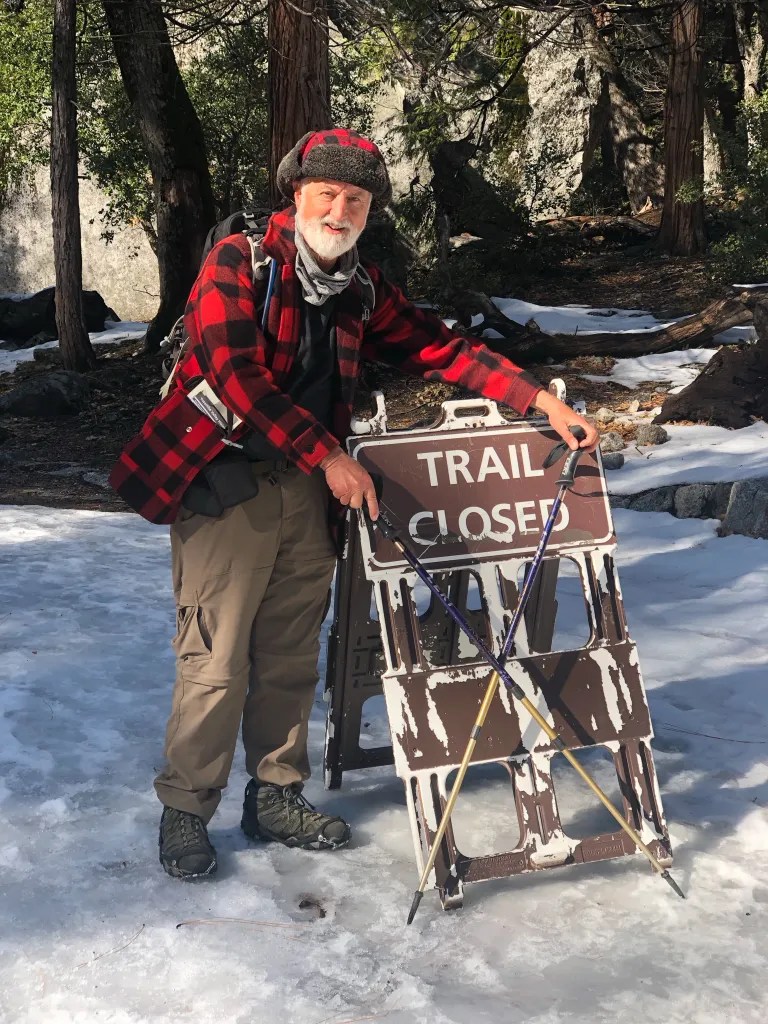
We discovered that the trail to the base of the falls was closed and, since we had our dog Carson with us, we were limited to trails that were paved or marked for bicycles. Even so we found plenty of places to walk. We did find that ice cleats, the kind that you can slip on over your boots were quite helpful for walking on icy trails and around camp.

On the second night the heater went out. I woke up at 4 a.m. feeling cold. The heater had shut down. Apparently, the battery went dead. This is a mystery. We should have had ample battery capacity to keep the heater fan going, but here we were with no power. We were prepared for the cold, so while we missed the comfort of a heated camper, we had our winter clothes and we carried on. After some hot coffee, eggs, and sausage we took a hike to Happy Isles.

While Yosemite Valley is an awesome location any time of year, I was not inspired with the iconic views of Yosemite Falls, Bridalveil Falls, Half Dome and El Capitan. It’s hard to beat the drama I’ve captured on previous trips.

What did capture my attention was more intimate landscapes, snowcapped rocks and flowing water at Happy Isles, a leaf in the snow, and Fern Spring.

After a day of exploring a variety of locations – Happy Isles, Swinging Bridge, and a few other sights – the plan was to stay out taking photos until dinner time and then have a nice meal before popping up the camper for the night. We were surprised to find the Ahwahnee closed for renovations, and the restaurant in Curry Village was closed as well. We ended up eating at the Base Camp at Yosemite Lodge. While it served our needs, it was not on par with our previous experiences.

On Friday, February 10, we had a very pleasant hike to Mirror Lake, even if it was a bit chilly. We were on the road heading home shortly after noon. As we left the park, we noted the arrangements that were being made to accommodate the throngs of people who would be coming to photograph the fire fall, a phenomenon that happens with the setting sun shines on Horsetail Falls making it look like it’s on fire. This phenomenon happens in mid to late February.

SFMOMA: Diego Rivera

November 22 was a day to play tourist in our own back yard. We had reservations to see the Diego Rivera exhibit at the San Francisco Museum of Modern Art. We also included a visit to Salesforce Park, an amazing park situated 70 feet in the air and spanning four blocks.

Our outing started with a short drive to the El Cerrito Plaza BART Station. We were concerned about parking, but when we got to the station at 11 a.m., there was an abundance of empty parking slots. We rode the train into the city and got off at Montgomery Station. It was noon when we exited the BART station. Downtown San Francisco was like a ghost town. There were very few people and many of the restaurants were closed. We walked the short distance to SFMOMA and headed to Café 5 on the fifth floor.

We both ordered the Chicken and Cilantro soup and then found a table outside in the Jean and James Douglas Family Sculpture Garden. One of the gingko trees was in full fall display and the “Love” sculpture seemed to be calling me. I’m hearing “can’t buy me love,” by the Beatles.

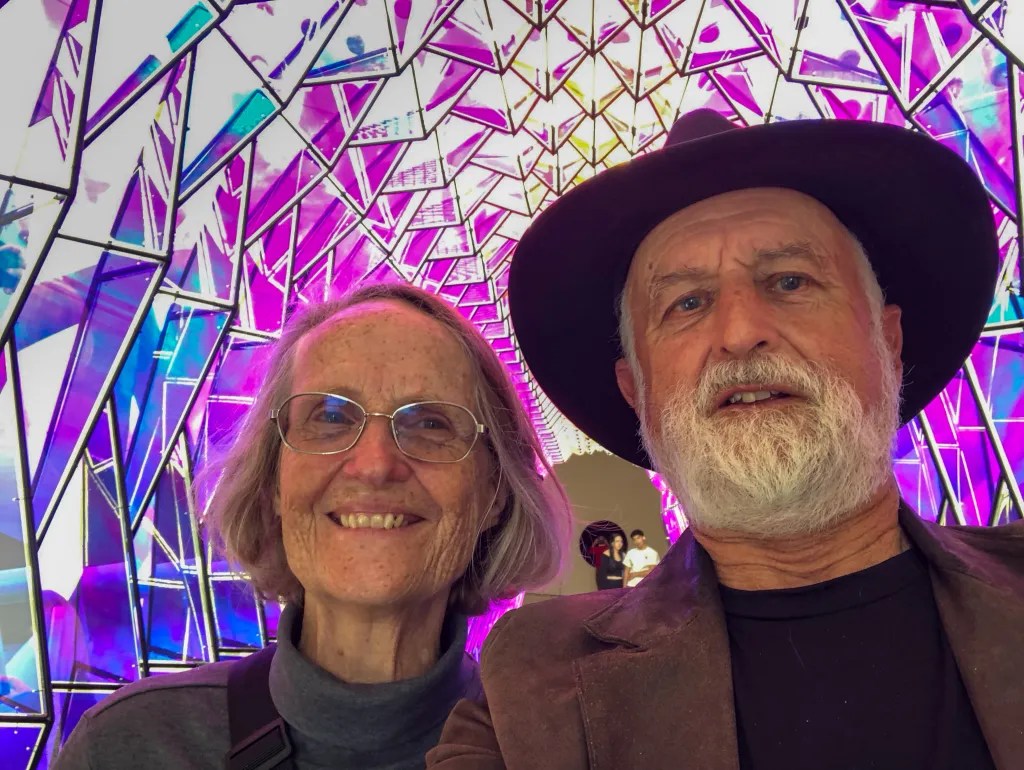
The soup was delicious, although it was a bit tepid by the time it reached us. Our tickets for the Diego Rivera exhibit were for 2 p.m. so we had some time to explore the museum. The Oculus Tunnel by Olafur Eliasson was fun.

Then it was time to explore the Diego Rivera exhibit. I was able to pull up the audio tour on my iPhone and listen to the discussion about Rivera’s work. My hearing aids act as wireless earbud, which makes for easy listening. While I was aware of some of Rivera’s work, I had forgotten about his involvement with communism and the influence he had on the art world. It is quite an extensive display and well worth a visit.

One of the pieces on display is the Pan American Unity mural which is huge. I thought it would be interesting to see if I could photograph it in sections and stitch the sections together. My effort worked better than I had imagined, although I ended up losing some of the top and bottom of the work.

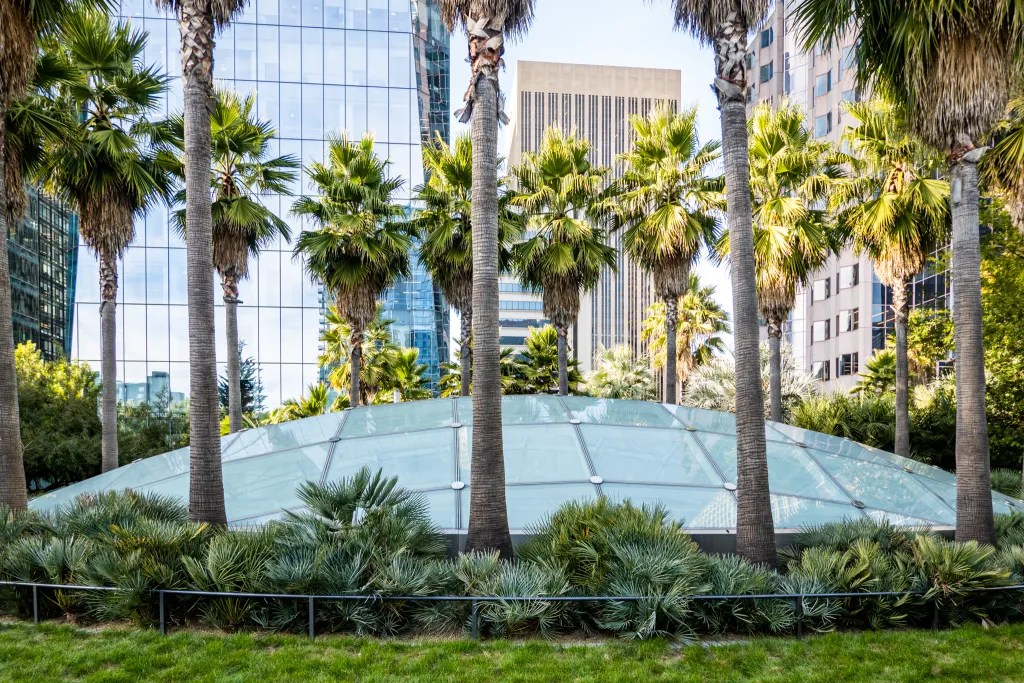
From SFMOMA we walked to the Salesforce Transit Center where we found our way up to the park, home to 600 trees and 16,000 plants arranged in 13 different ecological zones. I was intrigued with the “Bus Fountain” that dances to the movement of the busses on the lower level.

Playing tourist in our own back yard was fun. Sometimes we forget how much there is to see and enjoy here. We’re making a list of more things to do locally so stay tuned. In the meantime, feel free to view more photos online.

Oban

Following our stay in Edinburgh we took the train to Glasgow and transferred to a second train to Oban. You can see a photo here of me with my carry-on bag and daypack in the Glasgow train station. We wanted to avoid checking luggage for air travel, so we packed light, or at least light for our purposes. That roll-on bag has my travel tripod and laptop computer, spare batteries, chargers, as well as clothes. For travel photography I use a Sony RX100. I also had a GoPro and a waterproof Olympus TG-5 for kayaking.

Our itinerary had us in Oban for just a couple of days before joining Wilderness Scotland for a kayaking adventure. Check out my other Scotland blog posts for more about that. While we were in Oban, we hired a guide to take us around a few of the sights nearby. Martin, our tour guide, did an excellent job of showing us some of the sights despite a grey rainy day. And then on the evening of August 25 we celebrated our 49th wedding anniversary with dinner at Ee Usk, an excellent sea food restaurant on the pier.

After our kayaking adventure and hunkering down a few days with COVID, we returned to Oban where we rented an apartment. This gave us the opportunity to rest. Once we were feeling better, we explored more of Oban taking in a tour of the Oban Distillery, visiting the island of Kerrera, and visiting Dunollie Castle.

While Oban has some very fine restaurants, one of our favorite places to eat was MacGillivray’s Seafood on the pier. They serve excellent fish and chips, scallops and langoustine.

You can view many more photos from around Oban onlne.