Santa Pau and a Loop Hike

On June 3 we made our way from Girona to Santa Pau by bus, finding the local bus stop near our apartment in Girona. For this leg of our trip we’re carrying all our luggage. I carry a day pack and a travel pack. Once we start our walking tour our luggage will go by taxi and we’ll go on foot with just our day packs.

We transferred buses in Olot where we had few minutes for a snack; coffee, apples and coke. Once in Santa Pau we found our lodging at Hotel Sal Sastre right across the street from the castle. We spent some time walking around the medieval town.

On June 4 we began our Macs Adventures walking tour with a loop hike from town up to a high point at Santa Maria Finistres. Here there is a hermitage which has some historical significance. We had a very quite picnic lunch here. This is truly a place of solitude. From the time we left town at 10 am and when we returned at 3:45 pm we had the entire trail to ourselves. The trail was a moderately steep track up the mountainside passing through beechwood and oak forests. Our feet crunched through the leaves on the trail and there was no sign of anybody else having used the trail recently. We clambered over a couple of fallen trees and passed a number of sections in the trail that had been rooted up by wild pigs, as if a roto-tiller had gone through. I would imagine that some sections of the trail could be slippery following a rain, with slippery leaves and mud but with dry conditions we had good footing. It’s a very pretty hike through the cool shade of the forest, passing by farms and pastures closer to town. When we came out of the forest we could see our town on the hill in the distance.

Having returned to town, we had logged 10 miles. The Macs Adventure hike is a nine mile loop. We manged to add a mile with a trip to town in the morning to buy bread, cheese and salami for our picnic lunch. After 10 miles it was time for a cold beer.

Sagrada Familia

May 29. 9:00 AM. We’re in line for the tour of Sagrada Familia. We purchased tickets months ahead of time and I did some research to figure out what would be the best time to photograph the project. Photographing the whole building is a challenge. This is a work in progress with construction cranes towering over the structure. In looking at photos in tourist information I can only assume that some effort went into removing the construction cranes and other construction infrastructure in Photoshop.

The Nativity facade faces east, which where we found ourselves for the start of the tour and the best light is morning. The Passion facade faces west, which is best photographed in the afternoon.

Construction of The Temple Expiatori de la Sagrada FamĂ­lia began in 1882 under the guidance of Antoni GaudĂ­. The goal is to complete the construction by 2026, the one hundredth anniversary of Gaudi’s death.

Security to get into the tour is on par with airport security. No knives, liquids, and such. Backpacks go through an x-ray machine, and you walk through a scanner. My knee brace set off an alert and I was pulled aside. Staff was very courteous.

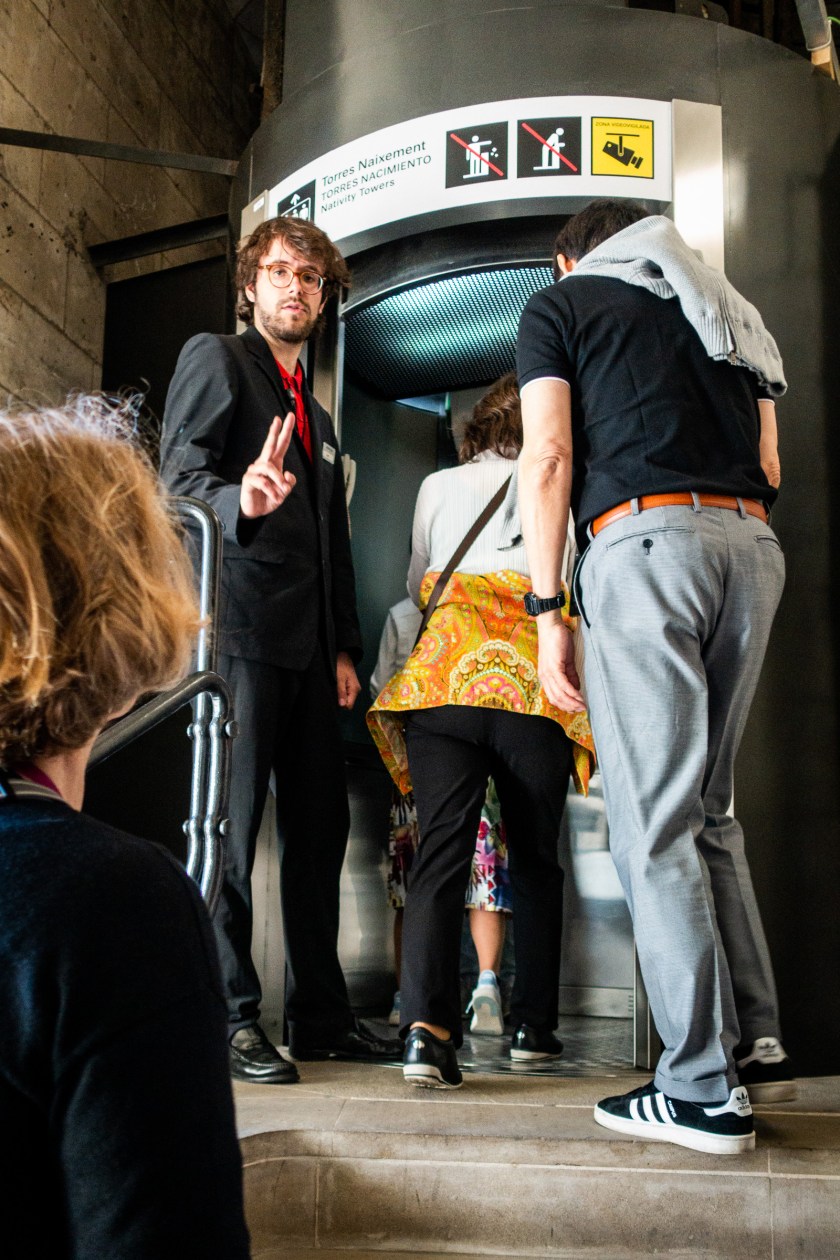
After picking up our interpretive handsets and putting our day pack in a locker we took the elevator up the tower and climbed back down a never ending spiral of stairs with occasional impressive views of the city below.

Inside the basilica one needs to keep in mind that this is a working Church and some sense of reverence is required. Here the genius of Gaudi’s design becomes apparent. The columns of multicolored stone rise up like trees and branch into smaller supporting limbs. Gaudi referred to this as the forest. Gaudi’s inspiration in the architecture of nature and natural forms and his devotion to his faith become apparent wherever you look. A stunning example of Gaudi’s architecture. And even with the construction there are so many interesting details to photograph that there is no shortage of subject matter for the camera.

Those who look for the laws of Nature as a support for their new works collaborate with the creator. – Anoni Gaudi

La Pedrera

May 28. Our first day of touring in Barcelona starts with a tour of La Pedrera, one of the architectural wonders created by Antoni Gaudi. Casa Mila, or La Pedrera as it is commonly known was built in the early 20th century. Construction began in 1906 and the building was finished in 1912. Well worth the tour if you are visiting Barcelona. Get your tickets ahead of time though. We arrived at 9:00 am, a little flustered since we started off on the wrong direction on our walk, and then discovered that we had left the tickets in the motel room. Internet connection was sparse so we had trouble pulling up the confirmation email on Joann’s iPhone. It seems that the clerk at the counter was gracious enough to believe our story and we were able to tour. The tour is self-guided with handsets to listen to narration about the features of the building. Gaudi in known for drawing inspiration from nature and his devotion to the Church.

…

The tour starts on the roof of the structure with the fanciful design of the roof vents. From there you go down the the attic where you can see the rib like structures that support the roof. The attic served as the work area for servants. The building itself was designed as an apartment building.

From the attic you go down to one of the apartments which is furnished as it might have been in the early 20th century.

Watch your Pockets

May 31, 2019. Waking up from a sound nights sleep. I’m wondering what time it is. I look at my phone and I’m flabbergasted. 10:40! I had no idea we had slept that late. For the previous two days we had tour tickets for 9:00 am both days, so we were up at 7 am to grab a bite to eat and then off on foot to find our destinations. On Tuesday it was La Pedrera at 9:00 am then on to the Picasso Museum at 12:30 and the Palau de la Musica Catalana at 3 pm. At 9 pm we went out in search of Tapas, having our first taste of acorn fed Iberian Ham. On Wednesday it was Sagrada Familia for our 9:00 am tour, followed by a spontaneous walking tour and then a bus up to Park Guell at 6:30 to see more of Gaudi’s work. We logged 10 miles on foot over the course of the day and decided we’d forego the alarm in the morning and get up when we felt like it.

We had numerous warning about pickpockets in Barcelona, both prior to the trip and and while touring. We did have an experience that bears sharing. While learning to navigate the Metro we got on the wrong train. After getting off and feeling a bit disoriented a young woman came up to us and told us we needed to take the elevator up a level to get to the right train. We were on the elevator with her and two of her friends when one of them attempted to access Joann’s purse. She thought they might have taken a notebook , but on later inspection nothing had been taken. Just a lesson to be careful. We’ve been traveling lightly. Leaving our backpacks in the room. I carry my small Sony RX100 camera in a Ripoffs brand holster on by belt with a strong Velcro flap. My pants have zippered pockets and I keep my iPhone in one of those pockets. Even so, I feel a bit bare without the camera support items like the tripod and such, and on both Tuesday and Wednesday I exhausted my camera batteries with the spares in the my backpack in the room. Passport, credit cards and such I keep in a pouch that hangs around my neck and kept inside my shirt. Probably not foolproof but so far so good.

La Pedrera, Palau de la Musica Catalana, Sagrada Familia and Park Guell will require separate blog posts so stay tuned. Pacing myself between touring, editing photos and writing is a challenge.

Gaudi’s Lizard at Park Guell

Sea Ranch Exhibit

Treve at The Sea Ranch exhitit at SFMOMA.

May 7, 2019 2 pm. We are at the San Francisco Museum of Modern Art touring an exhibit “The Sea Ranch.” The exhibit ends on June 2, so if you are a fan of architecture and California modernism this exhibit is worth seeing.

Sea Ranch is a development on the California Coast about 100 miles north of San Francisco. Architect and planner Al Boeke envisioned a community that would preserve the area’s natural beauty. Boeke hired landscape architect Lawrence Halprin to create the master plan which grew to encompass 10 miles of the Sonoma County coastline. The development is considered a beacon of modernism on the Northern California coast. The first building was completed in 1965 and the development was envisioned as a progressive, inclusive community, guided by the idealistic principles of good design, economy of space, and harmony with the natural environment.

The design guidelines require that the buildings become part of the landscape. Exteriors are unpainted wood or muted stains and the roofs lack overhanging eaves.

We found the exhibit to be quite interesting with many photos and drawings and some of Lawrence Halprin’s original notes and photos by Morley Baer .

At the moment there are some 1800 homes in the development with many of them serving as vacation rentals.

Being Still

Clouds and Reflection on Tomales Bay

We can make our minds so like still water that beings gather about us that they may see, it may be, their own images, and so live for a moment with a clearer, perhaps even with a fiercer life because of our quiet.”

from Earth, Fire and Water W.B. Yeats

I found this quote on the back of a business card that an associate handed me last week. It seems appropriate for the season.

Blog to Book

Not too long ago I found myself revisiting blog posts from the past year and thinking it would be fun to turn the posts into a book. To that end I asked my wife Joann if she would be interested in tackling the project. We started with a few posts from early 2018 and used those posts to put together a “proof” to see how the process would go. From there we decided to break the posts for 2018 into two volumes, each about 50 pages.

We looked at several options for creating the book and decided that Shutterfly seemed to be well suited to the task. We’ve used Blurb for past projects but the book building tools for Shutterfly are easier to use. We also looked at some of the options that let you import your blog content directly into a book, but those platforms seemed to compromise on the quality of the photos and have limited options for formatting. We wanted a book that would represent the content of the blog with high quality photos and the flexibility to deal with some complex formatting issues. Some blog posts have only one photo some have a dozen or so. Sometimes a post would just have a short paragraph and sometimes they’d ramble on.

Needless to say after two and half months of massaging text and pictures we hit the “publish” button. Two weeks later the books arrived. They are now on the coffee table, and it’s a treat so be able to pick up a book and revisit past adventures. Amsterdam, Africa, Santa Fe, Chicago, Frank Lloyd Wright, Kayaking around the San Francisco Bay Area.

I’m not sure if the books will be something the grandchildren find years from now when they’re sorting through dusty belongings, but I expect the books will outlast the bits and pixels of the blog once those have evaporated into the ether.

A Day with Monet

March 5. My birthday! I decided to play hookie. Client work will have to wait. Started the day by walking the dog. My wife Joann joined me. Just as we were heading out the door she asks “how does 69 feel?” I think she’s referring to the weather so I responded that it doesn’t feel that warm. She replied saying that I was in denial. Perhaps. I told her I was feeling younger this week than last week. I spent a good long day Sunday in a kayak, came back exhausted and with a few sore muscles, but nothing like physical activity to make me feel younger. I said “feels like 55,” which was probably closer to the temperature outside as well. Not sure I’m willing to admit that next year is the big seven-oh. Get your party hat ready!

Treve at Monet: The Late Years. de Young Museum. San Francisco

Claude Monet was born in 1840 in Paris and died in 1926 in Giverny. Not being much of a student of art I was surprised that he was painting in the early 20th century. I was also surprised by the size of some of the canvases, and with his fascination with water and flowers. It was an inspiration to see his work in person.

Everyone discusses my art and pretends to understand, as if it were necessary to understand, when it is simply necessary to love.

Monet

After the exhibit we headed home by way of Love at First Bite Bakery in Berkeley where we bought a cup cake, chocolate caramel sea salt.

Borrego Springs

On the evening of January 29 I decided I wanted to check out some of Ricardo Breceda’s sculptures, While Borrego Springs is notable for spring wildflowers in the surrounding desert, it’s also home to a collection of amazing sculptures, called the Metal Sky Art Sculptures. There are more than 130 sculptures here that represent everything from a 350 foot serpent that crosses the road, to dinosaurs and historical figures. I was hoping to find an opportunity to photograph a few of these on this trip. After a quick visit to a few of the sculptures the previous morning, I decided that afternoon or night time might afford some interesting photo opportunities. Our timing was a bit off though since we reached the serpent just as the shadows from the mountains were creeping across the valley floor. We only needed to wait a few minutes for sunset though which lit up the sky with color that seemed appropriate for a fiery serpent.

The sculptures were part of the vision of the late Dennis Avery, heir to the Avery Dennison label fortune and a self-made success on his own. Mr. Avery envisioned ‘free standing art’ on his property, Galleta Meadows Estates,. The steel welded sculptures were created by ‘Perris Jurassic Park’ owner/artist/welder Ricardo Breceda.

The sculptures are spread out around the north end of Borrego Springs. I had to search on-line for a map to help me locate them. They are all easily accessible and there is no fee to view them.

We noticed that bikes seemed to be quite popular in Borrego and I discovered a couple of places you can rent bikes including electric fat-tire bikes you can ride up the some of the sandy dirt roads. There are also tour operators that will take you on an off-road adventure.

You can view more photos here.

Basilica of St. Joseph

If you are interested in architecture or you are looking for something to do in downtown San Jose, then a visit to Cathedral Basilica of St. Joseph is the thing to do. The cathedral is listed as a California Historical Landmark and as well as the National Register of Historic Places.

Dome of the Cathedral Basilica of St. Joseph

I arrived on a Thursday afternoon and found very few visitors, which made it easy to capture photos of the architecture with out people.

The first church on this location was called San Jose de Guadalupe built in 1803. Earthquakes and fires took their toll of the original and several successive buildings. The existing structure was consecrated in 1877. In 1985 following a major renovation it was elevated to the status of cathedral and made a minor basilica by Pope John Paul II in 1997. The church is open to the public with no fee, although you may want to pay attention to the events happening at the church since it is an operating church with worship services and other events.