We missed the Bishop contingent of our family over Thanksgiving since they were hunkered down with Covid. This prompted us to clear our calendars to make the trek over the mountains for a visit. Since the camper had been sitting idle in the driveway for three months, it was no surprise that the battery was dead. A quick trip to the local auto parts store and we were ready to roll. We decided we’d break the drive up over two days.
We like to take our time. It was 10:30 am when we rolled out of the driveway. Highway 89 was open, so we drove over Echo Summit on Highway 50 and then took 89 over Luther Pass and down through Markleeville. It was 5:30 pm when we parked the rig for the night on National Forest land near Mono Lake. It was dark, but we found a spot to camp without much trouble. Four-wheel drive is recommended here since there is soft sand. This is dispersed camping, boondocking if you like. No services. We cooked dinner, turned the heater on and hunkered down for the night. It was 18 degrees when I stepped out of the camper at 7 am the next morning. I wandered around with my camera, fascinated by the stark beauty of our location.
We arrived in Bishop at 10:30 am with plenty of time to get settled before the evening Winter Tradition program at granddaughter Annabelle’s school.
Holiday activities also included a visit the Laws Railroad Museum, where we rode the train and sang Christmas carols with Santa. Daughter-in-law Serena got to show off a quilt project that she participated in.
On December 15 it was time to head home. A winter storm had dumped snow on the mountains, leaving the roads icy. We started our return journey by heading north on 395, but the ice on the roads was intimidating even with four-wheel drive and snow tires.
We turned around and headed south, arriving back in Bishop about noon where we rendezvoused with family for lunch at the Pupfish Cafe. This is one of our favorite local restaurants, noted for their Belgian waffles. From there we continued south going over Walker Pass. We found a gorgeous little campground, Sandy Flat Camp, on the Kern River and spent the night there. We were the only campers in the campground. More photos are available in an online gallery.
Our adventures recently took us over the Sierra to visit family and celebrate birthdays. We left Bishop on the afternoon on July 29 for our return trip, with a stop at Donna the Dog Lady to pick up our dog Carson. Carson spent the night there since we were involved in some activities where Carson was not welcome.
With daytime temperatures of 100 degrees, we were hoping to gain elevation and find some trees for shade. Green Creek near Bridgeport seemed to offer a good bet for the night. We turned off onto Green Creek Road and followed the well-graded dirt road for a little over six miles, finding a level spot to park the rig for the night at 7900 feet. Carson was happy to wander around camp off-leash. Having set up camp, we discovered that the mosquitos were quite abundant, so we did our best to cover any exposed skin and break out the repellent.
Green Creek is a gorgeous spot with Jeffrey pines, aspen and willows. The California Department of Fish and Game maintains the Green Creek Wildlife Area, a 720-acre protected area that includes habitat for mule deer migration and fawning. It’s also home to black bear, beaver, bald eagle, grouse, mountain quail and various waterfowl. We decided to camp outside of the wildlife area, which is marked with signs.
I wandered around our camp in the evening and again in the morning with my camera, in this case an iPhone 14. I was intrigued by the lush green vegetation, the aspen trees and the wildflowers. We saw lupine, penstemon, and prickly poppies. Once the mosquitos became annoying, it was nice to take refuge in the camper with its screened windows that still offer a view.
We arrived home on the afternoon of March 28 having logged 3012 miles over the course of 23 days: three of us, Joann, me and our dog Carson. We were a little concerned about taking our dog, but Baja turned out to be quite dog friendly. Along the way we had some amazing adventures, and I captured many photos to sort through and share.
Before we could obtain our Mexican Tourist Cards (FMMs) we had to make a stop in San Diego to renew our passports. If you are planning on traveling to Mexico, check your passport. You need to have at least three months on your passport to apply for an FMM. We discovered this just a few weeks before our trip and we had to scramble to get our passports renewed.
On the trip south we decided to take a quick detour to Anza Borrego to check out the wildflowers. We were not disappointed.
Our traveling rig consists of a pop-up Four Wheel Camper on our Toyota Tacoma. The camper is outfitted with a refrigerator, heater and cooktop. There is no toilet or shower on board, but we’re comfortable taking a shovel out in the woods (or desert) if we are boondocking or taking advantage of facilities including showers in established campgrounds. We also have the rig set up to carry two kayaks.
For planning both prior to the trip and on the road, we used the app iOvelander for locating facilities and Maps.Me for route planning. We discovered a hack that let us import the iOverlander pins into Maps.Me, which proved to be quite useful when we were offline without cell phone signal or Wi-Fi. We also found the Baja California Road and Recreation Atlas from Benchmark Maps useful, as well as Google Maps when we had a cell phone signal.
And of course, sharing travel information with fellow travelers is also fun and informative.
Some of the highlights along the trip included a fabulous lunch with a bottle of wine at Encuentro Guadalupe shortly after crossing the border, camping in the cactus gardens near Catavina, and whale watching in San Ignacio Lagoon.
We had our share of fabulous sunsets and sunrises and we managed to get our kayaks on the water at Bahia Conception and Gonzaga Bay.
Over the course of the trip, we spent 23 nights in our camper. On a couple nights, we were happy to have the camper as protection from fierce winds. The southern-most point in our trip was Playa Coyote on Bahia Conception. Three weeks is just not enough time to see much of Baja. We’re already thinking about our next trip.
With the Labor Day weekend approaching, it was time to make our way over the mountains towards home. We decided a three-day camping outing was in order. The trick was to find a spot off the beaten track that would be away from the throngs of campers. Here’s where a little local knowledge came in handy. Our son Aaron had a tip that Parker Lake might be the spot. So on Saturday, September 5, we pointed our rig towards Parker Lake. Along the way we observed that campgrounds near Grant Lake and Silver Lake seemed to be packed to capacity, and the trail head parking was full to overflowing.
We found Parker Lake road and left the pavement, switching into four wheel drive. This is not a road I would recommend for anybody with low clearance, although we did see a Subaru Forester. We stopped on a rise where I took a photo of our rig with Mono Lake in the background.
A few miles further on we found a nice camping spot in a grove of aspen and pine trees. As is my habit, I’m always looking for that Truck Camper Magazine calendar photo, without a camp fire in this case, since campfires are not allowed in the current conditions. I substituted a camp lantern for our campfire glow. In the morning we woke up to an orange dystopian sun peering through smoke from a wildfire, the Creek Fire, on the other side of the mountains. As you can see in the photo above, the sun is peeking through the smoke. Despite the smoke we decided to do the short hike to the lake before breaking camp.
From our camp we hiked up the road to the trail head, and then up through sage brush and desert vegetation and down into a lovely wooded valley with pines and aspen.
Once in the valley it’s a short distance to the lake which is situated in a bowl with mountains rising above. The mountains were shrouded in smoke, but nonetheless we stopped to let Carson get his feet wet and to watch ducks that seemed to be looking at us for a handout. Don’t look at me for a handout. I make it a point not to share my food with the local wildlife. After a brief stay, we hiked back to our campsite, popped the top town on the camper and headed over the mountains for clean air.
It seems like I can never get enough of Bodie, the Ghost Town in a far east corner of California. I spent a few hours here at the end of June, and on my recent trip over the mountains I decided another trip was in order.
As on my previous trip, I decided to camp in the Bodie Hills so that I could arrive at the Bodie State Historic Park when they opened at 9 a.m. This time I found the Paramount Campsite available, so I parked the Four Wheel Camper rig, set up camp and let my dog Carson run free. One thing I like about boondocking is the freedom to let my dog off leash.
The campsite had a well established fire ring, so I built a small campfire, more for effect than for warmth. I’m always looking to create photos that have a sense of drama to them and a campfire helps. That said, I was very conscious about the fires burning in California and of the drought conditions. If you are planning on camping, get a campfire permit, check with the appropriate land management office, be mindful of the risks, douse the fire with water and make sure the coals are cool to the touch before leaving.
In the evening I put my drone in the air to capture an image of the camp. As you can see I was in a grove of Aspen trees surrounded by the desert landscape of the Bodie Hills.
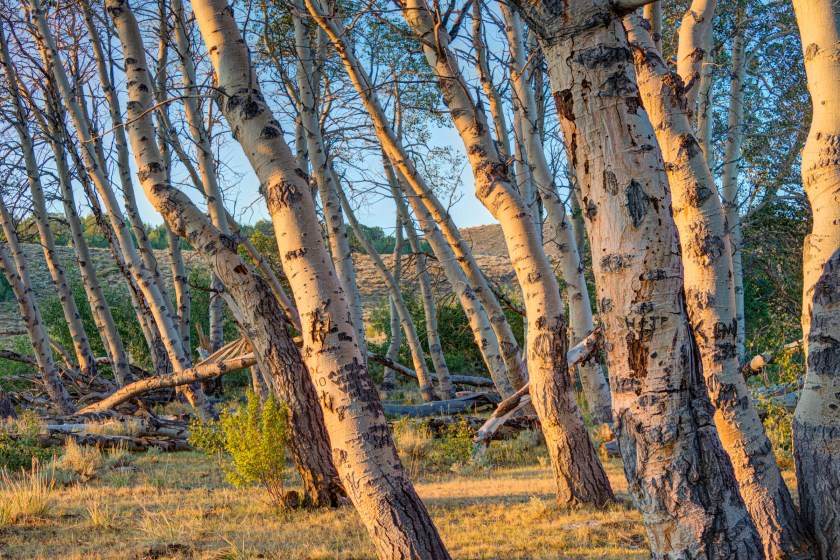
Sunset and sunrise did not provide much drama in the sky, although the motivation to watch the sun come up got me up and out of the camper in time to admire the morning light striking the trunks of the Aspen trees.
At 9 a.m. I was at the entrance station, and I joined the handful of people that were touring the site. As I made my way into the town, I noticed a couple with film cameras, Victor and Sarah. Sarah had an antique Graflex camera, something you don’t expect to see in this day with everybody using their phones to take pictures. I was struck by a mental image of Dorothea Lang holding a similar camera. I struck up a conversation with Sarah and Victor; it seemed we were crossing each other’s tracks all morning.
As we turned the calendar to July, it was time to leave our temporary post in Big Pine and head for home. We decided to make the trip a two-day drive with an overnight near Ebbetts Pass on State Route 4. This is one of the lesser-used passes crossing the Sierra. It’s a steep, winding, narrow road with one lane for a good portion of the time. Suitable for our rig, we figured that with throngs of people heading to the mountains for the Fourth of July weekend, it was a likely route on which to still find camping. And since we were driving midweek on a Thursday, we figured we’d have the jump on the campers coming up for the weekend.
Our route crossed two passes: Monitor Pass at 8,314 feet on State Route 89, and Ebbetts Pass at 8,736 feet on State Route 4. Just before cresting Monitor Pass, we stopped to admire the view. I was intrigued with the clouds and grasses on the high plateau.
Once over the passes we had plans to check out Hermit Valley for camping, but when we got there we decided to move on. Not far down the road we saw a sign for Pacific Valley Campground that looked promising. We found plenty of camping available along a lovely mountain stream.
In the morning we decided to explore the trail leading up Pacific Creek. Our dog Carson was happy to be off-leash once we were out of camp, and happy to cavort in the creek’s cool water. We manged to hike about six miles up the creek and back, and returned to camp lamenting the fact that we couldn’t stay longer. We had a commitment for a family Fourth of July get-together.
We broke camp and headed down the mountain passing Mosquito Lakes and Alpine Lake, which were quite busy. There was absolutely no parking available along the road. Every conceivable spot had a car parked with many more cruising looking for parking.
Despite the weekend crush of visitors, we were inspired by our overnight at Pacific Valley. We’ll be returning to explore more of the Stanislaus National Forest.
May 1. Our camper hasn’t moved much since our desert trip in January so, after two months of staying close to home, we decided to go camping in our own driveway. Actually, I did move the camper. I took it to a local car wash to clean off two months of dust and dirt; one of those car washes where you drive into a stall and grab a wand to wash and rinse.
Here we are in the morning with our fresh coffee. As tempting as it was to go into the house to cook, we used the camper to advantage. I dubbed our driveway “Wisteria Canyon,” since that sounds poetic. We did have a festive dinner the evening before. Chicken Cordon Bleu cooked in the Dutch Oven, and a glass of wine. That event was captured on video, but you’ll have to wait until my main computer is up and running before I can edit the video.
January 12, 2020. As I write this we’re nine days into an 11 day road trip, making a circuit through Joshua Tree, Mojave and Death Valley. It seems like the theme for this trip is desert, dogs and Dutch ovens. We like to travel with our dog Carson, and winter camping seems to be conducive to Dutch Oven cooking. After sunset I can put the camera away, start the coals for the Dutch Oven, and build a campfire.
Joshua trees at Red Rock Canyon State Park
Camping at Hidden Valley
Mushroom and Brie Breakfast Strada
We even used the Dutch Oven to thaw out Carson’s water dish after it had frozen solid one morning; that after we had fired up the oven to reheat some quiche from a previous breakfast. Our journey started on Saturday, January 4, with a drive to Red Rock Canyon State Park. Camp fees seemed a little steep there, but the location is worth it. Dogs need to be on leash, which is the rule for many of the places we visited. There is BLM land nearby where dispersed camping is available for free. We paid $23 for the night at Red Rock and that included a $2 senior discount. In the evening we fired up the Dutch Oven to cook cod with lemon and capers. Joann cooked a risotto dish to go along with it. A gourmet meal.
The next morning we were in no rush to hit the road so we fired up the oven again and cooked a mushroom and brie breakfast strada. Absolutely scrumptious, with enough left over to feed us for another breakfast and more.
Sunset on the Kelso Dunes
Breakfast at Kelso Dunes
Walking the dog in 20 Mule Team Canyon
From Red Rock we drove to Joshua Tree National Park. When we got to Hidden Valley Campground we were discouraged to see a “Campground Full” sign at the entrance, but we decided to take a look anyway and found one open site. We spent two nights and I took the opportunity to wander around for two mornings and one evening looking for early morning and evening landscape photography opportunities. Hidden Valley has interesting rock outcroppings as well as some nice stands of Joshua trees. As a popular spot for rock climbers, camping spaces are scarce. I’ll post more about the landscape photography in another post. It’s hard enough to condense eight days of travel into one blog post.
While wandering through Joshua Tree we managed to do the short nature walk at Hidden Valley. We alternated walking the trail while the other walked the dog around the parking and picnic areas. We also explored some of the other campgrounds and noted that there was plenty of camping available at Jumbo Rocks and Belle. We also drove down to the Cholla Garden which is an amazingly dense stand of cholla cactus.
On January 7 we drove to the Mojave National Preserve where we decided to camp at Kelso Dunes. This is a primitive campground with no running water or facilities except for a few fire rings. There was one other camper about a quarter mile from us. We took a hike up the sand dunes letting Carson wander off-leash, returning to camp just as the sky was going dark following a blazing sunset. With a near-full moon rising to the east we had light to find our way as darkness approached.
Dinner at Mesquite Springs
Serving quiche for breakfast
Dinner on the coals at Homestake
From Mojave we drove to Death Valley where we spent one night camped at the Oasis in Furnace Creek. Our motivation was to find hot showers and do some laundry. We camped at Fiddler’s Camp, an RV camp behind the gas station. $24 with showers and pool access included. We also took advantage of the food facilities and ate dinner and breakfast in the luxury of the Furnace Creek Ranch.
Furnace Creek is a good spot to spend a night or two if you want to see some of the more popular attractions of the park. We were intent on seeing some of the less popular locations. In the morning we drove the short distance to Twenty Mule Team Canyon which the park literature suggested was a good spot to walk a dog. We drove in the canyon a short distance, parked the truck and took a two mile walk with Carson on-leash. Dogs are not permitted on the trails in the park, but they are permitted on roads; this is a lightly used dirt road, perfect for walking the dog.
After walking the dog we topped off the fuel tank, anticipating a good 200 miles or so of driving before we could expect another gas station. From Furnace Creek we drove to Mesquite Springs Campground where we spent a very windy night. We were happy to be in the camper rather than a tent. With the propane heater going we were cozy even with a chilly wind blowing outside.
Teakettle Junction
Rock trails on the Racetrack
Flat tire on the return drive from the Racetrack
The next morning we drove to the Racetrack Playa with a stop for lunch at Teakettle Junction. The Racetrack is a perfectly flat playa. Near the southern end of the playa there are some truly bizarre trails left by rocks. When conditions are right a thin film of water freezes and thaws in such a way that fierce winds move the rocks leaving trails. Some of these trails go for hundreds of feet. It’s a truly mind bending experience to imagine how these rocks can move. We arrived at about 3 in the afternoon and found good lighting, using the glint of the sun on the playa to photograph the rock trails.
Getting to the Racetrack Playa is a bit of a chore. It’s a dirt road marked as a 4×4 road, and a two hour drive to cover the 27 mile distance over washboard and gravel.
From the playa we drove the short distance to Homestake campground, another primitive campground with no facilities. We had the campground to ourselves. Here we fired up the Dutch Oven to cook Eggplant Parmesan and we ate dinner by the campfire while we watched the full moon rise over the mountains to the east. With nobody else in sight we let Carson have free run of the campground.
Joann at Red Rock Canyon State Park. Slow Food Breakfast in the Dutch Oven.
We’re home and and with an internet connection I can share some of the adventures from our recent desert trip.
January 27 marked day two of our trip. 9:25 AM I opened the lid on the Ditch Oven to serve up breakfast; Mushroom and Brie Breakfast Strada, a recipe out of Robin Donovan’s The Camp Dutch Oven Cookbook. We were ready to eat. Breakfast had been in the works since 8 am when I started the coals and the aroma coming from the oven was mouth watering.
I’ve become a fan of Dutch Oven cooking and the cookbook was a Christmas gift from my son and daughter-in-law. The Dutch oven seems appropriate for winter trips, hot food on chilly mornings and evenings. And with short days, the oven can cook after dark, after I’m done messing about photographing the sunset.
Our Campsite at Red Rock Canyon State Park
After breakfast it was off to Anza Borrego, but not before we made a stop at Home Depot in Landcaster for a quick repair on the camper. It was dark when we arrived at Red Rock Canyon. While positioning our rig in we backed up into a Joshua Tree and knocked out the window in the rear door of the camper. Even with the backup camera located on the bumper we couldn’t see the tree limb that was threatening our rig. A lesson to pay close attention and perhaps have a spotter watch what’s happening when setting up camp in the dark.
We’re off to Anza Borrego Desert State Park, then on to Organ Pipe National Monument in Arizona, with our return trip taking us through the Mojave Desert. We have our dog Carson with us, so it will be interesting to see how we manage since many national parks and state parks for that matter do not permit dogs on trails. Here’ at Red Rock Canyon me managed with Carson on the leash.
We’re on our return trip from two weeks in the desert. Our adventures have taken us through Red Rock Canyon State Park, Anza Borrego Desert State Park, Organ Pipe Cactus National Monument and the Mojave Desert Preserve. Organ Pipe represents the Sonoran Desert with the iconic Saguaro Cactus, while Joshua Tree stands as the icon of the Mojave Desert. In Organ Pipe I was hiking in shorts and T-shirt, while in Mojave we woke to snow and 22 degree temperatures with howling winds.
We have WiFi access at the moment, so I thought I’d put up a short post to give you a preview of what to expect as I cue up the posts for the various segments of our trip. We’ve been traveling in our Four Wheel Pop-up Camper which has proven to be a comfortable way to travel. Stay tuned as I cue up more photos and stories about our trip.




You must be logged in to post a comment.